Space Becomes a Critical Component of Our Economies
The OECD's Space Economy at a Glance 2026, a new report released on 9 September 2026, shows that space is now at the core of day-to-day economic life. Satellites make it possible to transport goods, keep the electricity grid stable, and ensure the supply of food.
Space-based systems now underpin more than half of the most critical infrastructure and services in OECD countries, including transport, energy, communications, and food supply, to which close to one-fifth of GDP in some countries is directly attributable. Satellites also provide the observations for over 90% of weather forecasts and contribute to over 80% of automated shipboard navigation. By value, satellite broadband is minor (0.7% of OECD fixed broadband subscriptions in 2023), but low-earth orbit constellations are growing rapidly.
Why space? The global space market is expected to bring in between $550 and $600 billion in 2025, about the same as the worldwide semiconductor market. The satellite industry added USD 142.5 billion to the US's gross domestic product (USD 21.2 billion in 2023) and supported 373 thousand jobs in the US private sector. In 2023, Italy's space sector made up 0.14% of the country's GDP and provided over 23,000 jobs.
Governments and Private Investors Are Driving Growth
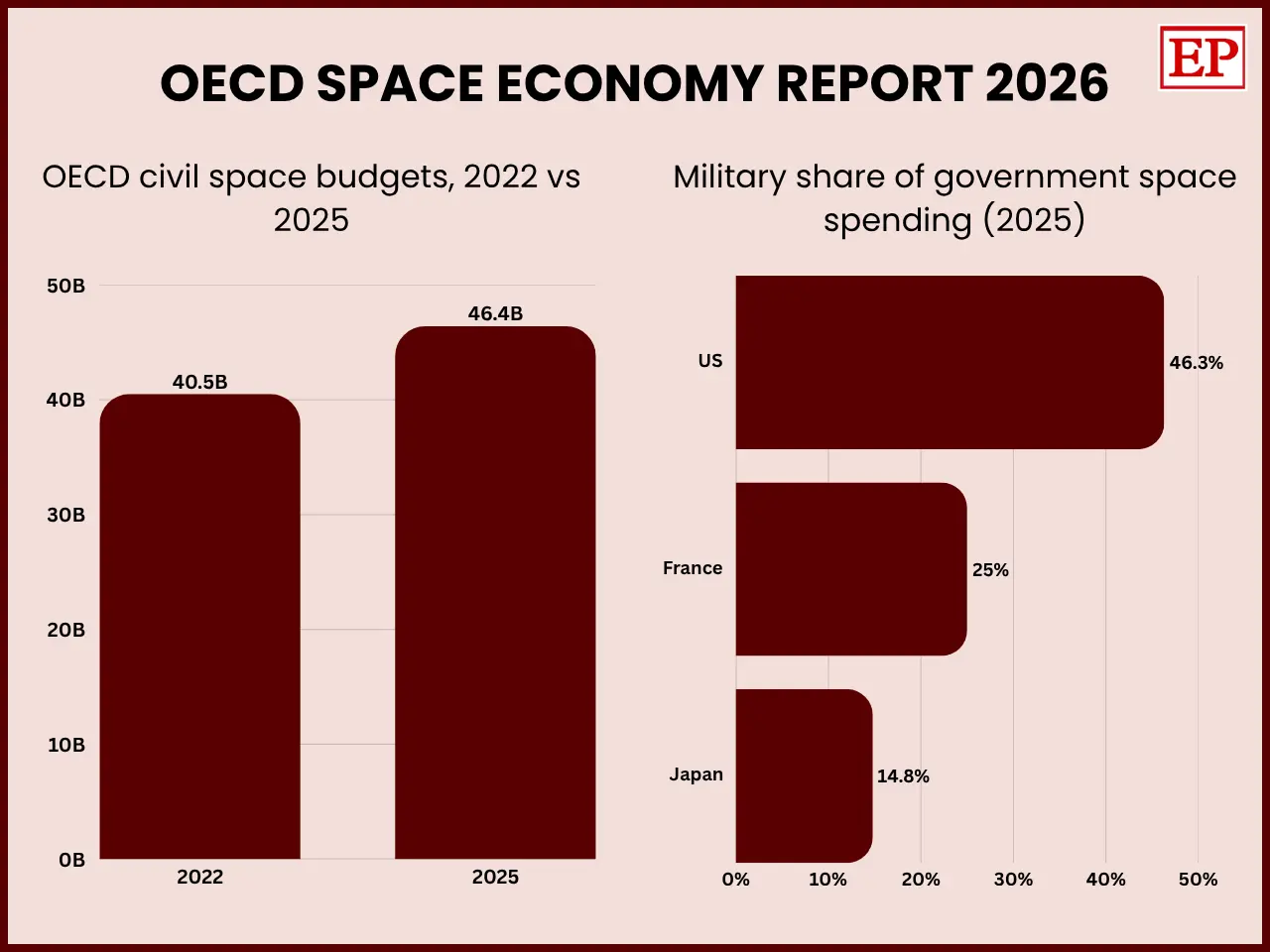
Governments are the primary drivers of growth. OECD civil space budgets grew by 15% in 2025, reaching an estimated USD 46.4 billion from USD 40.5 billion in 2022. OECD monitors 212 space-related policy initiatives and 289 policy instruments in 45 countries, the European Space Agency, and the European Union. The number of countries with space regulations has increased by 50% in a decade and is now approaching 60.
Defense is also a significant area of activity. In 2025, it accounted for 46.3% of government space spending in the United States, 25% in France, and 14.8% in Japan. Private capital is also contributing significantly. Investment reached an estimated USD 11-13 billion in 2025, the highest level since 2021, and is concentrated in established players and expensive areas such as manufacturing and launch. Private operators launched 88% of satellites in 2025, compared to 23% in 2010.
More Players, More Risks
More nations are joining the fray, but control of the action remains consolidated. Of 109 countries that have sent at least one spacecraft into orbit as of 2025, only 12 nations plus Europe (through the European Space Agency) can launch their spacecraft on their own. The United States launched 55% of all spacecraft in 2025, and China launched 28%. While participation in the space economy is growing, the ability to operate at a significant level is not.
Meanwhile, the pace of innovation is accelerating, with space-related scientific output more than doubling since 2009 and research networks increasing from 80 countries in 2000 to 119 in 2024. Spacecraft electrical power alone represented 46% of space-related patent applications filed in 2023, while the United States alone held 34.2% of all patent applications as of 2020-23.
Crowded orbits represent new risks. Over 14,000 satellites were operating by the end of 2025, and 45,860 pieces of debris are currently tracked on a regular basis. Almost USD 200 billion of economic activity is exposed to debris-related risks. The report also highlights jamming, cybersecurity, and fragile supply chains, with almost half of 29 crucial space-related inputs relying on a single country for at least two-thirds of total production.
OECD Secretary-General Mathias Cormann said governments can make the sector more competitive, attractive to investors, and safer through smart procurement and regulation as well as support for innovation. The message was clear: the space industry was no longer a side story but part of the economic backbone, and its management was crucial.