Artificial intelligence is becoming an increasingly significant engine of economic growth in Asia and the Pacific, but its benefits so far are largely confined to countries that produce AI chips, data center equipment, and AI-enabled devices, say economists at the Asian Development Bank.
AI Gains Remain Concentrated
Exports are soaring in Asian economies, advancing much of the way through 2024 and 2025 in shipments of chips, computers, and phones outstripping export growth in most of the rest of the world. Developing economies have only recently started to catch up and are also showing an expansion driven more by higher chip prices than by more chips.
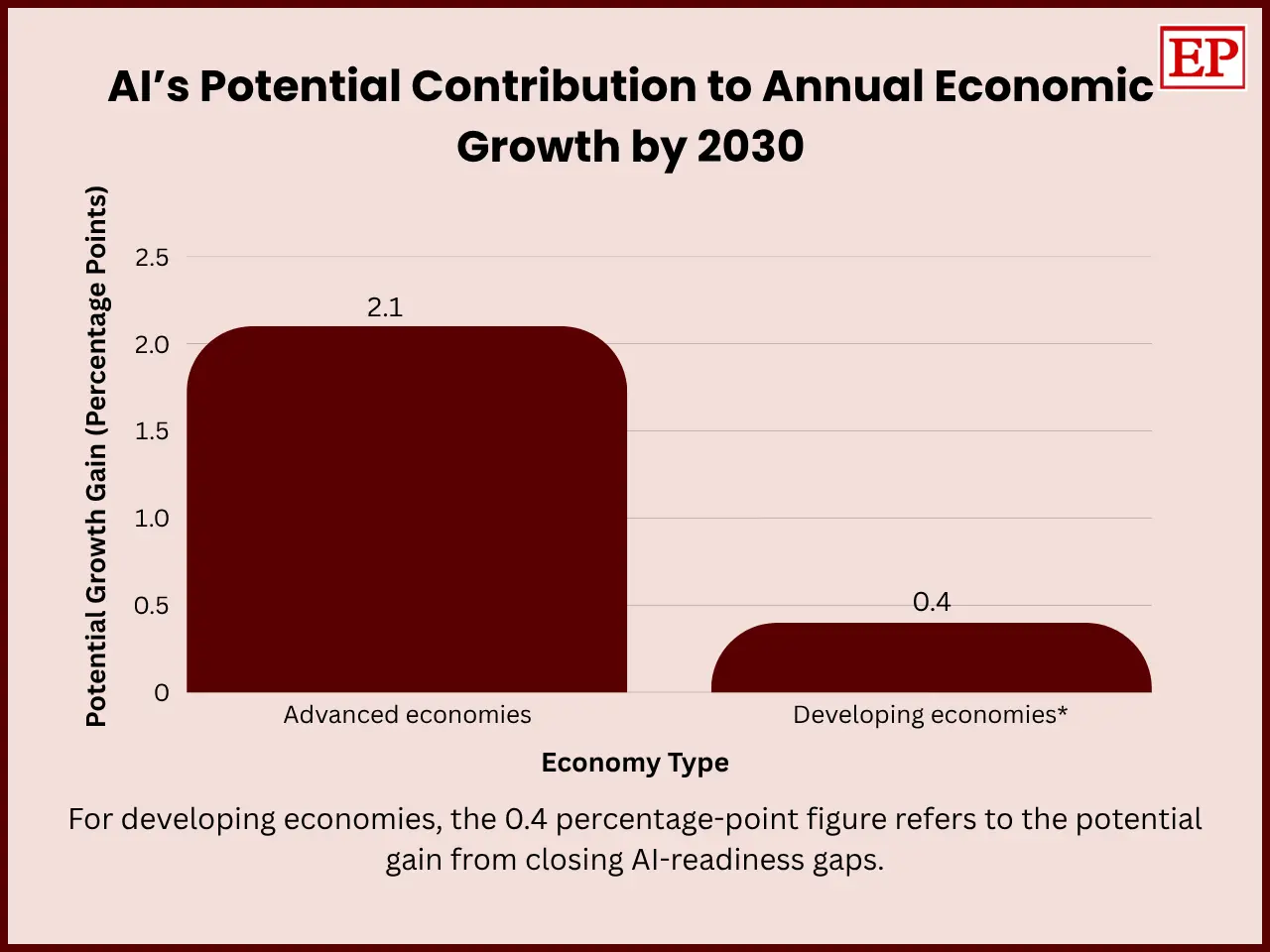
AI investment is uneven globally; the risk is that investment in AI could exacerbate development disparities, according to ADB. AI could boost annual growth in the advanced economies of the region by as much as 2.1 percentage points by 2030—far higher than most developing economies will experience.
Infrastructure, Workers Vital to Broader Impact
The ADB recommended that developing countries should help their local industry adopt AI as well as bring in data centers. Budget-hosting trials, low-cost cloud computing, local-language AI tools, and public sector use of AI could help narrow the AI-readiness gaps. Furthermore, adequate power and internet are a necessity. As for power, the bank lists it as the number one constraint, then water, and suggests that investments in regional power grids and electricity cooperation should be increased.
Meanwhile, governments need to get people ready for a transformation like the one automation will bring. Better social protection, training, and apprenticeships for freelancers and gig workers, for example, would ensure that displaced workers find jobs where they benefit from AI rather than are replaced by it.