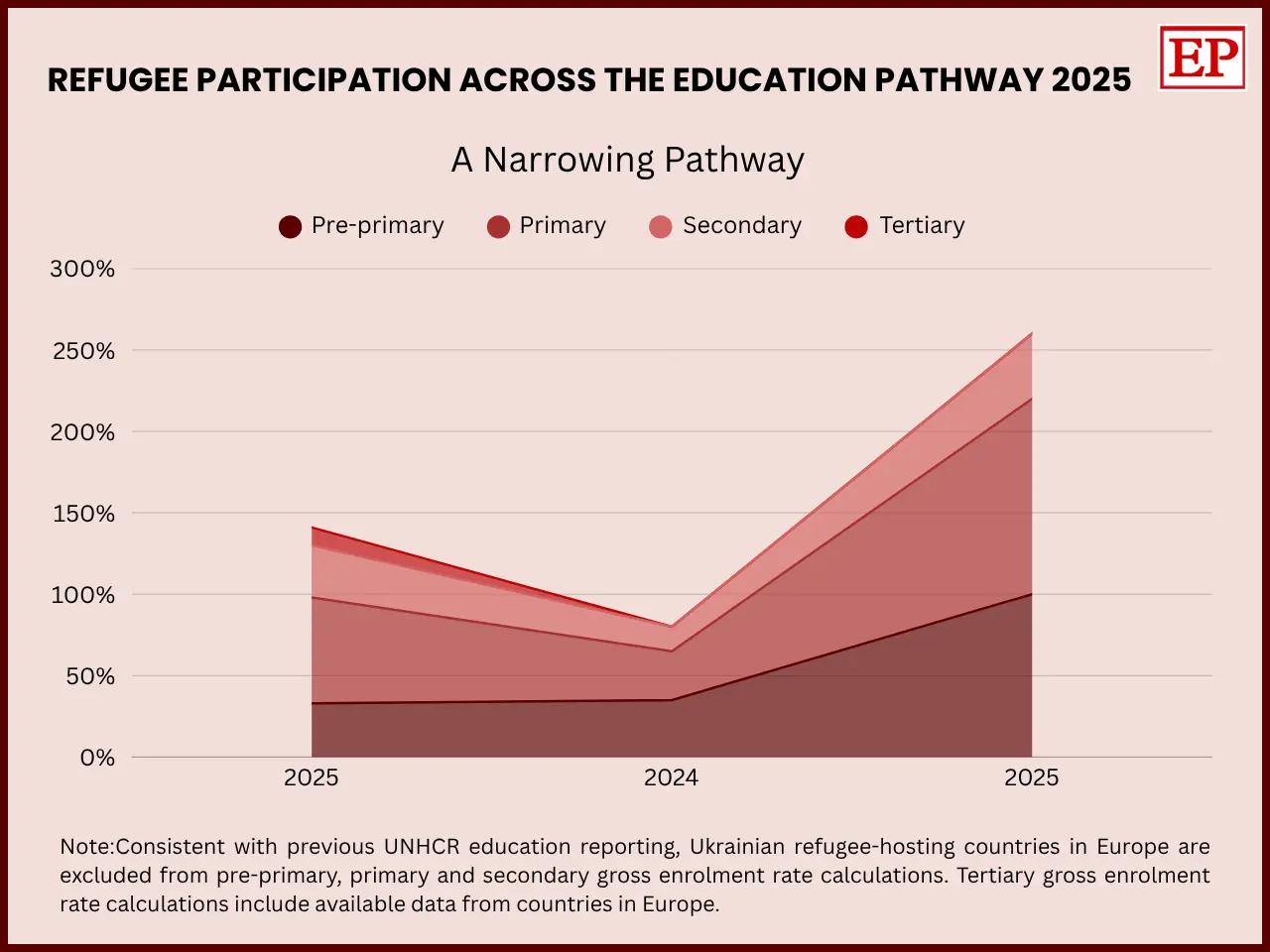
In UNHCR's education report 2026, which is titled "Pathways to the Future," it has been mentioned that there are nearly 35.6 million individuals who are the subjugates of UNHCR, among whom there are nearly 5.8 million children who are supposed to attend school, which means approximately 44% of youth that have to go to the school are already dropping out of it, which indicates some improvements from the year 2024 when the number remained approximately 46%, but the absolute numbers did not change, as the number of refugees kept increasing. In the beginning enrollment is high, with the maximum value at 65% in primary education, while the other stages, please see the pre-primary education, secondary education, and higher education stages, drop sharply, consisting of only 33%, 32%, and 11%, respectively, which indicates that there is a narrow path every stage. The challenges faced by schoolchildren refugees who live in poor or war-torn countries are much more severe since they have much greater access to secondary education. In contrast to other students, girls suffer more due to many factors tied to their age.
Progress and Priorities
It is good to note that the third-level entry into education is at its highest-ever level of more than 450,000 refugees, thanks to the rise in technical/vocational education as well as the availability of scholarships such as DAFI and the university corridor program in Italy and France. Many teachers, many of whom are refugees themselves, particularly women teachers at the pre-primary level, continue to be at the center of access to education and quality. The report identifies the need for inclusion into national systems, continuing financing, qualified teachers, and better learning-outcome data in order to overcome enrollment gaps and ensure that education contributes to the self-reliance of youth.