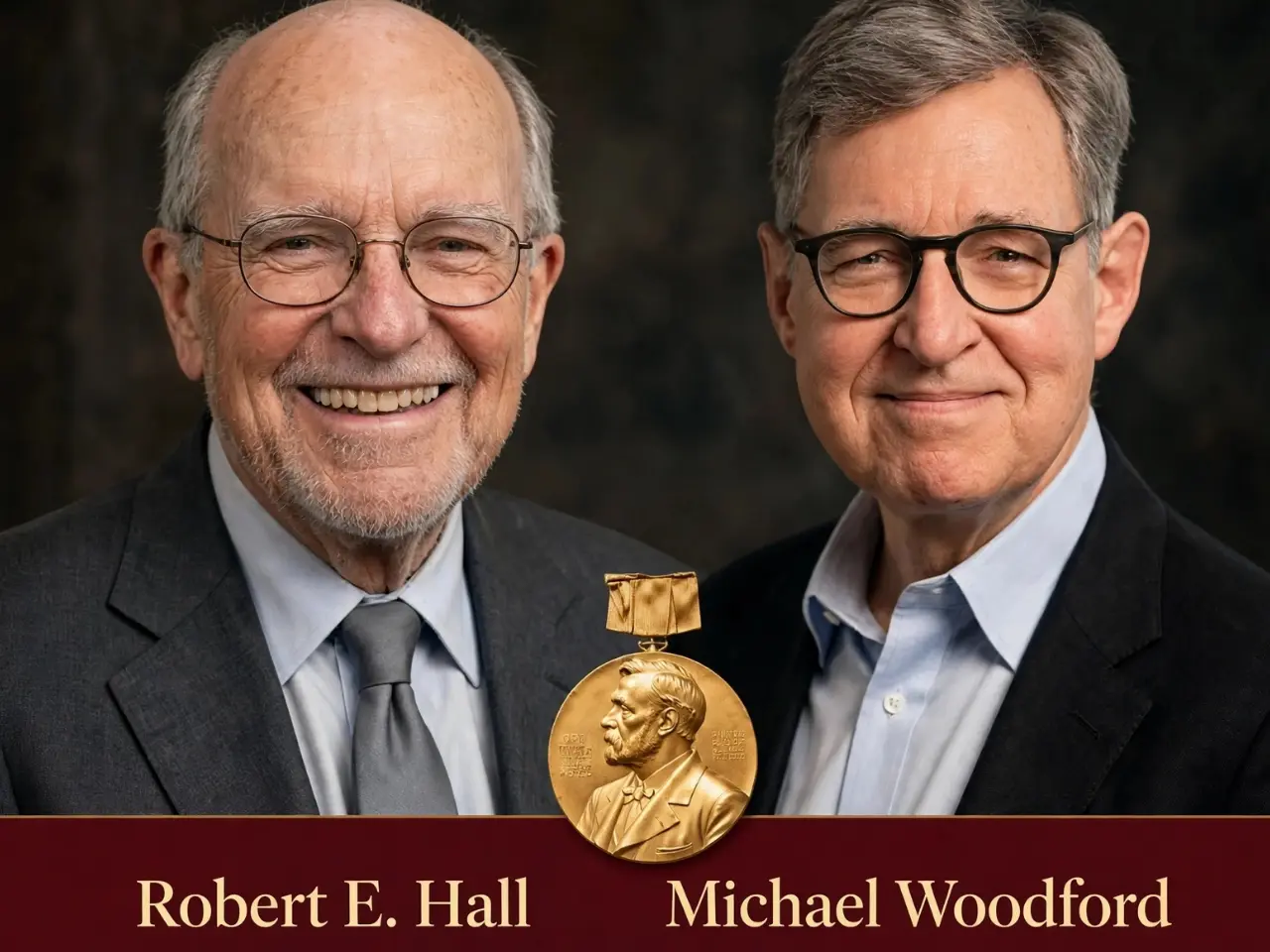
October 12, 2026, Stockholm, Sweden – The Royal Swedish Academy of Sciences announced yesterday that American economists Robert E. Hall and Michael Woodford have been awarded the 2026 Sveriges Riksbank Prize in Economic Sciences in Memory of Alfred Nobel for their work establishing the theory of macroeconomic stabilization.
What the Laureates Constructed
They both received the prize for their analysis of intertemporal choices about spending and prices, which formed the basis for the “New Keynesian” approach.
Hall’s best known contribution is his derivation of a test of how households respond to changes in income. His original insight was that changes in household spending cannot be predicted because such changes follow from new information, which by nature is unpredictable. In brief, people will modify their consumption when they learn something new about their income, say, a raise in their income. It was published in a paper in 1978, titled "Stochastic Implications of the Life Cycle-Permanent Income Hypothesis: Theory and Evidence."
The Academy later described it as a eureka moment for the field and a turning point in modern consumption analysis. Hall has also investigated the sources of persistent unemployment after the end of a recession and the effects of firms’ pricing power and market structure on productivity. Woodford took the problem from the perspective of a central bank. He claims that the expectations of inflation and interest rates affect the current decisions of people. According to Woodford, the current actions of the bank, which set the expectations about the future, change the behavior of market players. For instance, a company that knows that the bank will keep the rates low for the next year will take a loan now to invest in a project. In 1999, he published an article called “Optimal Monetary Policy Inertia” (The Manchester School, 67: 1-35). It is one of his main works. The NPR representative states that Woodford studied such aspects of inflation as supply-side and business pricing decisions.
Why It Matters Right Now
The timing of the award is notable. According to Reuters, the article states that both winners are frequently cited by leading central banks, which are currently struggling to manage an energy crisis caused by the Iran conflict after a post-pandemic inflation spike in 2022. “It provides central banks and governments around the world with a solid analytical foundation for their decision-making processes,” said committee chair John Hassler. “We are now better prepared to deal with surprises, for example, energy shocks or abrupt changes in consumer preferences.”
So, the insight is that you need at least two policies for stability. Take the point that economic stability relies on things other than interest rates and hikes in government spending. To obtain stable outcomes in policy, it is vital to consider people’s decision-making processes, including setting prices. Hall is well-known in policy circles, as he has served as an advisor to the US Treasury Department, the Justice Department, and the Federal Reserve Board.
Last year's economics prize was awarded to Joel Mokyr, Philippe Aghion, and Peter Howitt for their work on innovation-driven growth. This year's prize is a change of direction, focusing on the shorter, more turbulent cycles of inflation and unemployment that most people experience in their daily lives.