Asia’s growth is strong, but risks from energy trade and climate are rising
Developing Asia and the Pacific economies would remain resilient despite an economic growth slowdown, while rising energy costs, geopolitical tensions, and climate risks create new challenges. The Asian Development Bank (ADB) pegged growth in the region to slow to 5% in 2026 and recover to 5.1% in 2027 after growth of 5.5% in 2025. Its 2026 forecast is slightly better than the 4.9% forecast ADB published in July. Economic activity in developing Asia is being supported by strong investment, government stimulus, and technology exports related to the global AI investment cycle.
Simultaneously, the region is facing rising risks that threaten to weaken the outlook. An intensifying El Niño event combined with prolonged disruption in energy markets and growing geopolitical conflicts could add further pressure on economies, mainly via higher food and energy prices.
Demand Remains Strong Despite New Challenges
The ADB sees inflation in developing Asia and the Pacific averaging 4.2% in 2026, still below the previous forecast of 4.3%. Value containment arrangements are helping to cushion the blow from continuously elevated energy prices. Nonetheless, the forecast for inflation will be 3.5% in 2027, compared with 3.4% in the previous forecast, which is still above 3% achieved in 2025.
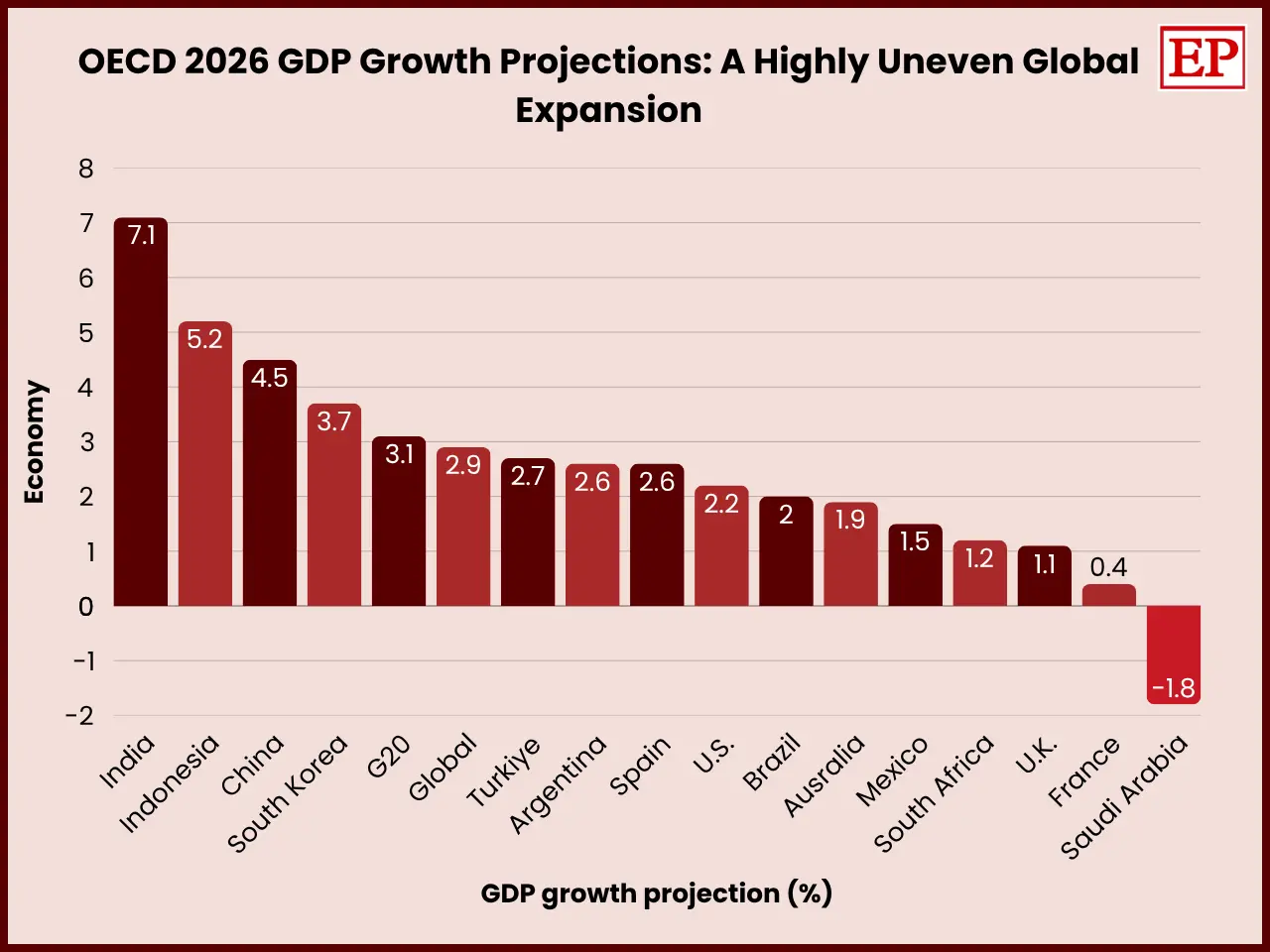
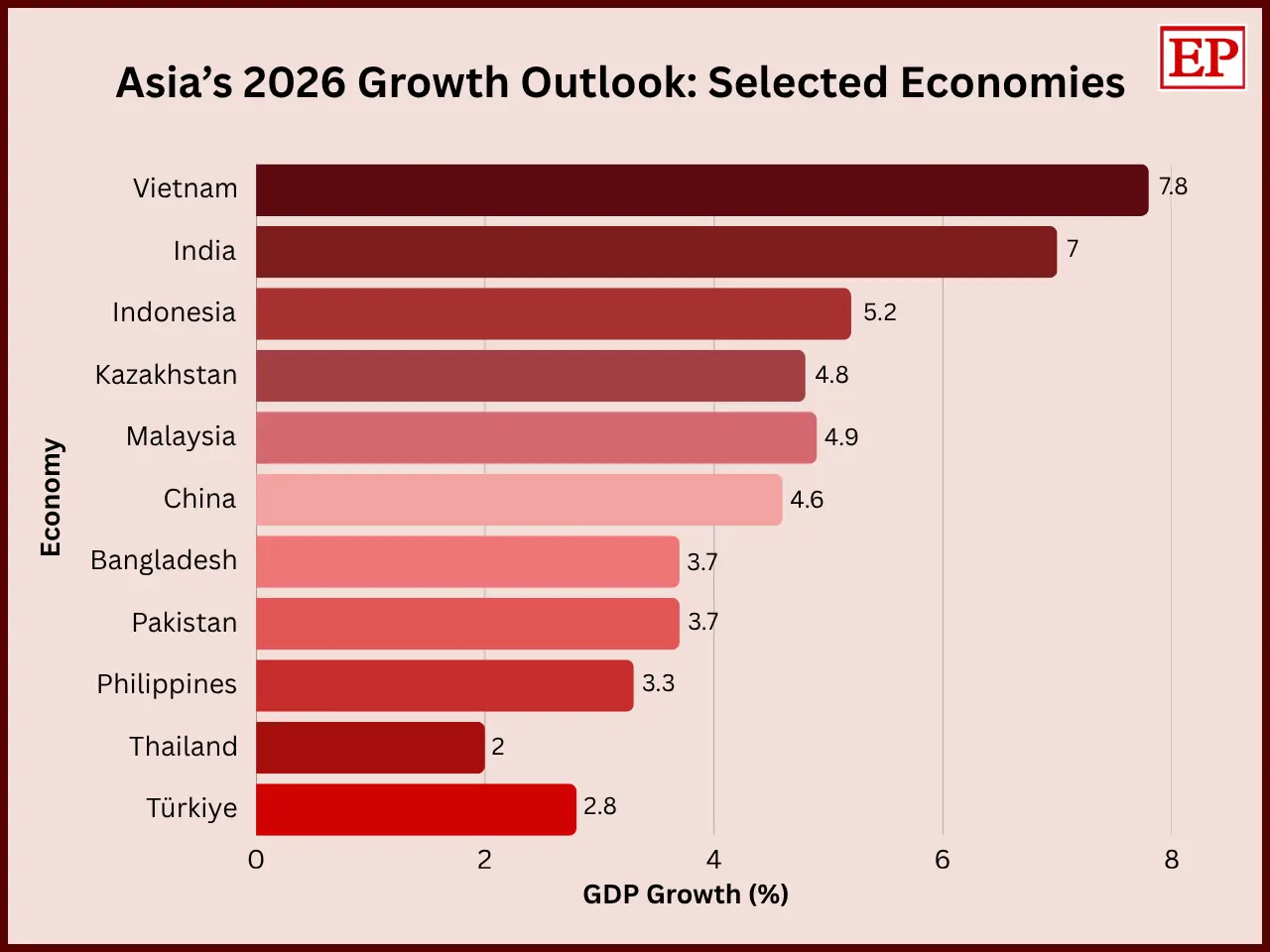
The regional picture is uneven. The gross domestic product of developing Southeast Asia is expected to grow 4.7% in 2026 and 4.9% in 2027, a little more than previously forecast, after a better-than-expected performance in the first half of 2026, according to the ADB. The ADB has kept a steady outlook for developing East Asia, including the People’s Republic of China. Major economies’ growth projections are China at 4.6%, Indonesia at 5.2%, Thailand at 2%, the Philippines at 3.3%, Vietnam at 7.8%, and Malaysia at 4.9%.
The subregion of South Asia is one of the stronger performers. The growth projection for India was raised to 6.4% for 2026 from 6%, supported by solid public investment and firm export growth. According to forecasts, India’s economy will double in size between 2026 and 2027, growing at a rate of 7 percent. However, the outlook suggests lower growth rates for Afghanistan, Bangladesh, India, and Nepal, as other shocks such as trade, energy, and weather were added to the list.
Geopolitical and Climate Risks Threaten the OutlookWhat threatens the region's resilience are risks outside the region's economic environment, according to the ADB. These include risks of an increased intensity of conflict, including an expansion of the Middle East conflict and escalation of Russia's war in Ukraine. Long-lasting conflicts could keep world energy prices high and volatile, with spillovers onto other commodities. Another significant factor of uncertainty is the climate. A very strong El Niño is likely to continue into the first quarter of 2027. If it remains drier, it may impact food production and hydroelectricity as well as raise energy demand. This would lead to higher prices for food and fuel, impacting households and economies across the region. There are also risks from financial markets. AI-led correction in equity prices, financial conditions tightening, and recovery in trade policy uncertainty could set back investment and activity.
Uneven Prospects Across Asia and the Pacific
Growing disparities between the subregions point to how imbalanced the economic outlook of the region has become. Downward revisions in the Caucasus and Central and West Asia push growth in 2026 to 3.7% and 4.1% in 2027. The ADB cites the primary reason for the weaker outlook as slow growth in external demand for the region, led by Turkey at 2.8%. Largest downward revisions for Pacific economies: Growth is now forecast at 3% in 2026 and 2.9% in 2027, due to continued disruptions to the energy markets and the anticipated impacts of El Niño on mining and agriculture.
The ADB's outlook comes with a caveat: it shows a region that continues to grow, yet whose risks are only rising in complexity. Investment, government interventions, and exports of technology are acting as key cushions, but unrest in geopolitics, energy markets, climate-related shocks, and financial markets might decide how long that cushion lasts.