It's estimated that 496 million Indians have lifted themselves out of poverty between 2011-12 and 2023-24 a huge improvement. India's overall poverty rate has fallen as the country has undergone tremendous change over the last decade, including overall household consumption, employment, and welfare.
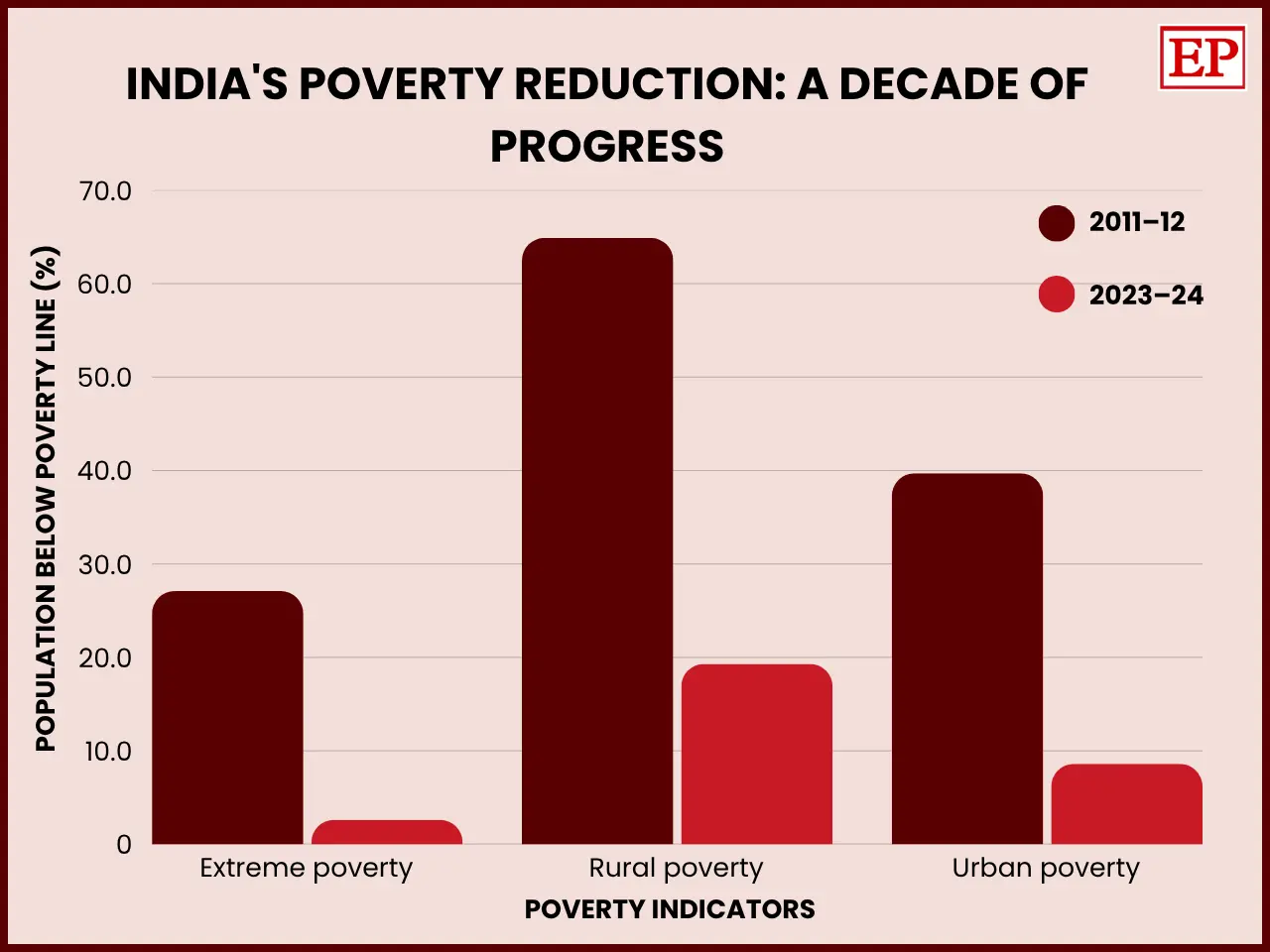
Significant progress has been made in reducing extreme poverty. Poverty at the international line of extreme poverty fell in India from 27.1 percent of the population in 2011-12 to 2.6 percent in 2023-24. These are positive signs of development, but within these levels of poverty is still considered an important indicator of development.
Economic growth and welfare programs aid progress
The Poverty and Equity Brief said that rising household consumption, more jobs, and government support programs were key to the progress in poverty reduction. It helped households to cope with shocks and increased their capacity to meet their basic needs. The signs of decline in poverty levels were visible in the rural and urban areas. But the progress was uneven and rapid. At the lower-middle-income threshold of $4.20 per day, 15 years ago, 64.9 percent of the country's rural population lived below the poverty line, and that rate has come down to 19.3 percent. Poverty has also been affected by the growth of employment. The entry of more women in the labor market (especially in rural areas) has, in addition, supported increases in income levels. Greater access to jobs can improve women's economic well-being and the financial security of households.
The second important contributor is the social protection adopted by the government. Food subsidies and other welfare transfers have also played an important role in helping many households to safeguard their consumption. Welfare transfers can serve to reduce the initial cost for low-income households and shield them, at least temporarily, from the shock.
Despite Success, Advancement Is Still Irregular
Although the poverty has drastically decreased, according to the report by the World Bank, poverty still persists in India, as 232 million people are below the $4.20 lower middle-income poverty line in 2023-24 and 35 million are below the international extreme poverty line of $3 per day. Note that this does not necessarily mean that 496 million people have escaped poverty, as this figure is based on the $4.20 lower-middle-income poverty line. When calculated based on the more established $3 aid poverty line, the reduction goes from 27.1 per cent in 2013 to 2.6 per cent in 2021. All the estimates here are based on the 2021 PPP in order to account for differences in the cost of living across countries.
Poverty remains a hot topic of discussion when it comes to employment. Even though job opportunities seem to be expanding, stable, productive, and well-paid jobs are vital to maintain any progress made in this regard. Employers, on the other hand, still face the problem of regional disparities and youth unemployment.
As a result, the most recent figures identify significant advances-not the total eradication of economic disadvantage. Equally, it will continue to be critical to allow for the rising tide of economic growth to flow through to the most disadvantaged communities, to our public services, and to job-creating opportunities.