What Positive Peace Means and Its Importance
According to the Institute for Economics & Peace (IEP), peace should not be viewed merely as an outcome accomplished by societies that are functioning effectively; rather, it is the basis on which they are founded. Through its Positive Peace framework, IEP has identified the principles, institutions, and infrastructure that support peaceful societies, as organized into eight interconnected pillars. To measure these, IEP has created the Positive Peace Index (PPI), which is based on statistical analysis of over 20,000 indicators across 163 countries, which cover almost the whole world.
The research indicates that those conditions supporting peace yield further outcomes cherished by individuals. Countries ranking higher tend to have stronger economies, environmental performance, life satisfaction, and social cohesiveness. Real GDP in countries where scores increased grew about twice as fast as those where scores declined, and foreign investment followed the same track. Inflation remained much more stable. Countries that made the greatest strides towards internal peace over the ten years saw improvements in positive peace four times greater than in the rest of the world, mainly due to the rule of law, control of corruption, and group grievances. Hence, it provides both rich and poor countries with an opportunity for some sort of internal renewal for rich countries, a bearer of renewal of cohesion and productivity, and poor countries for improved material performance.
A Decade of Mixed Progress
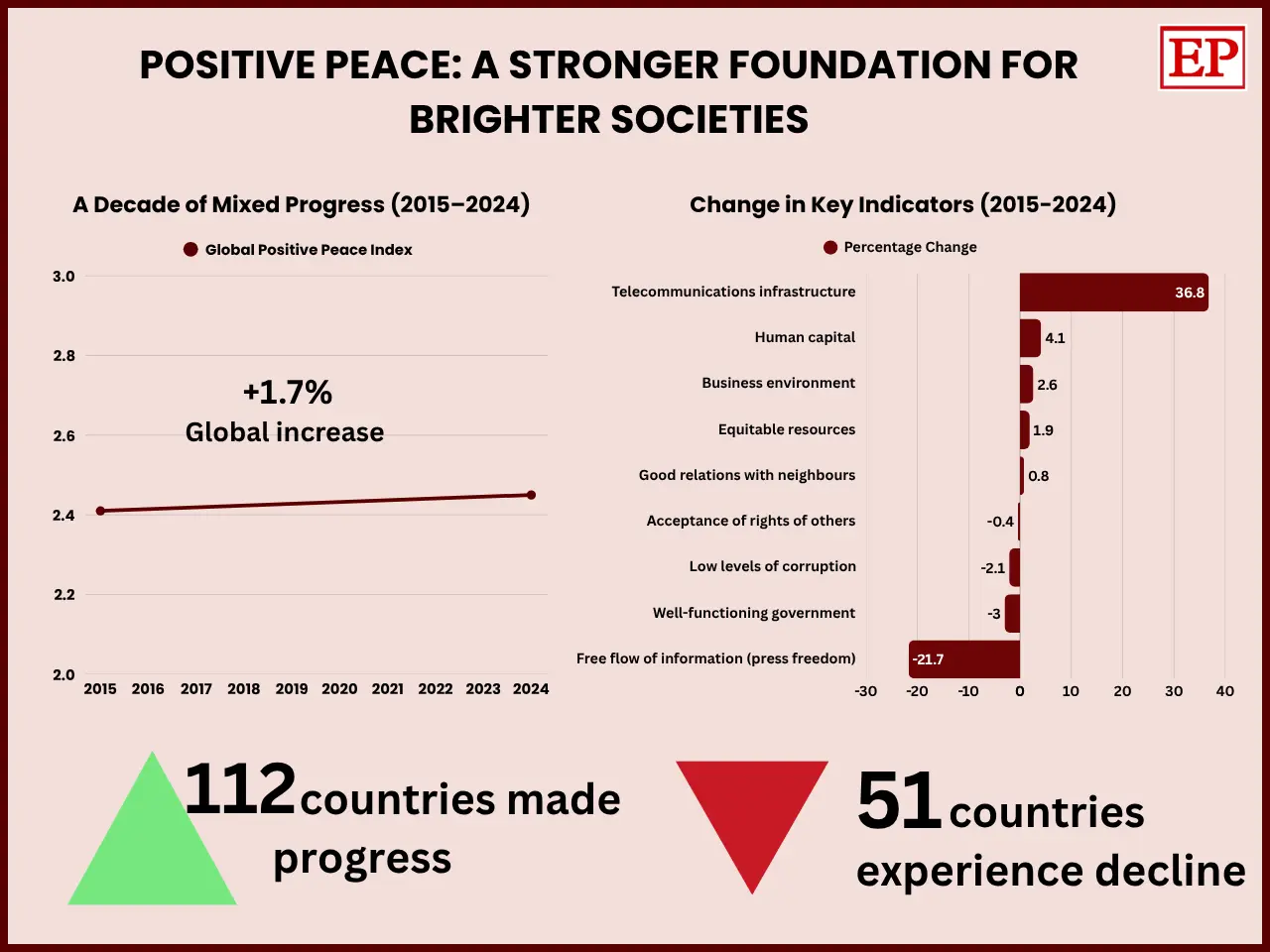
Positive peace globally has increased by 1.7 percent from 2015 to 2024, with 112 countries reporting progress. Nevertheless, the report warns that this headline figure hides a harsher reality. Almost all the improvement is owing to only one indicator, the telecommunications infrastructure, which rose by almost 37 percent. Excluding that indicator, the global score would have dropped with more countries experiencing a decline than improvement.
The decade may be presented as two opposing trends. The structural basis for peace, such as connectivity, health, and human capital, receives support, while institutional and informational aspects deteriorate. The authorities became less open, elite unity declined, and press freedoms were restricted. The Well-Functioning The government pillar saw the biggest decrease of 3 percent, with corruption worsening in more than 60 percent of countries. The press freedom indicator was the most depressed indicator, with more than one-fifth deterioration, which occurred disproportionately in the aftermath of COVID-19 with emergency restrictions in place and the spread of disinformation. In Western and Central Europe, the biggest deterioration was recorded in the Netherlands, the UK, and Austria, where the waning cohesion and trust in the government were noted.
Resilience, Major Powers, and Pathways Forward
The pandemic acted as a test of stability. Countries ranked high on Positive Peace performed better and recovered faster from the crisis. Those economies in the highest Positive Peace category saw their GDP rise by an average of 2.1 percent from 2021 until 2024, while countries in the lowest category became poorer by 0.6 percent during the same period. The United States, among the largest economies in the world, experienced the second biggest drop in terms of GDP contraction of 8.8 percent during that time, primarily due to corruption, while China and India got richer by about 6 percent and Russia became poorer by 5.2 percent. Despite the changes, the quality of press and information deteriorated in all of these countries. It is interesting to note that these countries are ranked higher in terms of positive peace than in the Global Peace Index, which means they have scored better than they should have.
Additionally, the report describes peace as a dynamic system that has two stable points, which are very hard to escape from, known as Conflict Trap and Sustainable Peace. While the mid-peace states are subject to constant change, which makes them very unpredictable. Each stage has its own priorities, like business environment and relations with neighboring countries for low-peace states, governmental quality and acceptance of other rights for mid-peace ones, and fair resource distribution for high-peace ones. Finally, this framework has been implemented in more than 150 countries, starting from bringing back the ex-combatants from Colombia and finishing various community projects in South Sudan by focusing on existing resources but not on problems.