Who says fantasy is aloof of Economics, because Harry Potter says otherwise. When you hear the name Harry Potter the first thing that springs to mind is probably Hogwarts, magic, spells, flying broomsticks, all sorts of strange creatures and the eternal battle between good and evil. But what about the economics of the wizarding world? How does it actually work? Who runs the banks? How do people get on in the world and make a living and how they deal with differences in wealth? J.K. Rowling’s seven book series is of course massively loved for its themes of friendship, courage, loyalty and sacrifice. There's another side to the stories which is just as interesting. The wizarding world is full of magic, but the people in it are still subject to the same economic problems that magic can't fix.
Gringotts: More than just a place to keep gold
One of the most interesting places in the whole series is Gringotts Wizarding Bank. With its massive underground vaults, the goblin bankers and the sheer reputation for security it has it is absolutely at the heart of the wizarding world's financial dealings. The question that arises if you look at it from an economic point of view is what happens when so much of the financial activity in the world is dependent on a single institution? The fact that Gringotts appears to be the dominant force in the financial world gives us a perfect opportunity to look at the issue of market concentration and the risks that are inherent in having such a large amount of financial power in the hands of a few. In any economy, if one of the major financial institutions is in difficulty the knock-on effects can be felt by far more than just its own customers.
The Ministry of Magic: When protecting power becomes the priority
The Ministry of Magic is another excellent illustration of how institutions work. Under Fudge, the Ministry is so concerned about its own image that it will simply not accept the reality of the threat posed by Voldemort. Rather than take Harry's warnings seriously, it goes out of its way to discredit him. That's the classic case of public choice theory in action. We all assume that public institutions will be acting in the interest of the public. The reality is that those in power are human and their decisions will be influenced by their own self interest, political expediency and the desire to stay in office. The fact that the Ministry has done what it has does serve as a stark reminder that having the power to govern does not necessarily equate to using that power in a responsible way. Institutions must be transparent, they must be accountable and they must be genuinely committed to the public interest. If they aren't then an organisation which is in theory there to serve the public can end up being all concerned about its own position rather than the problems it was created to solve.
Dobby's freedom: A reminder that every worker deserves dignity
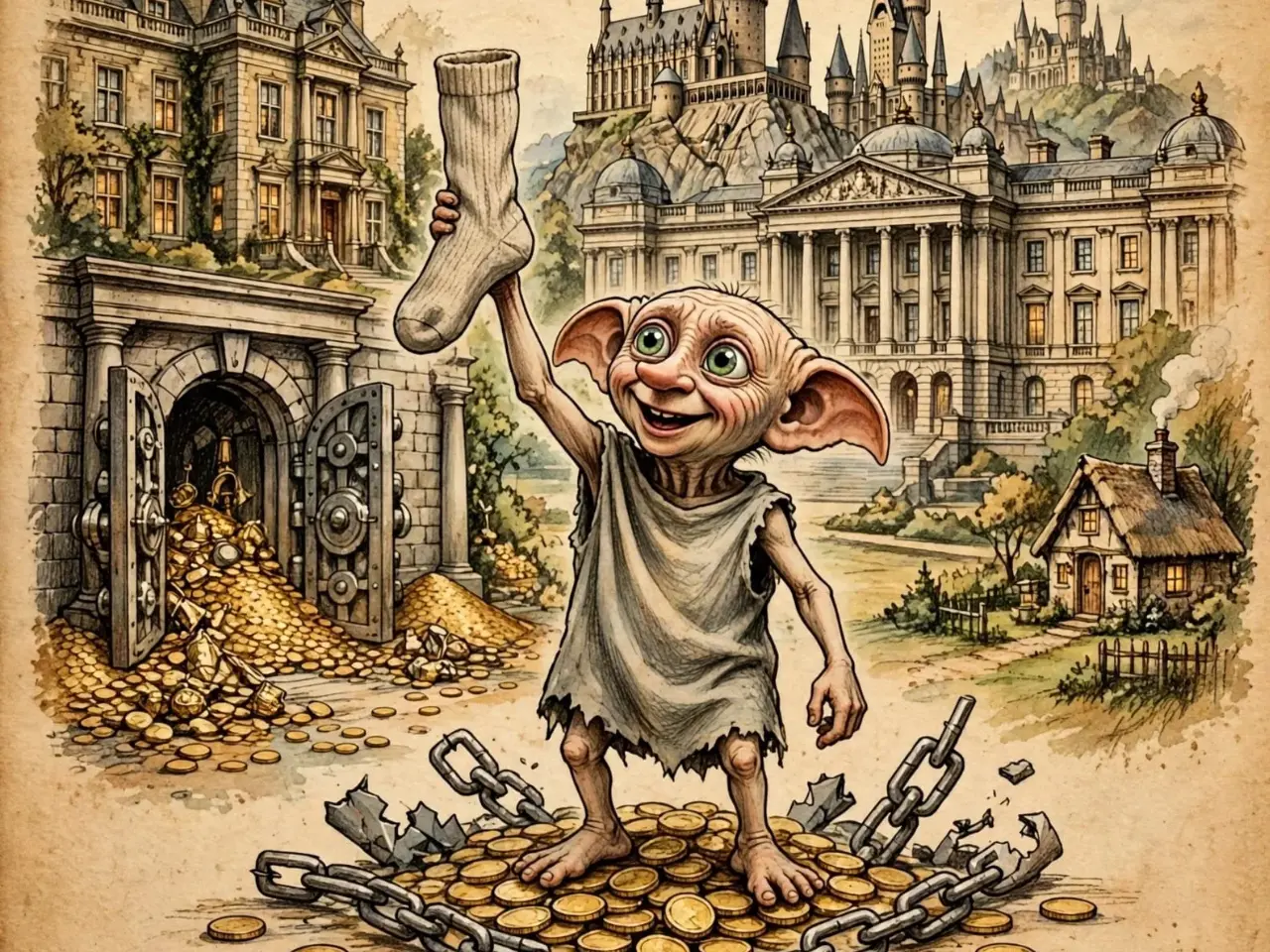
Of all the memorable characters in the series, Dobby's is perhaps the one most associated with labour and the freedom from labour. House elves work in households and in various institutions throughout the wizarding world, doing the domestic work for no pay and with no freedom or employment rights whatsoever. Dobby however wants something different. He wants to be free, to make his own choices and to be treated with some degree of respect. His struggle is a challenge to the very system in which we are expected to just accept the way things are. It forces you to ask who really benefits from the work of others? Why do we so often ignore certain forms of work? And can work ever be fair when you have absolutely no freedom or ability to negotiate? It's all very much a question that we still have to grapple with today. These issues go well beyond the realm of fiction. Unpaid domestic work, the informal economy and workers' rights remain very much issues in the modern economy. A huge amount of the work that goes on to keep the household and the community going is not properly acknowledged, especially where there is no direct monetary payment involved.
The Malfoys and the Weasleys: Not everyone gets the same start in life
The Malfoys have the inherited wealth, the social standing, the privilege. The Weasleys are a lovely family, but they're very much in the financial struggle. The contrast between the two makes the issue of inequality so much easier to grasp. It's not just about how much you earn. It's about the opportunities that wealth can create. The opportunities that wealth can create in terms of access to good education, access to resources, access to good connections, access to a decent standard of living, all of those things can have a massive impact on a person's life. Wealth also moves from generation to generation. A family with a head start in terms of wealth can pass that on to their kids and so on. The other side of the coin is that a family who don't have that head start will find it very difficult to pass on the same sort of advantage. The Malfoys and the Weasleys are part of the same magical world but their economic situations are very different. Their stories do make you think about a very fundamental question in any society at all: can people really have equal opportunity when they start life in such vastly different circumstances?
The Daily Prophet: Who controls the information controls the story
In the wizarding world the Daily Prophet is far more than just a paper. The way it treats Harry in particular, when he's talking about the return of Voldemort, is a case in point as to how information can be used to construct a particular reality for the readerThis is very much in the remit of information economics which is all about how the quantity and quality of information available to us affects our decisions. What happens when the information is incomplete, when it's selectively presented or when it's deliberately misleading? People can end up making decisions without having the full picture. The Daily Prophet is a good example of this. It's not just about what's happening, it's about who gets to tell the story, what gets left out and the effect that has on what people believe.
The Sorting Hat: Are our decisions always rational?
Harry's first meeting with the Hat is a nice little link to behavioural economics. It sees the traits in Harry which would make him a perfect fit for Slytherin, but Harry is very keen to avoid that. His preference is exactly the sort of thing that behavioural economics would have us believe we're likely to do. Behavioural economics reminds us that people don't always make decisions through rational calculation. Our choices are frequently the product of emotion, fear, social pressure and our own personal biases. We can see a similar effect at work in the wizarding world's reaction to Voldemort's return. Fear and social pressure have a massive influence on who we trust, what we believe and how we react to what is going on. It's a useful reminder that economic decisions are not always the result of prices and income and financial incentives. Human behaviour and human psychology are just as important in explaining why people make the decisions they do.
Beyond Hogwarts: What can economics learn from a magical world?
Ultimately Harry Potter teaches us that an economy is about so much more than money changing hands. The wizarding world may have magic to deal with the most extraordinary of challenges, but building a fairer society requires something far more fundamental: the recognition of inequality, the willingness to question the systems that no longer work for everyone and the courage to change them. After all the most important lessons in economics aren't necessarily in the textbooks. They're in the stories we love.