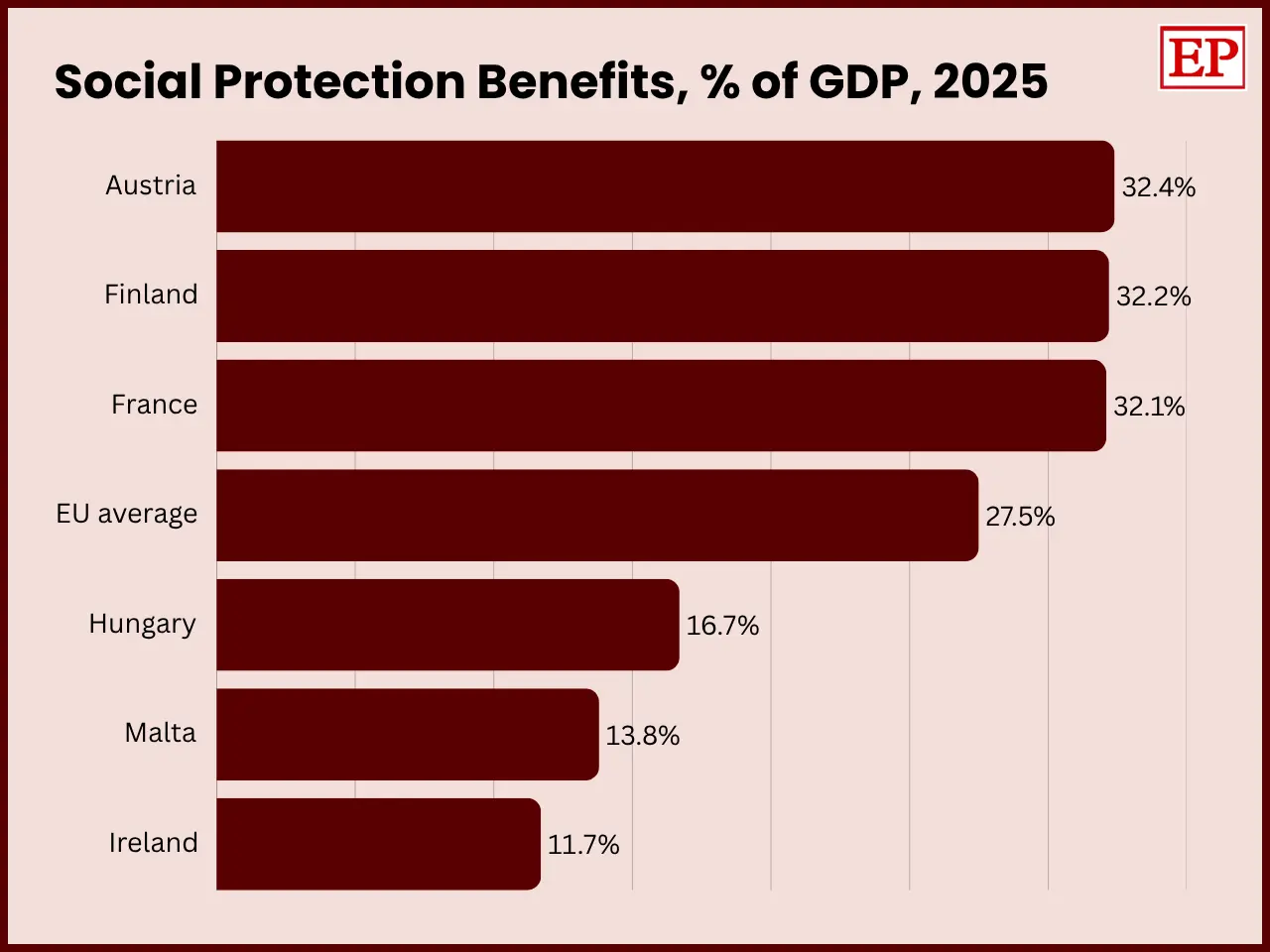
The European Union 2025 expenditure on social protection was around €5,183 billion, according to eurostat’s early findings. Spending was up by 4.9% on the previous year. All EU countries had increases in spending. Yet this was not as high as economic growth, and so the share of GDP devoted to social protection edged down by 0.2 percentage points to 27.5%.
Variation between member states
There is great variation in the proportion of national income that is spent on social protection. The highest spenders are Austria (32.4%), Finland (32.2%), and France (32.1%). On the other hand, Ireland (11.7%), Malta (13.8%), and Hungary (16.7%) have the lowest levels of spending in this area. Different member states also show different rates of increase. Once again, measured in euro terms, the highest growth was seen in Croatia (15.4%), Bulgaria (12.1%), and Lithuania (11.6%). The lowest were in Greece (0.6%), Romania (0.7%), and Finland (1.3%).
The majority of expenditure is spent on these two sectors. Ill-health and healthcare cost another €1,556 billion (30.0%). As a whole, these areas accounted for 71.5% of total spending. The rest was spent on disability, bereavement, family- and child-related costs, unemployment, housing, and social exclusion. Please note that these are provisional figures and have been voluntarily submitted by member states. They may therefore be subject to change.