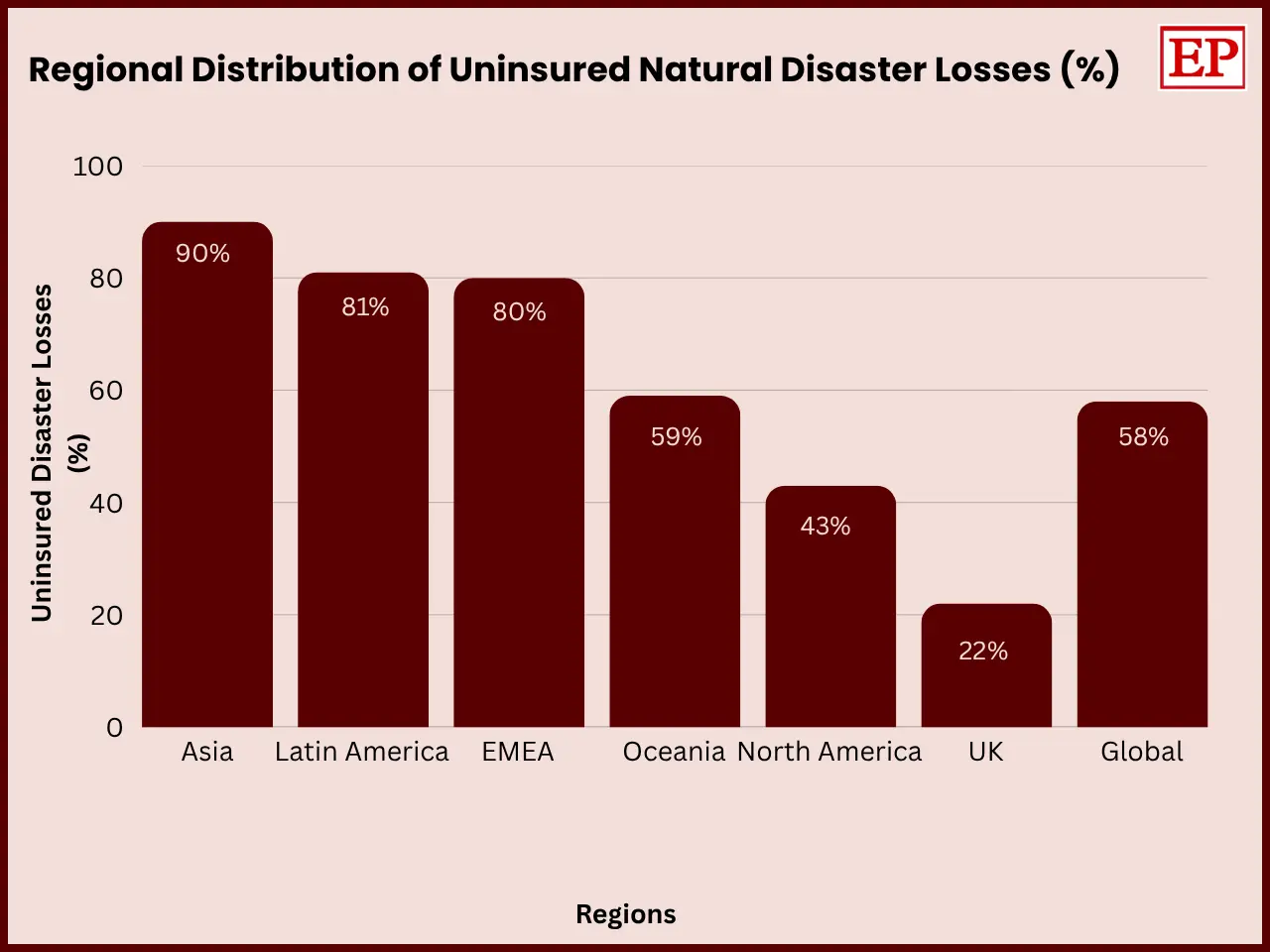
Over the past decade, according to the Finance and Prosperity 2026 Report released today by World Bank President David Malpass, “uninsured financial losses due to weather-related shocks and natural disasters have surpassed 80 percent of GDP in parts of Africa, Asia, and Latin America and hit 95 percent in some of the world’s poorest and most vulnerable countries."
These numbers suggest that households, businesses, and governments have no choice but to absorb the lion’s share of the costs incurred in response to a range of natural disasters, hurricanes, floods, and droughts-without adequate insurance cover. By showing how much economic activity can be affected during such crises, these statistics underline the role of insurance as an important mechanism to support economic stability in the wake of frequently occurring climate-related disasters—even when faced with constrained financial resources.
The Economic Consequences of The Insurance Protection Gap
The insurance protection gap is the difference between total economic losses caused by events such as natural disasters and losses covered by insurance. While insurance is widely accessible, it is often out of reach for many households and businesses. This means that in the case of an economic loss, households and businesses are forced to depend on their personal savings, borrowing, or government support.
In developing economies, this is more pronounced as a significant part of the population engages in subsistence agriculture, informal employment, and small businesses. Losses and disruptions in agricultural production caused by flooding or droughts, for example, can eliminate income and negatively impact supply and production chains.
If uninsured losses occur, it may be necessary for households to sell their productive assets or for businesses to not reopen. Farmers may face challenges funding the next agricultural season. This means the economic losses caused by a disaster are extended beyond the disaster period.
Using Insurance to Accelerate Economic Growth
Having access to affordable insurance can help accelerate the recovery of developing economies after natural disasters. Insurance compensation provides households and businesses with financial means to restore their properties and help them return to their income-earning activities.
For farmers, insuring their crops can help reduce financial risks of potential crop failures due to weather conditions. For micro, small, and medium enterprises (MSMEs), insurance can help businesses resume operations without relying on emergency loans.
The World Bank notes that to achieve the optimal combination of availability and affordability of disaster risk finance products, countries need to strengthen their insurance markets and industries, along with the appropriate legal and regulatory frameworks and financial products that respond to the needs of poor and vulnerable households and businesses. Increasing the insurance coverage of countries also has the additional benefit of extending financial protection to underserved households, ultimately deepening financial inclusion.
Better Risk Management to Alleviate Financial Burden on Governments
When unexpected disasters occur and losses are not covered by insurance, government budgets are usually the only source of financial support. Such unexpected expenditures could put additional financial strain on already stressed budgets, especially if the government is implementing debt and fiscal management programs.
If insurance systems were strengthened, uncovered risk from disasters could be distributed to other policyholders and insurers, reducing the financial burden on governments to cover recoveries independently. Public sector insurance schemes will not and should not replace public sector investments for disaster risk management, social protection, and the development of risk-reducing, resilient infrastructures.
The World Bank's report shows the need for the integration of insurance and related risk transfer mechanisms to strengthen other risk management and finance systems. The need for closure of the insurance protection gap is increasingly urgent to sustain economic recoveries and provide protection to livelihoods of at-risk populations of developing economies.