Increased privacy management
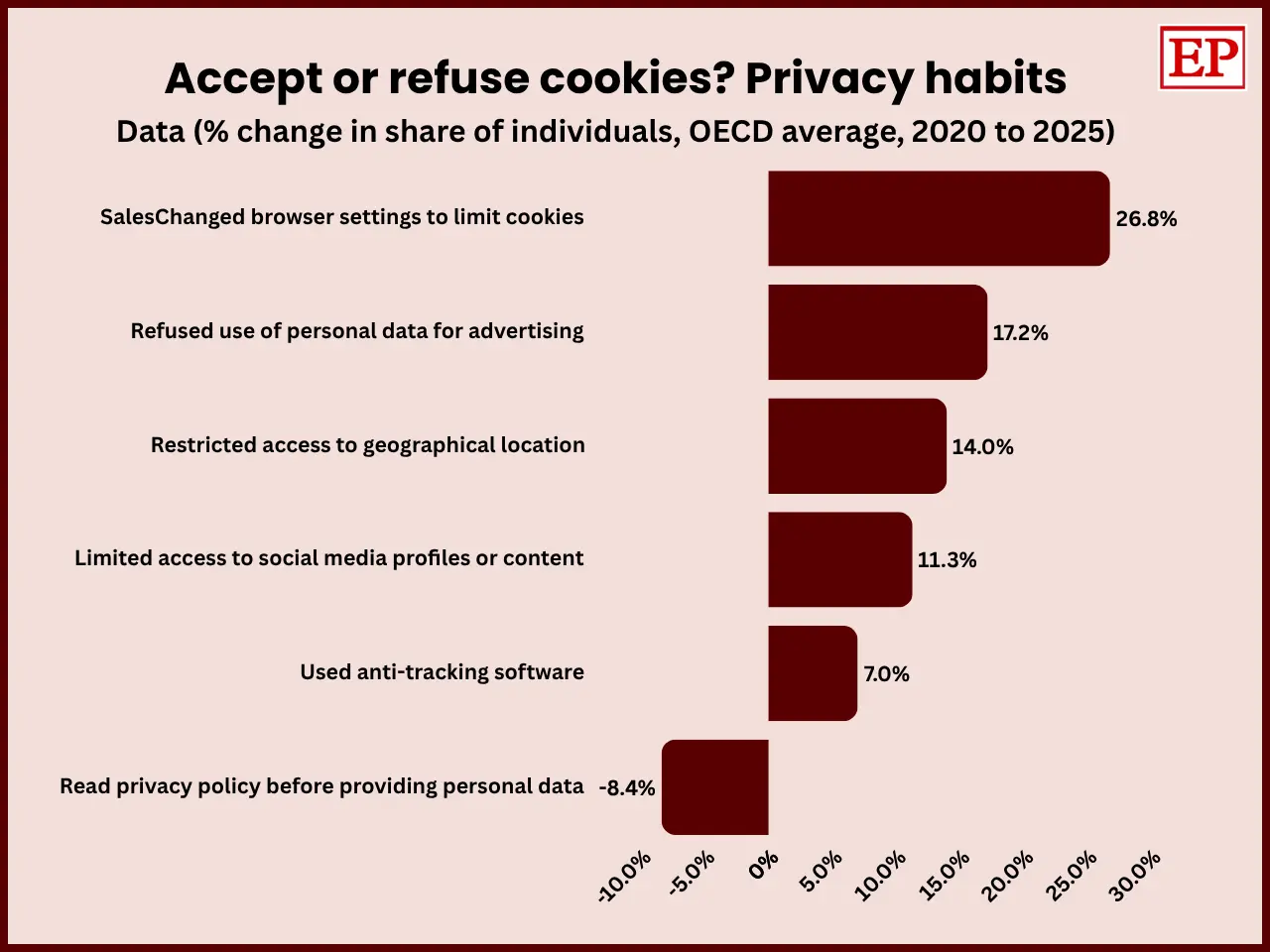
Between 2020 and 2025, there has been an increase in users limiting cookie tracking in their browser. This increase is by 26.8% over this period. Cookies are small pieces of data that can be used to track users between different websites.
Other trends in privacy management have increased. Users refusing to allow personal data to be used for advertising increased by 17.2%. Location data was restricted by 14.0% of users. Social media profiles were restricted by 11.3% of users. Anti-tracking software was used by 7.0% more users.
Over half of individuals in the OECD restricted location data or refused to allow data to be used for advertising in 2025. However, one trend decreased. Users reading privacy policies before sharing personal data decreased by approximately 8.4%. This indicates that users are using quick settings and tools to adjust their privacy settings rather than reading long legal documents. increased due to improved privacy settings in browsers, operating systems, and online platforms. It has also increased due to increased awareness of data protection.
Education and Age
Individuals with higher education levels are more likely to protect their data than individuals with lower education levels. 68.1% of individuals with higher education levels opted out of data usage, and 65.8% limited their location data. However, 39.5% and 38.9% of individuals with lower education levels did so, respectively.
Individuals aged 16-24 are less concerned with privacy issues surrounding generative AI but are more likely to implement measures to protect their data, including changing browser settings, limiting data tracking, or using anti-tracking software. In comparison, individuals aged 55-74 are more likely to avoid using AI due to privacy, security, and safety concerns (5.8% vs 1.9%); however, they are less likely to proactively manage their online privacy.
How People Protect Data
Across the OECD, only 4.5% of individuals cited privacy, security, or safety as the main reason for not using generative AI tools in 2025. Similarly, individuals with high and low education levels were very similar in this respect (3.9% and 3.5%, respectively). Therefore, it seems that privacy concerns alone do not fully determine whether individuals act in this way. The knowledge of available tools and knowledge of how to use them seems to be an equally important factor.
Businesses Fight Cyber Threats With AI
In 2023, 17.7% of OECD enterprises suffered a security incident in their ICT systems. As a result, more companies are using AI to detect, prevent cyberattacks, and confirm users. 5.3% of enterprises in 2025 used AI in ICT security. This is roughly a quarter of all enterprises using AI. It has increased significantly from 2024 (an increase of 23.2%), from 2023 (an increase of 68.6%) and from 2021 (more than double).
There is significant variation across enterprise sizes. Large enterprises are most likely to implement AI within ICT security (26.7%) compared with medium (9.6%) and small (3.7%). Differences also exist between sectors. Within the information and communication sector, 18.1% of enterprises implement AI in ICT security. This is much higher than within professional, scientific, and technical activities (8.9%) and almost 9 times higher than in accommodation and food services (2.1%). Therefore, AI in ICT security appears to be increasing most in sectors with high digital risks. Although individuals and enterprises are taking greater control over digital security, not all businesses have equal access to these AI tools.