Middle East oil-exporting countries are now facing the economic realities of a slowdown caused by the persistent worldwide disturbance to energy production and shipments. The International Monetary Fund reports that the Middle East is experiencing severe disruption to oil and gas production, changes to export routes, and decreased economic confidence in the Gulf. While higher energy prices on a global basis may have mitigated these problems to some degree, the likelihood is that such price hikes cannot fully compensate for the economic damage from lower production and shipments.
Outlook further shows how the economic repercussions of the crisis are not equal: the large direct impact on oil-exporting countries is combined with near-term resilience in some oil and neighboring economies.
Disruptions to Energy Production Weigh on Economic Growth
One of the main difficulties Middle Eastern oil-exporting economies faced was the breakdown of energy production and trade. Because it is home to one of the world's most important routes for transportation of energy, the restriction of shipping via the Strait of Hormuz has caused various delays and setbacks for the shipments of crude oil.
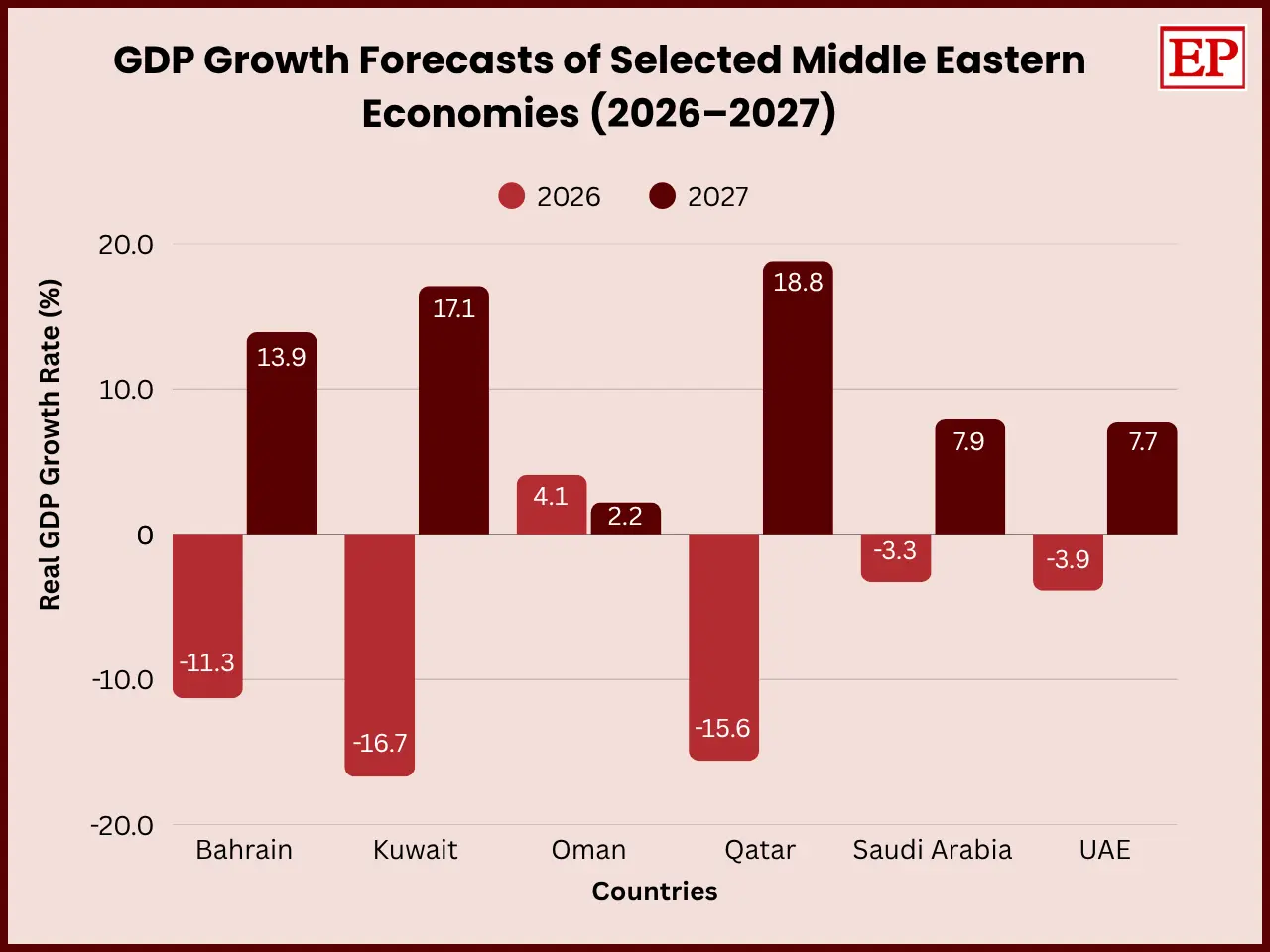
International Monetary Fund (IMF) study evidence shows a -0.3% economic growth for the Middle East and Central Asia in 2026 before bouncing back to 6.3% in 2027. This dramatic decline will be mainly driven by those countries that rely most on the production and export of hydrocarbons. Furthermore, Bahrain, Iraq, Kuwait, and Qatar are expecting a 10% or higher economic downturn in 2026 due to production drops and logistic issues.
In addition, Saudi Arabia is also forecasted to go through the process of contraction, yet because it has more routes available for exports and alternative systems of transportation, it can mitigate some of the factors leading to disruptions. The IMF forecasts contraction of 3.3 percent for the Saudi economy in 2026. Both these examples provide insight into the degree of economic fragility driven by reliance on energy exports.
Increased Energy Costs Are Not an Economic Panacea
Although overall production and exports have decreased, higher energy prices internationally have provided some consolation for oil-producing economies. As a result of supply disruptions, global oil and gas prices have increased, which could translate into higher revenues from the volume of energy that these economies continue to export. This has probably softened the blow for the revenues of their governments, their exports, and their balance of payments. But simply raising prices will not be enough to offset large losses in output. Countries suffering large disruptions, in particular, may not be able to take advantage of higher international prices if they cannot produce and move energy. Disruptions have also dampened activity in the non-energy sector, from tourism and transport to trade and logistics.
The International Monetary Fund (IMF) indicates that economic impacts of the situation are also felt outside of the energy sector. With a slowdown in business confidence, a delay in investment decisions and disruptions in global trade, prospects for the economy are expected to be adversely affected. Also, high rates of freight and insurance increase the costs of international trade.
This highlights an issue facing economies that rely heavily on resources: when production and export activity face serious disruptions, high prices for the commodities don't always translate into increased economic growth.
Economic Recovery Will Depend on Regional Stability and Appropriate Policies
Recovery of the economies of the Middle East will depend in particular on the reinstatement of oil production and trade in the region as well as greater general political stability. Based on our current information, the IMF expects one or more of the economies in the region to show signs of economic recovery by 2027. Without more stable conditions in the region, however, we should expect further delays in economic recovery. To achieve more robust and sustained economic growth in the region, we recommend that a variety of policies be adopted, aimed at achieving a more diversified economy as well as greater investment in the region’s transportation infrastructure to facilitate the movement of goods and services.