Investment and Business Reform Can Lead to More Jobs
The report, Building Food Security, Creating Jobs, finds that investment and business climate reforms in the agrifood system could result in the equivalent of 5 million more jobs in the economy of the Middle East and North Africa, Afghanistan, and Pakistan by 2050. Currently, agrifood systems employ nearly 3 in 10 workers in the region and are an important source of livelihoods in the region.
Benefits would be felt well beyond the field. The required investments in land and labor for boosting farm productivity, along with investments in areas such as technology, irrigation, storage, logistics, and food processing, could drive the increase of off- and on-farm employment in the food-supply chain. Off-farm agrifood employment has already increased at twice the global rate from 2010 to 2023, according to the report.
Private Capital and Trade as Top Job Drivers
At the current levels of investment, the World Bank projects a need for around US$12 billion per year in additional agrifood financing. The mobilization of private capital is therefore likely to be necessary and could be complemented by policy reforms that allow better access to finance, infrastructure, markets, and technology.
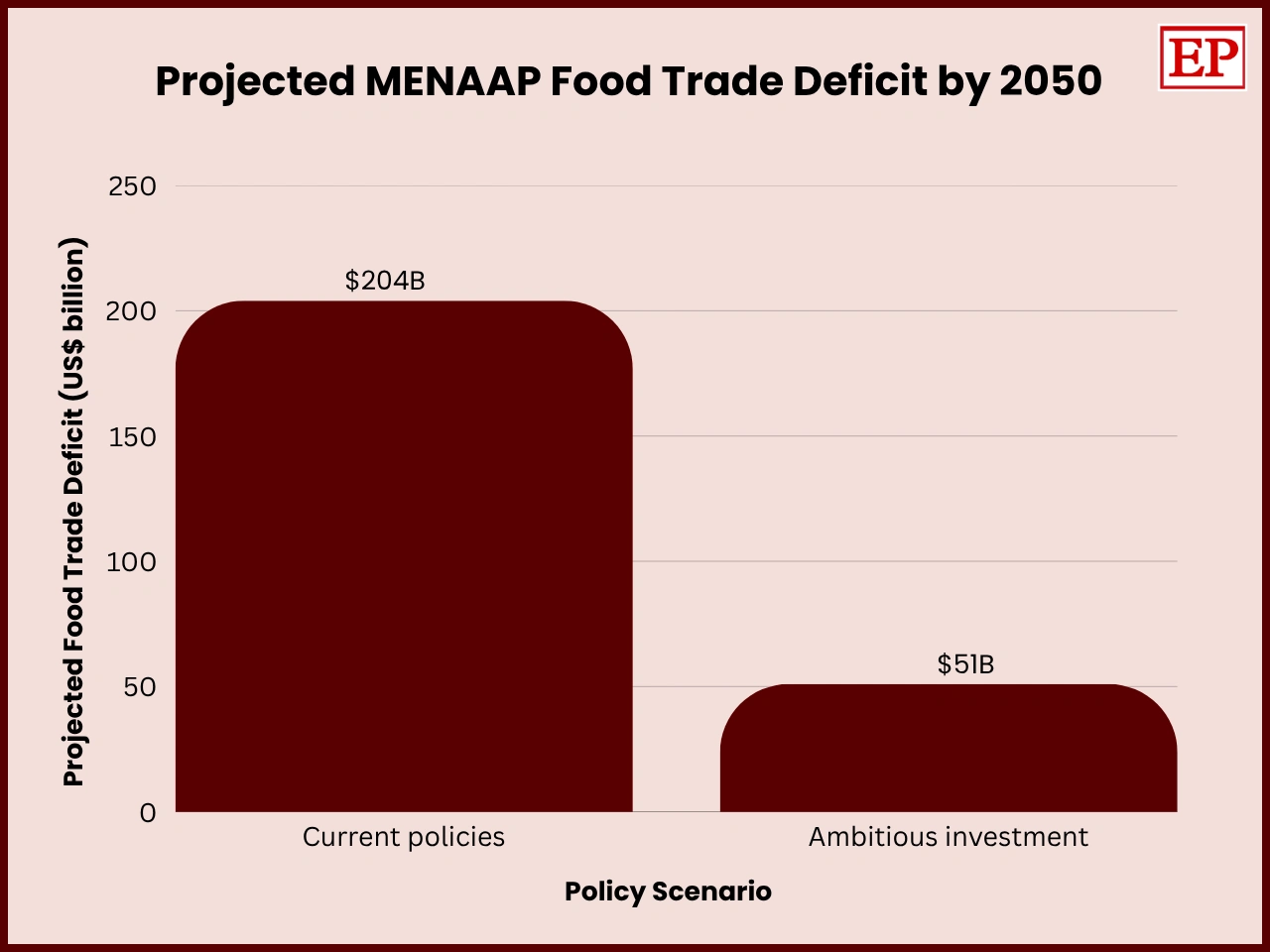
Looking ahead, a set of higher investments in the region's commodities could help: A larger volume of food trade surpluses for the region by 2050 would be US$177 billion, and sound agrifood investment could cut it by about US$153 billion. Export-driven production, in particular of fruit and vegetables, could bring US$110 billion to US$130 billion in net foreign-exchange income.