WTO Report 2026: Reforming Global Trade Regulations
After 80 years of shared trade regulations, the WTO questions what may happen if the rules fail to resist the erosion. The World Trade Report 2026, launched on 15 September, reveals that a reinforced multilateral system could raise the world gross domestic product (GDP) by 3 percent, or about 3 trillion US dollars, by 2050, while the dissolution of the rules can slash the output by up to 10 percent. The report is the WTO Secretariat’s flagship study on international trade that takes stock of the past 80 years of trade rules.
Three Visions on World Trade
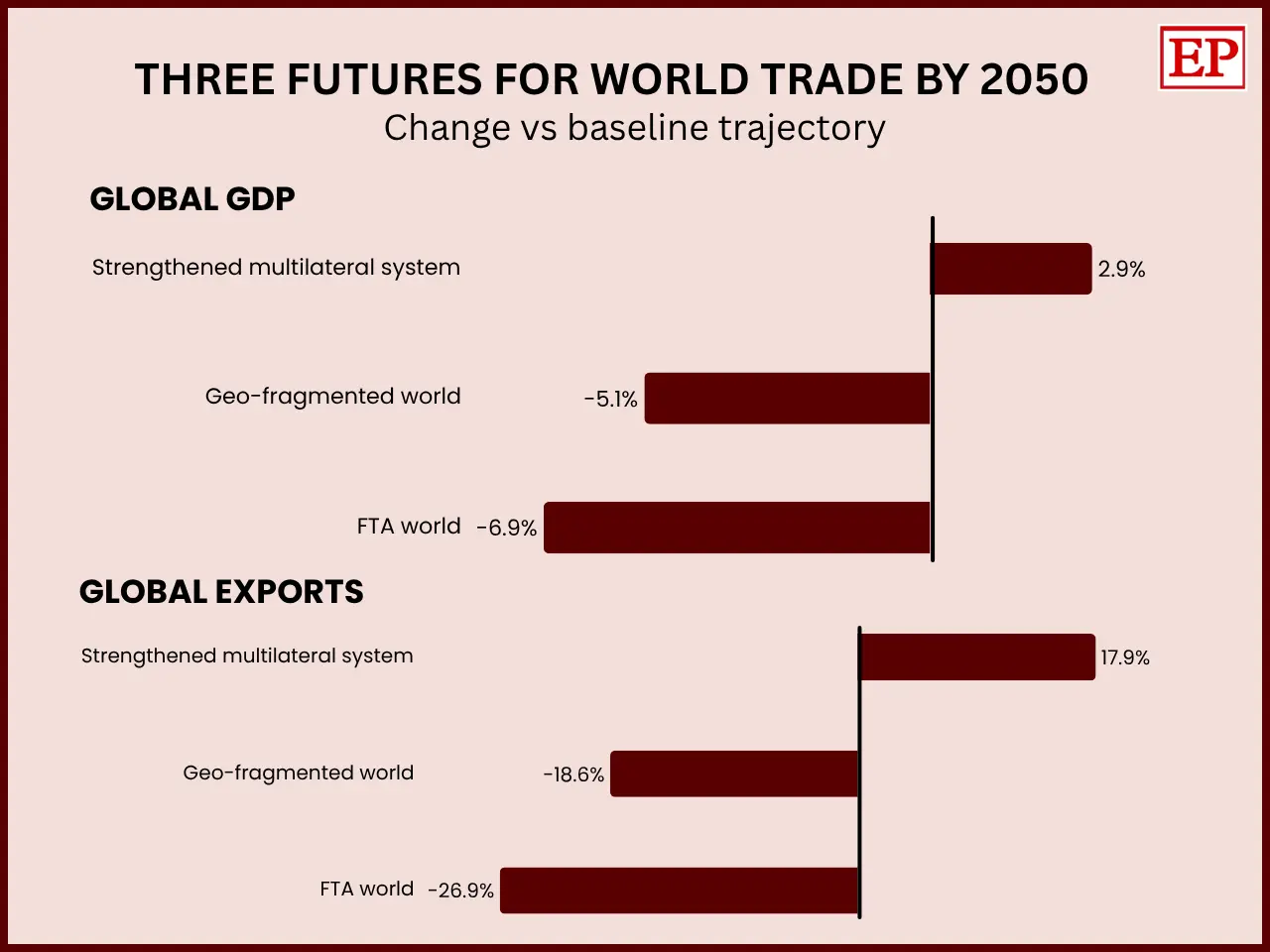
The report assesses three possible paths of world trade to 2050 against the “business as usual” scenario. In the first case, the world trade rules are reformed to make the multilateral system more resilient. It implies deeper market opening commitments, new regulations on digital trade and services, a larger number of members, and a balanced approach to security and free trade. As a result, the world GDP is projected to grow by 2.9 percent and the global trade volume to rise by 17.9 percent.
The other two scenarios show how world trade would evolve if the multinational rules were progressively dismantled. The “geo-fractured world” scenario forecasts a 5.1 percent fall in the world GDP and an 18.6 percent decrease in world trade volume. In the “free trade agreement world” scenario, world trade is split into numerous regional blocs with preferential agreements. Under this view, the world GDP is projected to fall by 6.9 percent, and the world trade volume to decline by 26.9 percent. Compared to a “business as usual” scenario, a unilateral approach can yield a loss of 5 to 10 percent of the world’s real GDP, depending on the case.
Who will receive more benefits?
The benefits may be substantial for the least-developed countries (LDCs). Constituting less than 1 percent of world trade today, their GDP could rise by 7.7 percent under the strengthened scenario as a result of reduced tariffs and other trade costs. The report also finds that high-income economies could benefit significantly (about US$1.7 trillion in additional GDP, in 2023 prices) from expanded access to cheaper trade in services.
The report cites historical evidence of the rules-based trade system's contribution to a "near 50-fold increase in global trade flows over the past eight decades." It cites increased trade among members, greater resilience in times of economic crisis, and a peace-building role as factors. Ngozi Okonjo-Iweala, director-general of the WTO, observes that roughly 72 percent of world merchandise trade takes place on a most-favored-nation basis." The report identifies several factors likely to have contributed to the current challenges to the multilateral trading system, including its own success," it says. As trade expanded, it became more difficult to agree on further expansion. The report lists four areas of confluence contributing to the situation: shifting power dynamics in the international economic and trade order; increased government involvement in trade, including industrial policies and level-playing-field issues; changes in the nature of trade, including the impact of digitization, global supply chains, and environmental transformation; and heightened geopolitical tensions.
The report does not provide a recipe for reforming the WTO. It does identify areas in which the rules may need to evolve, and it provides a reminder that defending the benefits of the system is not synonymous with defending the status quo. The challenge for members is to update rules-based cooperation for a more integrated, multipolar, and diverse economy while at the same time maintaining openness, predictability, and equity.
Speaking at the launch of the report at the Public Forum, Okonjo-Iweala said that the system has been repaired and refreshed before, so it can happen again. 'Let's not be fearful,' she said. WTO Chief Economist Robert Staiger shared his research before taking part in a panel discussion with ambassadors, scholars, and a senior official of the International Chamber of Commerce.
The bottom line for business, government, and consumers is that trade rules are not an unnecessary distraction. According to the report's modelling, the choice between renewing them and letting them go would be worth trillions of dollars, and the biggest percentage gains could be the countries that traded the least.