Southeast Asia’s Rise Offers Lessons for the Rest of the World
Southeast Asia is poised to become a significant economic force. The 11 ASEAN economies form a $4.5 trillion economic region, being “the world’s fourth largest economy.” This region, with a population of 700 million people growing by more than 4.5 percent a year, is one of the fastest-growing economic regions in the world. Southeast Asia is becoming an increasingly popular location for manufacturing by multinational companies.
Automakers, manufacturers of chips and electronics, are increasing their presence in Southeast Asia, making it one of the major manufacturing hubs of the global supply chain. Foreign investments in the region (2025) amounted to 244 billion (up 10% from the previous year in 2025), while investments in manufacturing increased by almost 50%. This proves the confidence of investors in the alternative to China as a world manufacturing center. Yet, its integration into the global economy comes at a cost. ASEAN is highly integrated into the global economy but less so with its neighbors.
A Global Trading Power with a Missing Regional Market
Only around 22 percent of ASEAN exports go to fellow ASEAN members compared to 61 percent within the European Union. The difference is significant considering the ASEAN region has some of the most liberalized economies in the region. Despite the region’s openness, there is less trade with neighbors.
What moves across ASEAN borders are intermediate goods, which are inputs used in the production process before being sold as finished goods to other countries. This reflects a global production network in which ASEAN plays a key role, but not one dominated by a shared market for goods. The IMF’s accompanying “Missing Market” analysis highlights the vulnerability of the ASEAN economies. ASEAN has created shared production lines but not shared markets. This leaves the region exposed to a slowdown in demand from outside the region. The challenge for ASEAN is therefore to capture more value from the economic activity taking place within its borders.
The Home Advantage Could Become ASEAN’s Next Growth Engine
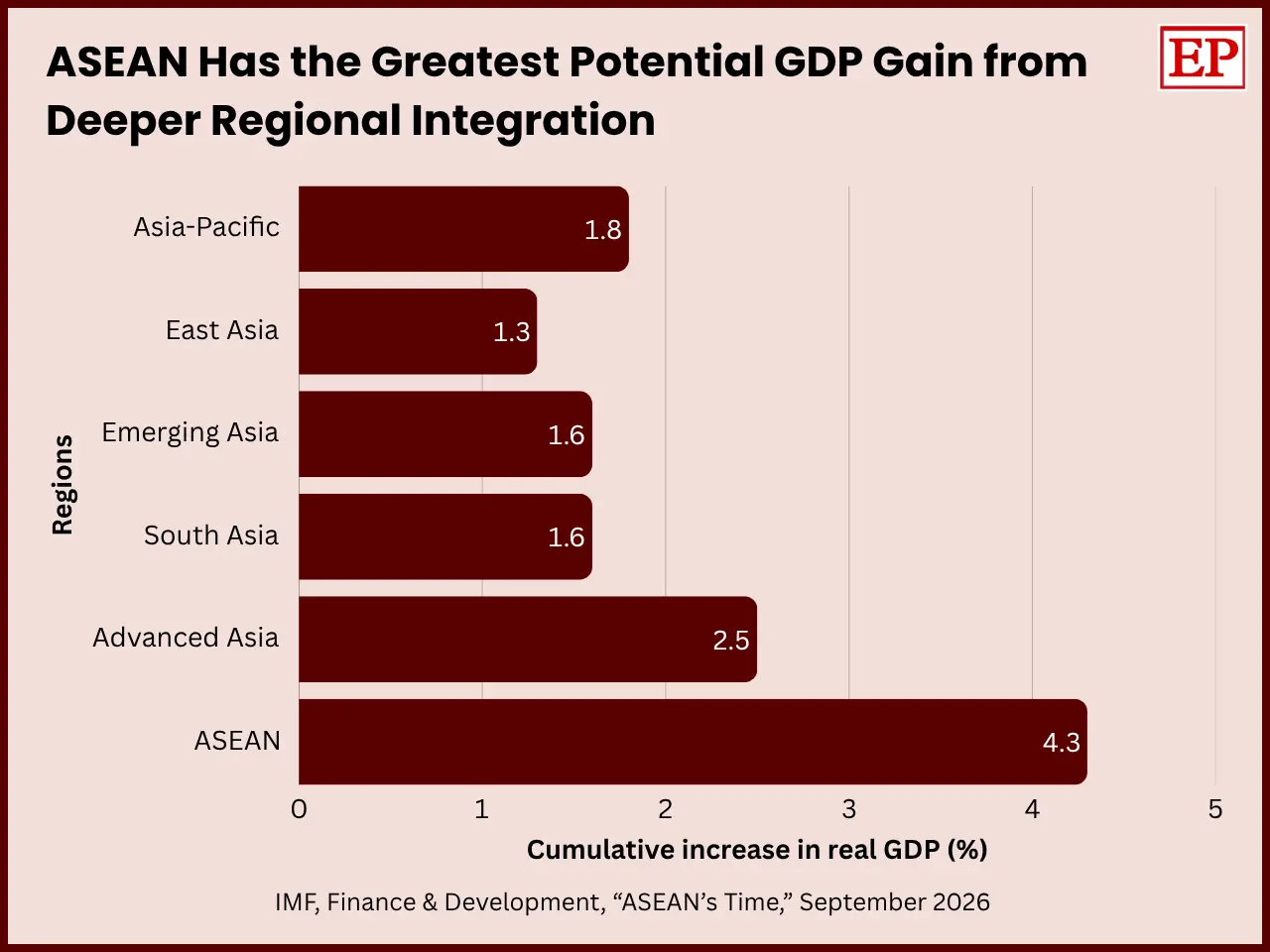
ASEAN’s limited internal trade also represents an opportunity. The IMF estimates that removing nontariff barriers would boost ASEAN’s output by 4.3 percent over the long term, which would add more than one-third of Malaysia’s economy. This opportunity can be harnessed by enhancing regional integration.
The “Home Advantage” analysis shows that the potential gains from greater integration extend beyond Southeast Asia and into Asia more broadly. However, ASEAN has the largest estimated cumulative increase in real GDP among the regions shown in the analysis. With the global trade environment becoming increasingly uncertain, increasing regional integration would provide Southeast Asia with a buffer against external shocks.
The task of ASEAN is therefore to use the economic growth to improve its position in the world economy. Southeast Asia has already attracted a lot of investments, developed its manufacturing industry, and increased its role in world trade. The next opportunity lies closer to home, turning a global production network into a deeper and more integrated regional market. With a $4.5 trillion economy and a population of 700 million, ASEAN has the scale and scope to become a powerful economic growth engine.