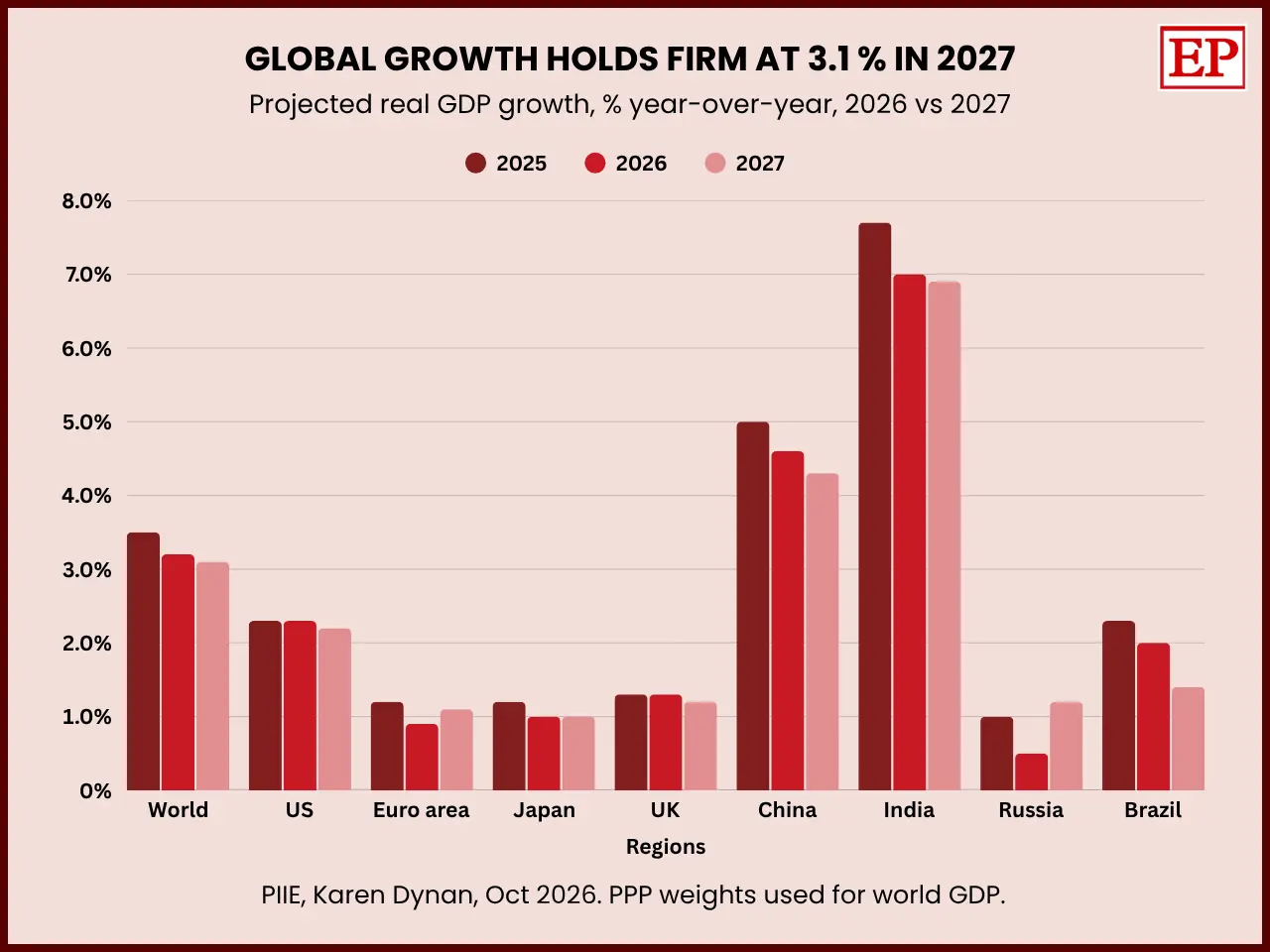
The world's economy may be taking a hit, but it doesn't seem to be breaking. Even with a war in Iran driving up energy prices and pushing up interest rates, the world economy keeps on growing. The Peterson Institute for International Economics (PIIE) forecasts that the world economy will grow by 3.2 percent in 2026 and 3.1 percent in 2027, compared to 3.5 percent in 2025, says an economist named Karen Dynan in a lecture at PIIE's Fall 2026 Global Economic Prospects.
How the AI Boom Is Softening the Blow
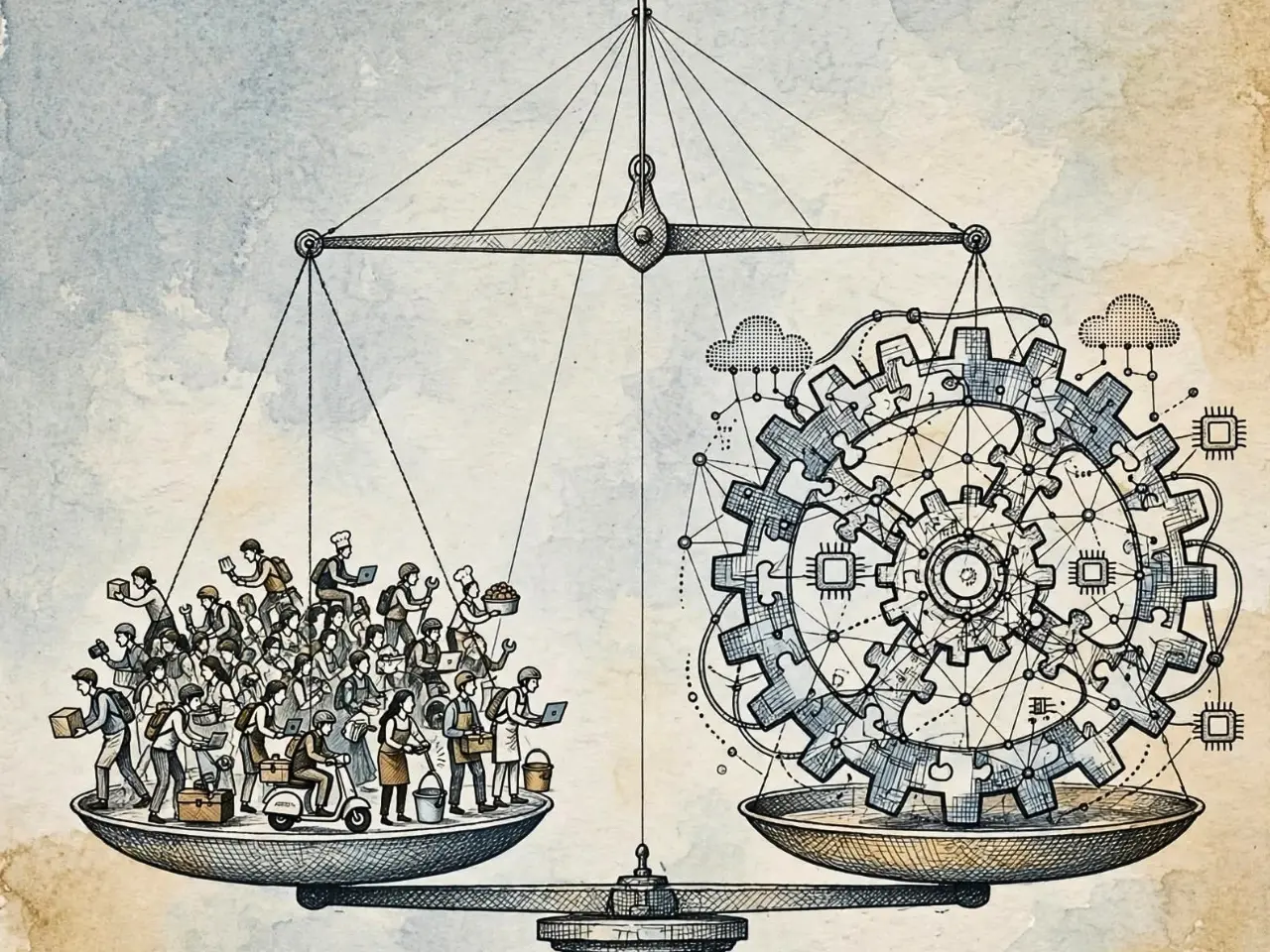
Imagine an economic shock absorber. That’s what the AI boom is proving to be in several countries. Companies are pouring money into AI-related technology, and stock prices are soaring. The combination of the two serves as a boost to overall spending and helps the economy, even as the price of fuel weighs it down. In some countries, government policies are also spurring the economy.
The US stands to benefit the most. PIIE expects 2.3% growth in 2026 and a slight slowdown to 2.2% in 2027, nonetheless. The UK is experiencing a similar pattern, where technology-related investments are buffering the energy shock, contributing to 1.3% growth in 2026 and 1.2% in 2027. The key risk on the growth trajectory is inflation. Higher interest rates will hurt growth next year, which should prove to be moderated by the gradual easing of energy prices.
Europe and Japan: Modest Growth, Divergent Sources
In the eurozone, growth is expected to accelerate in the coming years, driven by a recovery in Germany and falling energy prices, to 0.9% and 1.1% in 2026 and 2027, respectively. While the growth rates may seem tame, they represent a welcome relief after two consecutive years of disappointment.
Japan is expected to post a solid performance, with growth of 1.0% in each of the next two years, well above its long-term potential. Strong semiconductor exports and a fiscal stimulus package will be key growth drivers. Besides advanced economies, there are other countries that have a mixed performance outlook. India is expected to grow faster, mainly because of its huge domestic market. India, for the present, already has for 2026 and 2027 a GDP growth forecast of 7.0% and 6.9%, respectively, and more than double compared to the world average. Conversely, China is in the opposite situation, where most sectors are terribly oversaturated while the real estate sector crisis is eating away at domestic demand. China's growth forecast estimates are significantly lower at 5%, 4.6%, and 4.3%.
Russia is limited by sanctions and tighter monetary policy. Growth is expected to pick up slightly in 2026 to 0.5 percent and then accelerate to 1.2 percent in 2027. Brazil has seen an increase in commodity prices, but growth is expected to slow down from 2.0 to 1.4 percent as this year’s fiscal impulse fades away and persisting high interest rates persist.
The bottom line is that the world economy is growing, but unevenly: the rise in AI investments and domestic demand has offset some headwinds, namely higher energy prices and interest rates and China's, Russia's, and Brazil's structural challenges. The evolution of energy prices and interest rates will be decisive for the strength of growth in 2027.