Anti-Avoidance Measures Start Changing Corporate Tax Behavior
Governments have been in a race to attract foreign multinationals by cutting corporate tax rates, while international businesses have circumvented them by transferring profits around the world. However, more stringent anti-avoidance measures and significant international tax reforms are coming to change this scenario, according to a recently published International Monetary Fund (IMF) analysis.
As globalization and technology create an increasing role of intangible assets, such as data, patents, software, and trademarks, multinational corporations can decouple the location of profits from the countries in which they are reported. As a result, profits can be reported in lower-tax locations, even though significant economic activity is taking place elsewhere.
The IMF finds that reported profits have become less sensitive to differences in tax rates, while real investment has become more sensitive. Thus, reported earnings tend to reflect the location of economic activity. The concentration has been especially marked in multinational companies, which tend to have a lower proportion of intangible assets and in countries with more rigorous anti-avoidance rules. At the same time, competition on headline tax rates for multinationals has decreased since the mid-2010s, and this also coincides with a period of enhanced measures to counteract tax avoidance.
Tax competition continues to exert its influence, but the economic costs matter
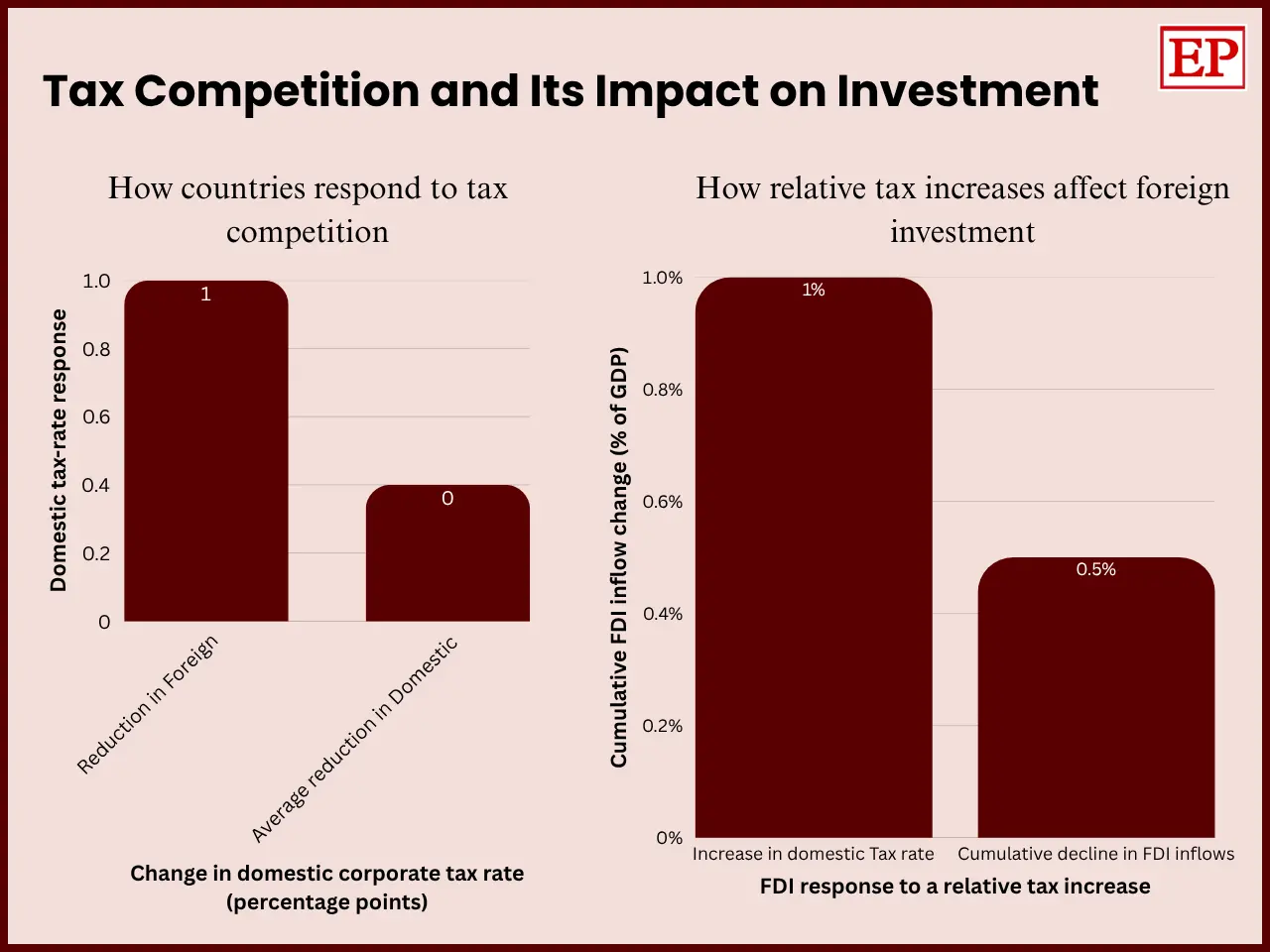
Despite these developments, tax competition continues to be an important factor in government policy. Firms based in different economies continue to adapt their corporate tax rates in response to actions by other economies. The IMF calculates that a one-percentage-point decrease in headline corporate tax rates elsewhere, on average, would result in a 0.4-percentage point decrease in domestic tax rates.
Tax decisions can also exert their influence on international investment flows. A one percentage point increase in the corporate income tax rate compared to other countries leads to a decrease in foreign direct investment flows by about 0.5% of GDP during three years, the IMF analysis estimates.
But cutting taxes is not guaranteed to deliver enduring gains. Tax cuts that are financed by extra government borrowing can raise real interest rates across economies and restrict investment expansion. In addition, if competing countries respond with their own tax cuts, the gains for the initial country can be eroded, says the IMF report.
Stronger Tax Rules Could Protect the Public Investments
The implications of this are far greater than just a game between large multinational companies and the state's tax revenues. These revenues pay for many things; roads, education, the healthcare system, and various types of investment in the economy that are critical to its development. Tax competition can lead to dilemmas for states in their budgets because they have to find a balance between cutting spending, raising other taxes, and going into debt.
Particularly in developing countries and emerging markets, the share of corporate profit taxes in total state revenues is significant, meaning that they need it to finance many critical areas of the economy. At the same time, it is necessary to consider other factors, such as the attraction of real investments, their implementation, and the development and introduction of innovations. In the context of high-tech technologies and the high mobility of capital, maintaining and developing the economy requires attracting investments with their further implementation in production. The challenge for states is to develop methods to attract investments without losing a significant share of revenues and opportunities for their own development. The fight against tax avoidance gives the state an opportunity to ensure that profits correspond to real revenues in the form of profits and expand the fiscal space for economic development.