How did Switzerland manage to make the world's densest public transport network with 70 percent of the nation being mountainous?
Switzerland does not offer convenient conditions for the creation of an expansive public transportation system. Because the nation is comprised of approximately 70 percent mountains, building a system seemed impossible. However, the Swiss managed to build an extensive system of railways, bus routes, and water transport all synchronized together under one schedule.
This feat is not only the result of the resources of mountains but also the result of overcoming such obstacles during transportation. Although it may not seem like it, Swiss public transport is not only an example of engineering mastery but also a bold endeavor to overcome the restrictions of their geography.
Turning the Limitations into the Goalposts
In 1871, Switzerland became the first European country to develop a mountain railway. In 1882, the first Gotthard tunnel was completed, which extended through the Alps and provided access to the European market. However, the success of the Swiss engineers was not limited to the first Gotthard tunnel. The motivation for the construction of the rail was not only the pride of the nation and the bragging rights among the European powers but also the economic benefits.
With electricity obtained in dams, Swiss engineers have managed to electrify the national rail system, which became fully renewable. The Stoosbahn funicular was also built in similar conditions, using rotating capsules to allow the citizens of the region to travel up the nearly 50-degree slope.
Innovation Beyond the Rails
Switzerland is set to revolutionize transportation with innovative solutions beyond the tracks. To decarbonize transport by 2035, PostBus, a Swiss rail passenger company, has developed the project of more than 800 routes.
Meanwhile, on Lake Lucerne, a historic steamship is being converted to run on climate-neutral fuel produced with the help of sunlight. Innovative companies such as MobyFly have developed a solar-powered hydrofoil that uses up to 70 percent less energy than a conventional diesel ferry. Near the village of Buttes, a startup by the name of Sun-Ways pioneered a “solar railway,” in which photovoltaic panels are positioned along the railway track. Were the Swiss to fully exploit their rail tracks' photovoltaic potential, solar panels could supply 2 percent of the country’s electricity needs.
The Real Secret to the Swiss Mobility Model
Smart mobility is more than just fancy vehicles. Coordinated planning of transport routes plays a critical role, too. Many Swiss railroads, buses, ferries, and even cable cars are governed by the taktfahrplan (clock-face timetable). This high degree of coordination helps to explain why Switzerland’s public-transport passengers are so enthusiastic about the system that they buy more train tickets per person than any other European country.
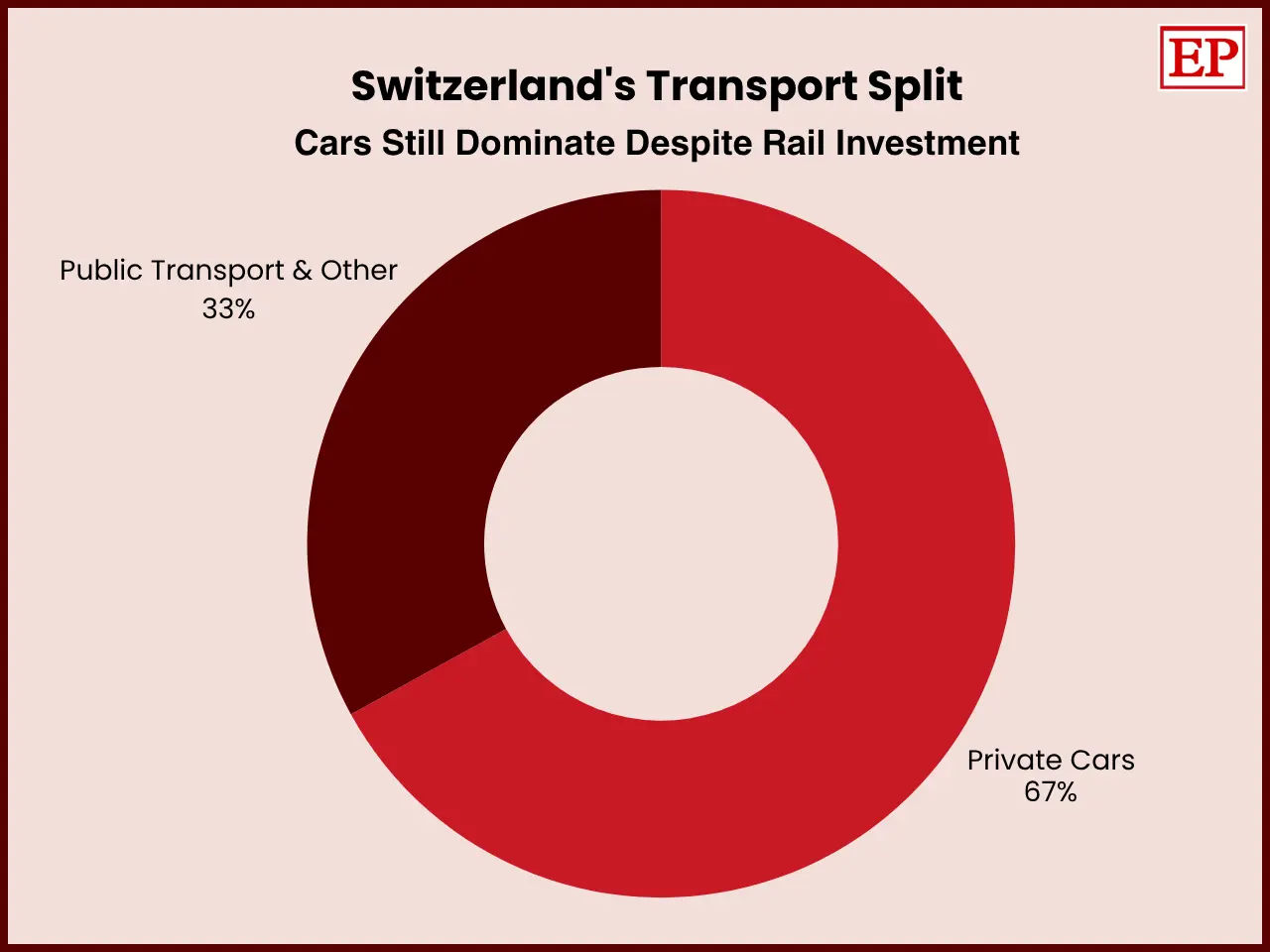
Nevertheless, the Swiss mobility model has its weaknesses. For instance, currently, 67 percent of all transportation in the country is done by private cars, which are heavily subsidized. After the voters rejected the initiative to develop the motorway network in Switzerland in 2024, the new coalition government drew up a transport strategy for 2045, which cancels more than 30 road-project contracts and allocates 24 billion francs to railways. Other countries, which are aiming to follow the example of Switzerland, should bear in mind that the Swiss prefer a public-transport system, in which various types of transport are combined into an integral system in a coordinated manner.
Unlike in other countries, Switzerland’s railways and buses are not separate entities that compete with one another but rather form a cohesive whole managed by more than 250 different transport companies. This degree of organizational compatibility is challenging to achieve, but it may well be the most important lesson to be learned from the mobility model in Switzerland.