A Growing Footprint With Two Faces
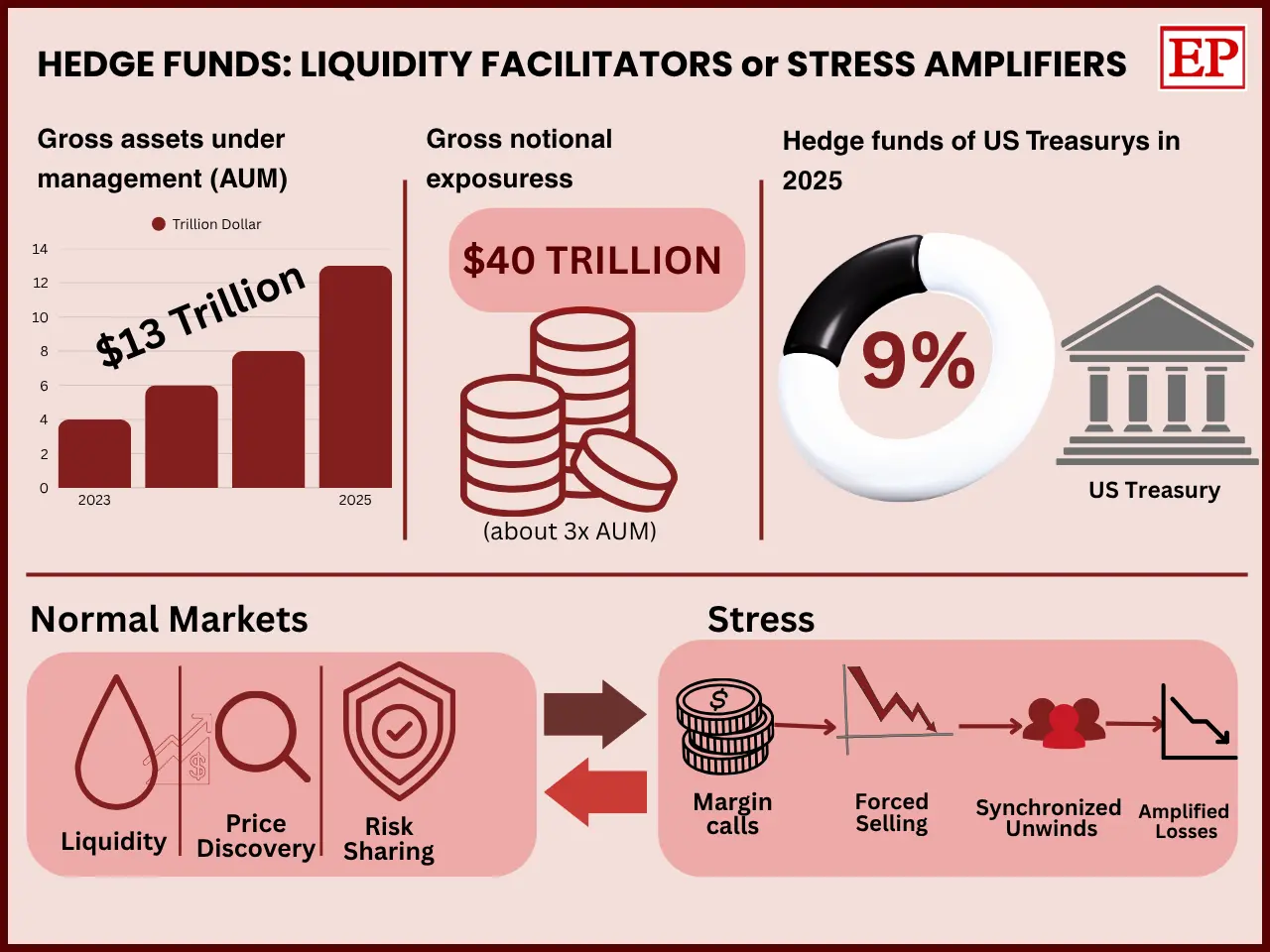
Hedge funds currently make up a relatively small part of the non-bank finance sector but have grown significantly in size. The gross assets of the sector tripled from 2013 to the present, to almost $13 trillion. The overall amount of the hedge funds’ exposure, taking into account on-balance-sheet assets and off-balance-sheet obligations, is in the neighborhood of $40 trillion. The role of hedge funds can be distinctly seen in the cases of government debt, where they owned around 9% of US debt in 2025. Hedge funds have fewer restrictions on operations than banks and traditional asset management firms. They can purchase hard-to-sell assets, use significant leverage, and adjust portfolios within a short time. In normal times, hedge fund activity helps restore market liquidity and price discovery; however, in cases where the economic conditions worsen, the same flexibility may prove to be destructive. As per the authors of the chapter published in the GFSR of October 2026, there are three major weaknesses: leverage, overcrowded positions, and investor redemptions.
How Stress Builds and Spreads
Borrowing plays a key role in numerous methods, through practices such as repurchase agreements or derivative transactions. Higher collateral requirements may arise in times of increased volatility or financial limitations. As a result, funds will pull their investments at a time when demand for their stock is low, going from liquidity suppliers to the source of pressure selling.
The risk intensifies if several funds make the same trade and the investors withdraw their cash quickly after losing money. If one fund loses money, other funds may follow it almost instantly, as any losses lead to a drop in prices. Results obtained during periods of market instability show the effect of the spikes in VIX. Stocks most commonly held by hedge funds exhibit volatility that is equal to 10% as compared to the least commonly held stocks, while the maximum drop reaches 4%. The US Treasury market follows the same trend. During the time when there are no disturbances, funds use borrowed money to engage in “basis trades” that help them take advantage of minor discrepancies in prices of Treasuries and similar derivatives, thus guaranteeing the unification of the prices and the liquidity of the market. Yet, if the cost of borrowing increases, funds might be influenced to close such positions drastically, which will worsen the situation in terms of liquidity and lead to a stronger extent of dislocation.
Stress can move. Prime brokers, which are the major investment banks assisting and lending money to hedge funds, can incur losses and therefore lend even less during the periods of trouble on the market. Overall, when risk appetite declines globally, the markets with more hedge funds are likely to show greater losses, especially those with lower liquidity.
Building Durability Through Smarter Policy
The authors state that in order for regulators to be able to manage issues, first they need an understanding of where vulnerabilities are located and how they interact with each other during downturns. They note that in most cases authorities do not possess enough information concerning leverage, derivative positions, prime broker relations, and cross-border activities, and thus improved reporting and information sharing are essential.
They emphasize that tools should be used in accordance with what kind of risk is present. If the danger includes many funds trying to deleverage at once, then it might be better to use systemic measures like minimum margins and haircuts, as well as more efficient collateral management. If the threats are, however, concentrated on one firm or exposed to a specific risk, then instead of applying systemic methods, focused measures should be employed, including risk-based leverage limits, additional requirements for minimum margin and capital, and limits on maximum exposure.
Regulators should also make sure prime brokers monitor their relationships with highly leveraged funds and manage counterparty risk efficiently. The results of systemic stress tests may provide insight into how potential hedge funds and counterparties are likely to behave in a stress environment and how the stress might be transmitted among them.