Global Aid Drops Again, and Health Programs Take the Toughest Hit
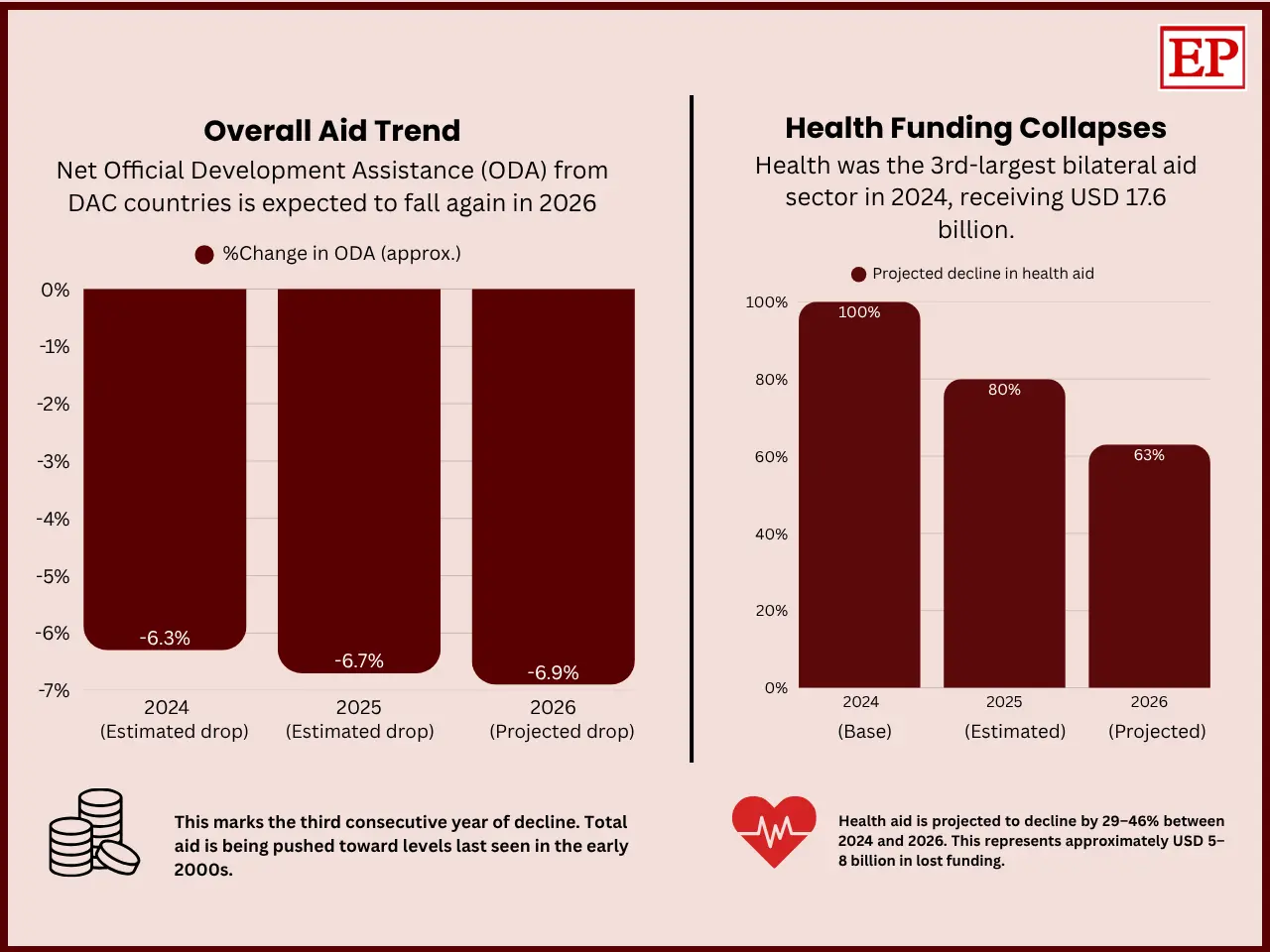
The new OECD report points toward another year of decreasing foreign aid, with health initiatives suffering the most from the cuts. According to the research, net official development assistance provided by the countries from DAC (Development Assistance Committee) is expected to fall by another 6.9% in 2026, which is driven by major donors’ cuts. In 2025, there was a big decline as well; thus, the foreign aid sector is now in its third year of decline, pushing total aid to the levels of the beginning of the 2000s.
Health Funding Collapses to Two-Decade Lows
Health has traditionally been a major group of bilateral aid and was number three for the volume of funds in 2024 (USD 17.6 billion), following humanitarian aid only and aid for government/civil society. However, that position is now declining quickly. The projection for the years from 2024 to 2026 is that health aid will decline by 29-46%, which stands for about USD 5-8 billion and will thus be at 63% under the peak level of 2022. Furthermore, the decline is predicted to be lasting, as the pledges of major donors for multi-year reductions till 2028 already exist.
Multilateral institutions are expected to bring change despite governments receding from their positions. Funds allocated through these institutions are expected to drop again by 3.4% in 2026, which will make it the third year of decline and the second longest setback in the history of multilateral relief. Meanwhile, basic funds allocated to UN agencies are going to decline by around 31% as compared to 2024 figures.
Disease Programs and Vulnerable Regions Face the Sharpest Losses
The budget cuts do not impact different sectors of health spending equally. The biggest reductions will be experienced in the sector of reproductive health and services for reproduction and population, including HIV and other sexually transmitted disease funds, which may be cut by up to 54.1% by 2026 as compared to 2024. A similar situation refers to infectious diseases: funding for malaria prevention, tuberculosis, and other infectious diseases may be reduced by up to 59.6%, 57.2%, and 40.4%, respectively. There are cuts that will also be made in the area connected with readiness for outbreaks, as expenditures on water and sanitation systems that serve as a basis for epidemic readiness may reach a 22.3% decrease between 2024 and 2026.
With regard to geography, the most suffering countries are those that lack any resources to resist the crisis. As a result, bilateral funding for the least developed countries and sub-Saharan Africa regions of the world will decrease by 10.9% and 11.6%, respectively, in 2026, which will result in losses suffered by these regions in 2025. It is particularly difficult for these countries to deal with a cutback in funding when most of their donors also cut funding to these regions at the same time.
Why It Matters
The timing of the cuts in funding is especially shocking given the existing global health pressures at this moment. Advocacy groups have observed that these cuts are occurring at the same time when countries are dealing with active epidemics such as Ebola and the general economic stress coming from the rising food and energy prices. Health experts quoted in the coverage of the forecasts predict that the funding instability in programs like the US President’s Emergency Plan for AIDS Relief will result in a significant increase in HIV incidence and mortality rates by 2030. Moreover, serious disruption in maternal care, vaccination campaigns, and disease surveillance already pointed out by WHO is anticipated.
The OECD’s report emphasizes that this is a crucial moment in history, as the diminishing amount of funding needs to cover more acute crises and make a decision on the allocation of limited resources and coordination among the sponsors.