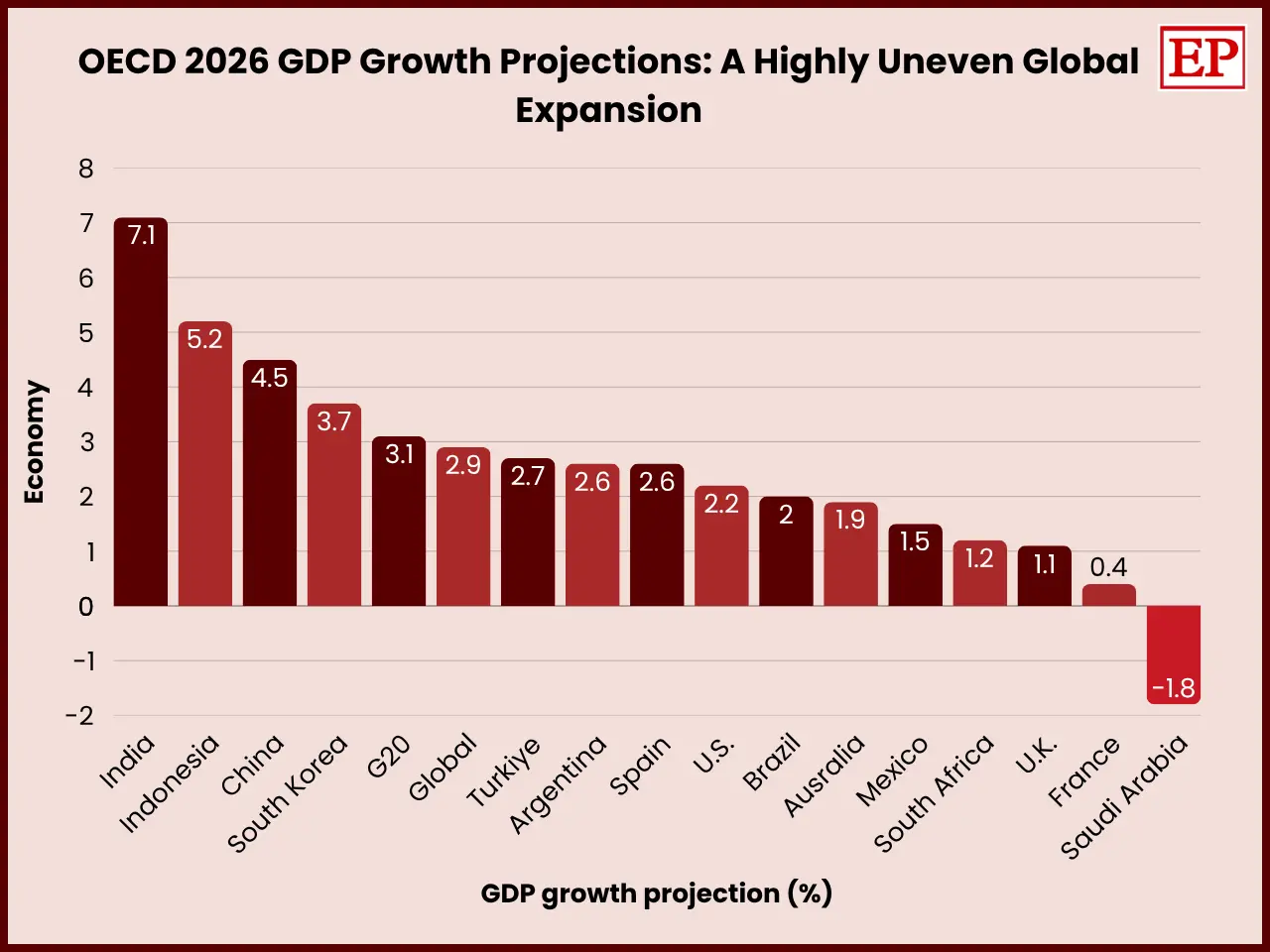

India’s drop from 4th to 6th rank in the global GDP rankings has sparked uproar, as was expected, among economists, policymakers, and the public at large. At first glance such a decline might suggest a slowdown in the economy. But a closer look reveals that the shift is more due to technical and external factors than a worsening of India’s economic fundamentals. According to the latest IMF estimates, India's nominal GDP is estimated at about $4.15 trillion, the United States at almost $32.38 trillion, China at $20.85 trillion, Germany at $5.45 trillion, Japan at $4.38 trillion, and the United Kingdom at $4.26 trillion. But this change in ranking does not prevent India from being one of the fastest-growing big economies in the world, with real GDP growth pegged at around 6.2% to 6.5% in recent years.
Why Did India Slip from 4th to 6th Position?
The fall in the value of the Indian rupee against the US dollar is one of the main reasons for this decline. The world’s GDP rankings are typically reported as nominal GDP, in US dollars. So, a falling rupee means the dollar value of India’s GDP goes down even if its economy is growing strongly in local currency terms. The Indian rupee weakened from around 85 per dollar in 2025 to over 90 now. As a result, India's GDP appeared smaller when converted into dollars, negatively affecting its international ranking. But if the same situation occurs to China, this may not be the case. As India is primarily an import economy, when the rupee depreciates, most of the country’s capital flows outside, and that reduces the nominal value of the country. But in the case of China, it is an export economy where a currency depreciation would create a demand for their goods and thereby increase their GDP.
A major factor was the revision of the base year for India’s GDP. In 2026, the base year for the calculation of the GDP was changed from 2011-12 to 2022-23 to better reflect the current structure of the economy. These updates are a routine statistical practice and help to ensure the accuracy of economic measurement. But the new methodology reduced the estimate of India’s nominal GDP by around 3% from earlier estimates. This was not a real slowdown of economic activity, but it helped lower India’s rank in international comparisons. The performance of other big economies was also remarkable. Japan and the United Kingdom, for example, saw the dollar value of their economies increase due to the relatively stronger currencies and favorable economic conditions. For example, Japan and the UK's GDP stood at $4.38 trillion and $4.26 trillion, respectively, and both these countries retained their position ahead of India in nominal dollar terms. This means that global GDP rankings are not only affected by economic growth but also by fluctuations in exchange rates, inflation trends, and international financial conditions. In other words, a country can grow faster in real terms and still drop in rank if its currency weakens sharply against the dollar.
Importantly, India’s drop in the ranking should not be taken as a sign of economic fragility. The country continues to achieve one of the highest growth rates globally, driven by robust domestic consumption, increasing infrastructure investment, fast digitalization, and ongoing economic reforms. Manufacturing, technology, financial services, and renewable energy sectors continue to attract significant domestic and foreign investment. Long-term growth prospects are also boosted by the country's 1.4 billion people, rising middle class, and growing integration into global supply chains. India remains a force to be reckoned with, with a nominal gross domestic product of around $4.15 trillion, and should move up the rank again if growth remains robust and the rupee stabilizes. At the same time, the shift in ranking is a reminder that size in economic terms alone does not make a nation prosperous. “Policymakers have to continue to focus on improving productivity, generation of employment, education, healthcare, and development of infrastructure. It will be important to strengthen competitiveness in manufacturing, enhance human capital and innovation, and maintain macroeconomic stability to support growth and enhance living standards. Besides, measures to stabilize the rupee and make exports more competitive can cushion the impact of changes in exchange rates on future GDP rankings. If India maintains a real growth rate of around 6% or more while improving productivity and exports, it can strengthen both its global ranking and domestic economic resilience.
Overall, it can be concluded that India's move from the predicted 4th rank to the 6th rank on the basis of global GDP rankings is mainly due to devaluation of currency, base year change in GDP, and the relative performance of other major countries. This move is not an indication of any weakness in the Indian economy but rather shows that relying on nominal GDP ranking as the indicator of success may not be the best option. With high growth capabilities and undergoing reforms, India is poised to return to its rightful ranks in the future.