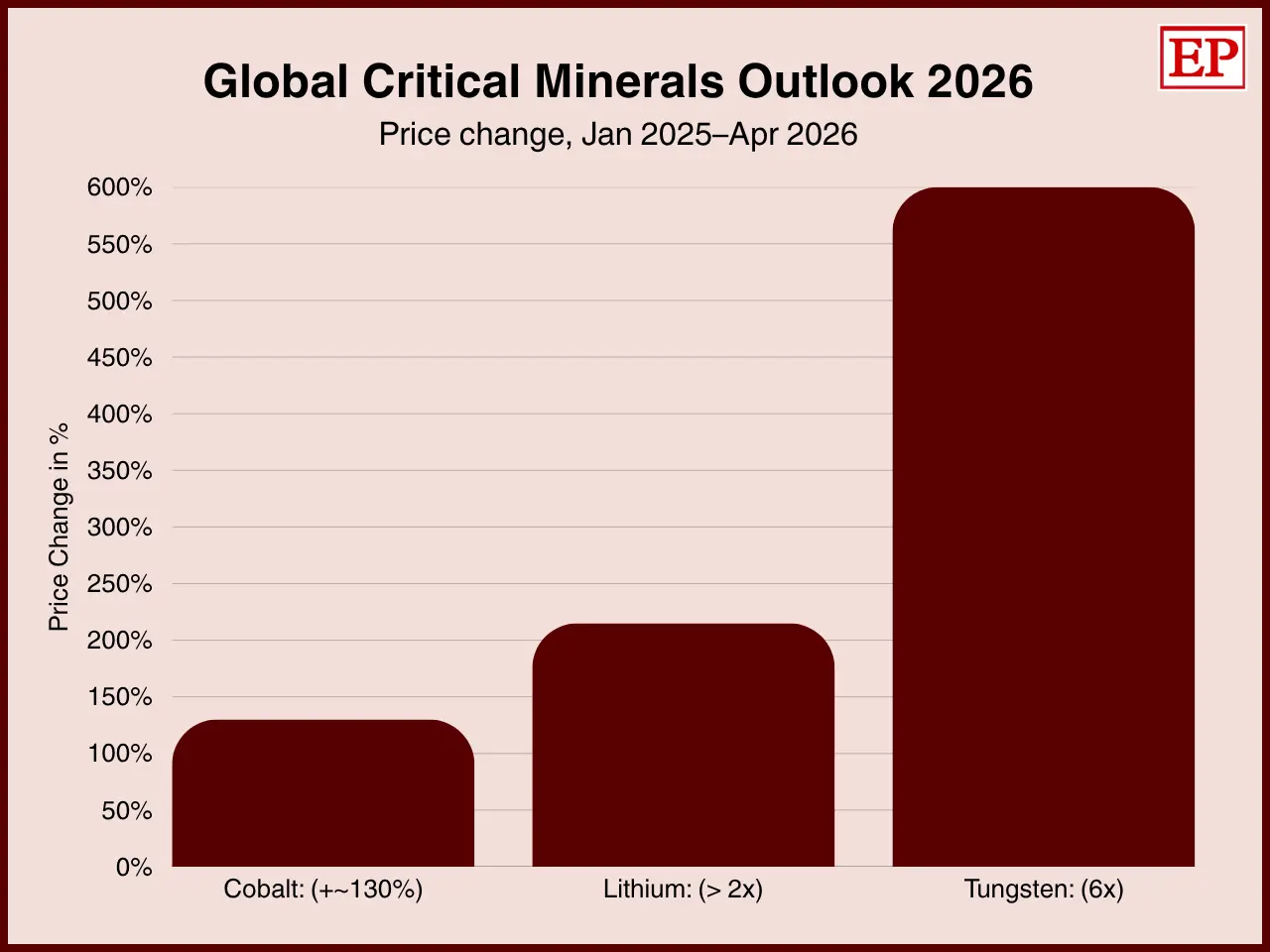
Key metal prices rally as trade curbs present real risk of supply squeezes. Critical materials that go into batteries, magnets, chip wafers, and weapons have been pulled back from multi-year lows and saw significant bounces. Aluminum, copper, and tin, all base metals, posted gains greater than 30 percent from Jan 2025 to April, and copper gained about 20% from the beginning of the year to set a record high for the commodity in April, the IEA stated in the Global Critical Minerals Outlook 2026.
Battery metals ran even faster. Lithium jumped more than doubling on strong demand from energy storage, and cobalt more than doubled after one producer, the Democratic Republic of Congo, added export quotas. In even thinner markets powering the AI, robotics, and defense sectors, strategic minor minerals gallium, tungsten, and germanium's prices more than doubled, and for tungsten, six times.
2025: The Year Risk Came Home
For decades analysts predicted it was only a question of time before the handful of countries involved in mineral processing became a threat. In 2025, they did. When Chinese export bans on seven rare earths in January 2025 hit automakers’ assembly lines with delays and shutdowns, some predicted chaos. The IEA estimates that when restrictions were widened before being lifted in October this year, prior to their suspension until November 2026, some $6.5 trillion of downstream production outside of China was at risk, from autos and tech to defense and energy.
A similar impact rippled through the battery sector as China introduced cathode and anode restrictions, putting a complete supply chain collapse at risk of $300 billion in downstream output. At the same time, the already stark concentration of processing capacities was further increasing outside the complex and unique case of rare earths; the largest processing country's market share stood at an ever-higher 72% in 2025 (up from 70% in 2023).
The Solution: Diversify Supply. And go Latin American:
The report's solution, then, is not for countries to brace for impact. Instead, they should "make prudently proactive investments and increase diversity across mineral value chains." Shoring up the magnet supply chain, as one example, “would cost about $60 billion over ten years, a tiny insurance price tag for an economy otherwise susceptible to a new supply shock.” Governments are already willing: Public finance for critically important mining in advanced countries has reached $65 billion in 2025, four times the levels of the last year. Latin America and the Caribbean is an untapped opportunity; the region is the source for nearly 40% of the world’s mined copper and one-quarter of its lithium but refines only “around one-fifth of its minerals.” The IEA figures if the region simply “processed all its potential lithium, nickel, cobalt, graphite, rare earths, and copper, the value of the mineral sector could nearly double."
Rising to roughly $220 billion by 2035.” The region needs help building the financial infrastructure, power, water, and skills required to process minerals there, but it has the raw materials.