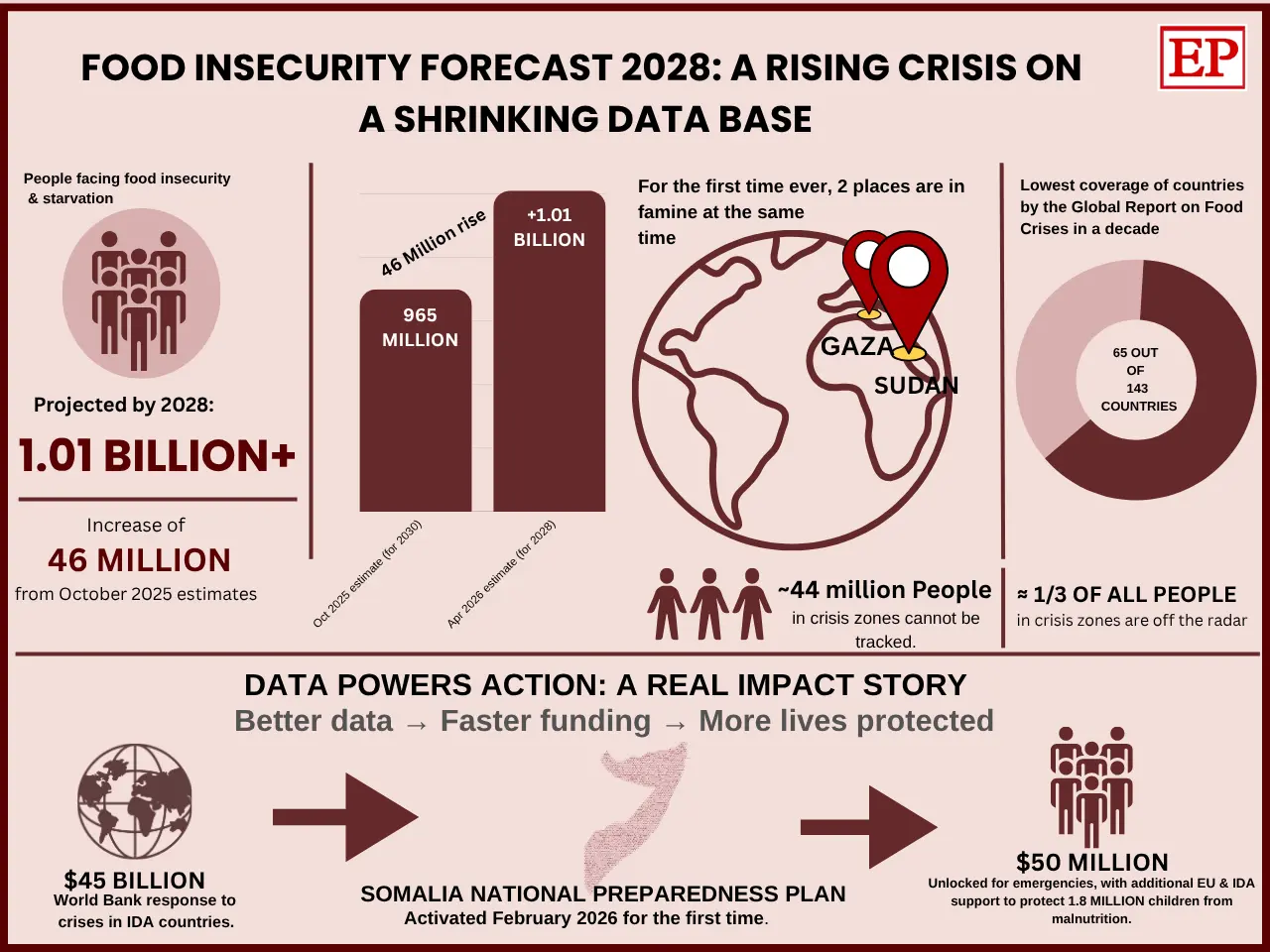
The re-emerged Middle Eastern conflict that began in February 2026 has increased prices of energy sources while causing global economic turmoil. In April 2026, the World Bank released an updated forecast about food security, which says that by 2028 over 1 billion people will be facing food insecurity and starvation. This is an increase of 46 million from last October's estimates about 2030. These estimates can be true only if the data used for creating them is reliable, but unfortunately the situation keeps getting worse.
A Forecast Built on Crumbling Base
For the first time in the history of tracking food crises, two locations in the world are suffering from famine at the same time; this is the situation in Gaza and one region in Sudan. This disturbing moment comes with another condition; the Global Report on Food Crises has seen the lowest percentage of countries covered in a decade with respect to information about food crises. In connection with some challenges faced by the researchers, 65 out of 43 countries cannot be assessed. This means roughly 44 million people living in crisis zones cannot be tracked by research, which means almost a third of all people in crisis zones do not receive attention from officials due to either lack of information or lack of political will.
This is not a unique case either. An analysis of humanitarian information provided in 22 operations reveals problems with the quality of data. Worldwide, the situation appears to be the same. Global data has dropped down to 68% from 74% in the last year, which shows a decline in food security monitoring. What is more, the number of experts in humanitarian organizations has decreased significantly.
Three Pillars, All Flagging
The World Bank’s quarterly forecast is based on three separate sources of information, each of which is experiencing difficulties.
Monitoring food security: The leading food insecurity warning system ceased functioning for six months starting in January 2025 due to the cessation of American aid. Therefore, two complete assessment processes were lost, and hence, only one out of three yearly inspections contributed to the 2025 figures.
Economic projections: The IMF data sources regarding demographics, growth, and inflation depend on consultations with countries, which have now become much rarer. Therefore, in many instances researchers are forced to use estimated data instead of real numbers.
Background development indicators: The data on poverty gained trustworthiness through surveys, which have expired by now in 60% of countries with low and average incomes, as the latest survey has become outdated. The authorities add that no statistical methods could overcome this shortage of information.
Why Cutting Data Systems Backfires
The infrastructure of this information is not merely theoretical; it leads to actual funding decisions. It has been responsible for a $45 billion World Bank response to crises affecting IDA countries and also led to the use of the Somali National Preparedness Plan for the first time in February 2026, with which $50 million was unlocked for emergencies and further aid from the EU and IDA for the protection of 1.8 million children from malnutrition.
When monitoring becomes less effective, the consequences can be felt. This would result in difficulty calibrating the thresholds of various crises, calculating the finances needed in response, and acting rapidly. All of this results in long-term consequences since malnutrition during pregnancy and the early years of a child’s life affects his/her growth and learning abilities later on.
The authors of the study argue that the cost of maintaining food security data is minimal compared to what these systems cost. Abandoning the monitoring is not a cost-effective decision since the prices only go up downstream, where they are much more difficult to deal with.