The Great Reversal: FDI Goes Back to Levels of 2005
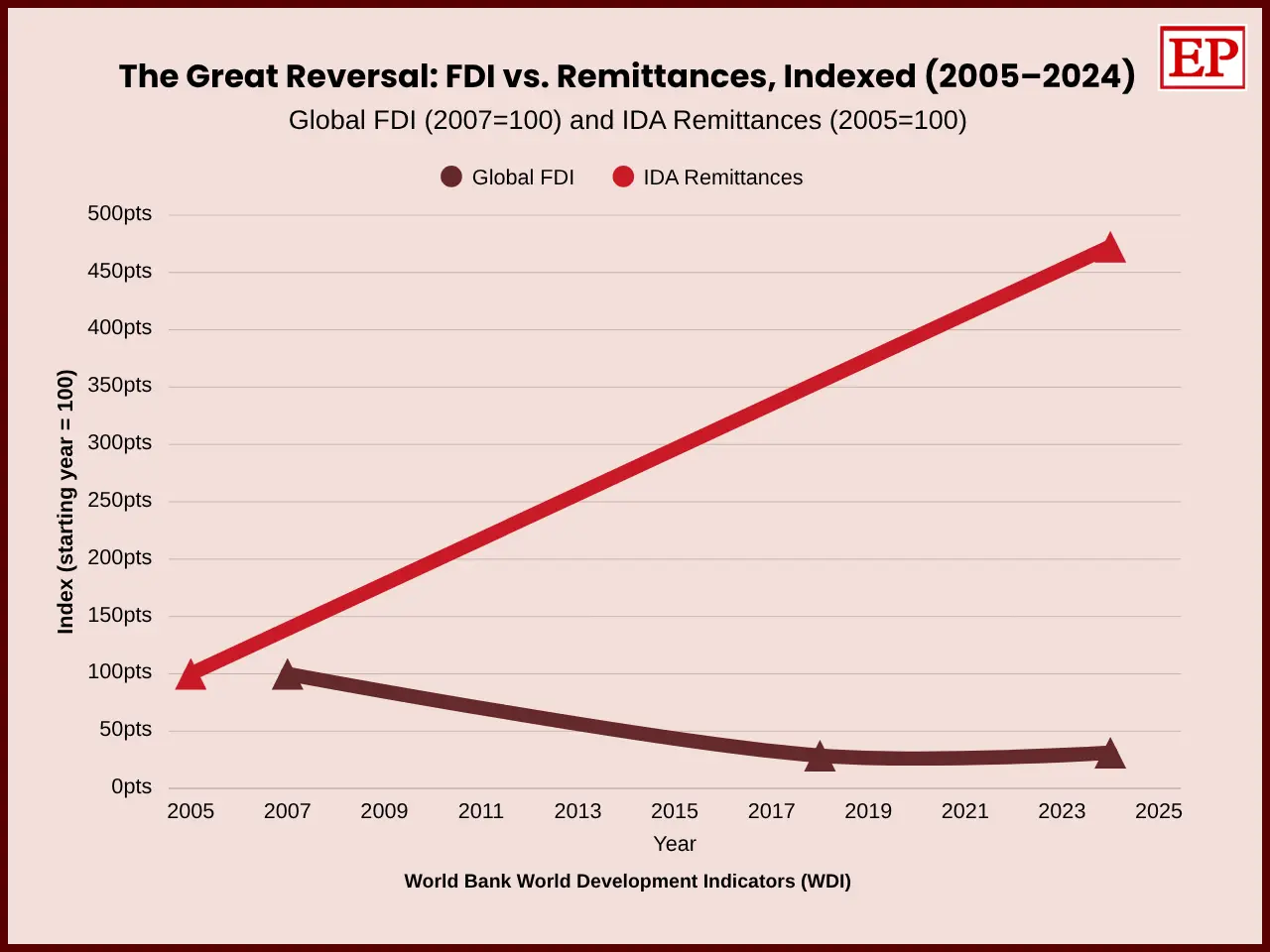
Foreign Direct Investment used to be considered the cornerstone of development finance, the critical mass that allowed financing enterprises, enabling innovation and technology transfer and creating employment opportunities. This trend, however, has been reversed, as the latest data from the World Bank’s World Development Indicators (WDI) show. Global FDI tends to decline throughout the years and only equals the level of 2005.
In particular, in 2007, the amount of FDI worldwide peaked at approximately $3.2 trillion, the high point of a boom fueled by globalization and cheap credit. By 2024, that figure had fallen to roughly $1 trillion, both inflows and outflows. China’s development is especially noticeable since the growth of FDI there slowed down in 2001, and in 2024, they only reached $344 billion in 2021 before collapsing to around $43 billion, as was the case at the beginning of the century. Still, the changes in China hide the fact that the country invests heavily abroad, on par with the United States, being among the biggest investors globally.
The traditional favorites, in turn, continue to dominate. The United States, Singapore, Canada, and Germany accounted for the largest shares of FDI throughout the 35 years. For the world’s poorest countries, the trends are not so positive. Inflows to IDA countries increased significantly, reaching over $2 billion in 1990 to over $66 billion in 2024. At the same time, the share of least developed countries in global FDI hardly changed, being just over 4% in 2024. Thus, despite a significant increase in the amount of FDI, the least developed countries are unable to attract significant amounts of investment for their development.
Remittances Become a Lifeline for the World’s Poorest Economies
While investments of various kinds constitute a critical source of financing for emerging and developing countries, remittances sent by migrants to their families are growing rapidly. Overall, between 2005 and 2024, global remittances increased by 240%, while outflows grew by 227% over the same period.
Meanwhile, the picture of remittance flows also tells us a story of growing inequality. For IDA countries, total remittances amounted to $40 billion in 2005 and $189 billion in 2024. India remained the largest recipient, with $22 billion in 2005 to $138 billion of remittances in 2024. Mexico, the Philippines, and China ranked second to fourth. At the same time, the largest inflows of remittances came from the most developed economies, namely the United States, which accounted for $103 billion in 2024, followed by the UAE at $58 billion in 2024. Other G20 countries such as Australia, Canada, and Germany also account for a considerable share of remittances. Even India, which traditionally receives the largest number of remittances, has become a transit country for money, as its outflows grew significantly, from $1.3 billion to $12 billion between 2005 and 2024, which is close to the UK’s outflows of $12.3 billion.
In summary, while FDI remains a dominant source of financing for the development of emerging and developing countries, the share of FDI in the global economy is decreasing. This trend is associated with both the growth of alternative sources of financing and the import of large volumes of remittances by the least developed countries.