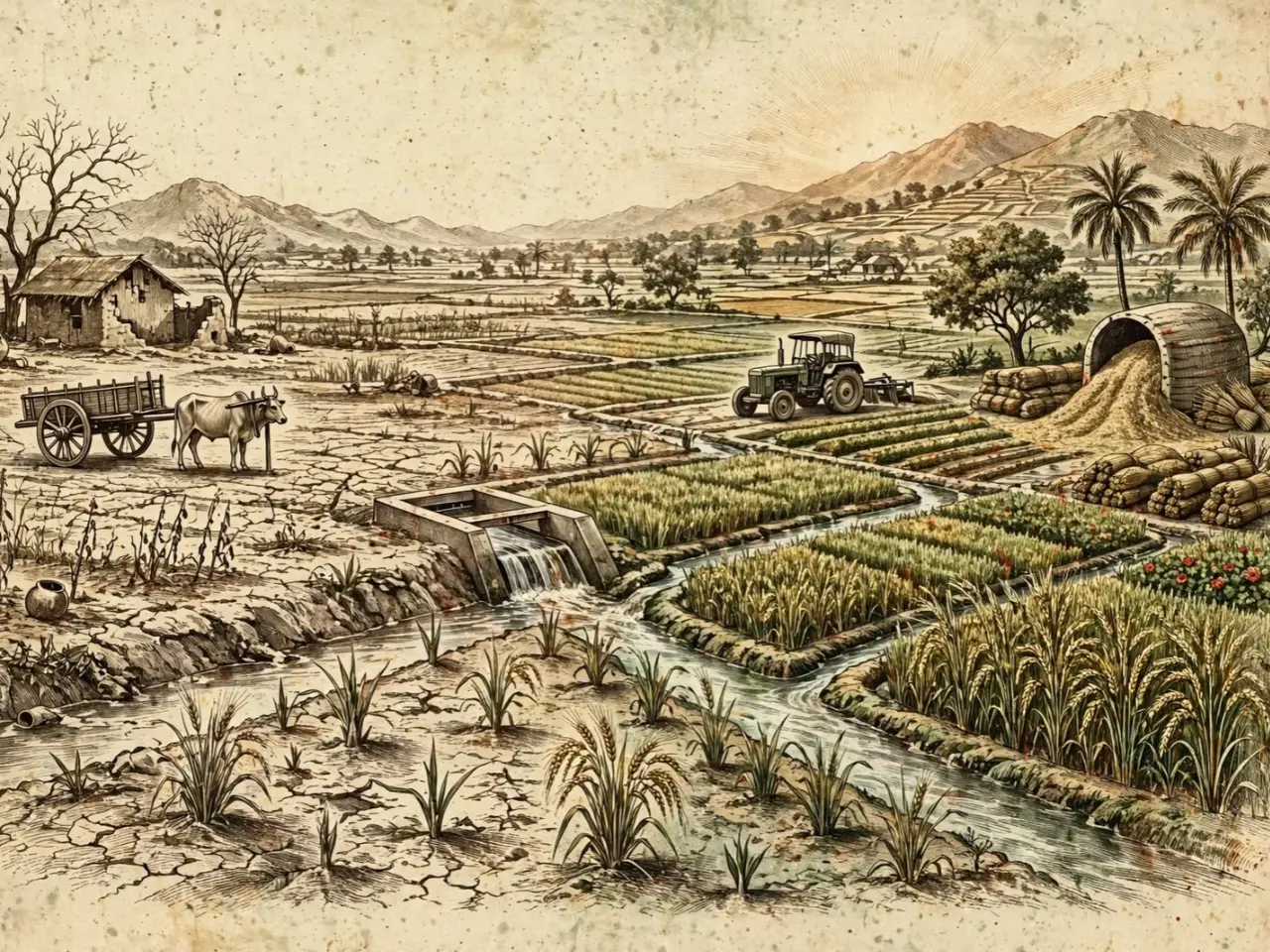
India has witnessed a drastic alteration in the agricultural sector in the post-independence period. It has hitherto been a food-deficient country that has now emerged as one of the world's largest agricultural producers. Several interventions have been taken by the Indian government to develop the agricultural system of the country. Toward this, the Green Revolution, which includes the expansion of irrigation systems and technology modernization. On the other hand, it enhances the government support and procurement system through the introduction of the Minimum Support Price (MSP) policy in the 1960s decade. This transformation has strengthened the national food security system and improved the condition of rural households. Yet, the issues related to contemporary Indian agriculture are vastly different from what they used to be in the earlier decades. In order to do this, there are various factors that have been raising doubts about the sustainability of the current agricultural development model. These factors include the cost of production, market price uncertainty, climate change, overexploitation of groundwater resources, and declining land quality. Thus, the critical question is no longer simply how to raise agricultural production. But rather, how to ensure agricultural profitability so that farmers can survive while not compromising on the natural resources for future generations. In this light, the Indian Agricultural Price Policy should not merely be viewed through the prism of farmers' incomes and food security but viewed holistically through an environmental lens as well.
MSP: Beyond Price Protection
The MSP plays an important role in agricultural policy in India. It protects farmers from sharp falls in market prices or distress sales. It plays an important role in the Public Distribution System (PDS) and maintains the food grain reserve of the country. The government of India announced MSP for 22 crops, and their procurement has been done by the government procurement agencies at the declared prices. Hence, all farmers and crops do not benefit from such policies. Because the actual procurement remains heavily connected to rice and wheat, particularly in states such as Punjab, Haryana, and Uttar Pradesh. Although the procurement mechanism also covers pulses, oilseeds, and other commercial crops. But their procurement is limited to a ceiling of 25% of the state’s production. In reality, the condition for farmers to sell their produce is very complicated. The farmers are not even aware of the state policy on price and marketing strategy. They grow crops that can ensure profits and provide marketing options. Nevertheless, this does not mean that the farmers will change their focus on less commonly grown products. In simple terms, till such time that farmers know that they will get a definite price for their produce, they will not change their preferred course of action. Thus, while it is required to increase the levels of MSPs, it is also necessary to improve the institutional framework that provides price support to farmers. Later the government introduced several programs for farmers to improve their welfare. Programs like PM-AASHA or Mission for Aatmanirbharta in Pulses are meant for price and production support. The efficiency of these schemes is influenced by such factors as available facilities, good collecting points, efficient payment processes, and quality of crops.
Agricultural Growth and the Environmental Challenge
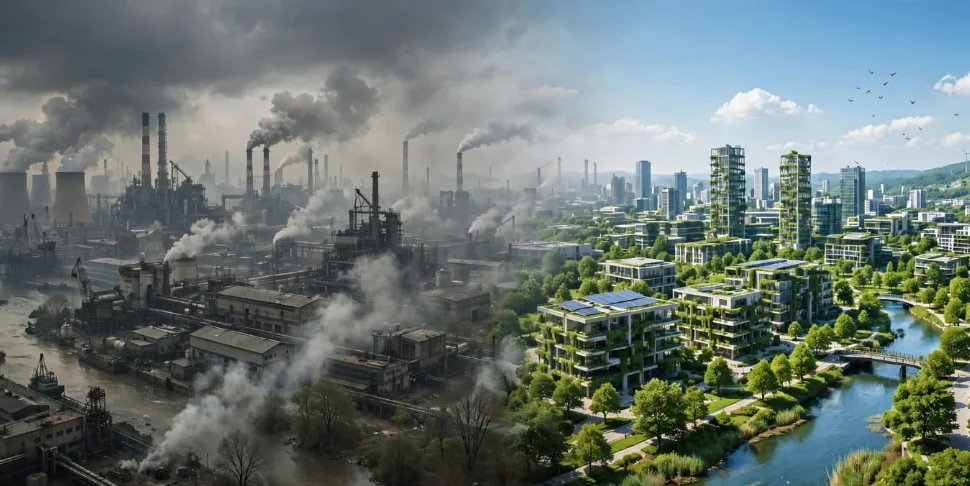
The development of the agriculture sector has raised ecological concerns in the last few years. It is especially pronounced in those areas where agricultural activities are highly developed. One of the most important components of food security in India. It is the rice-wheat system in the northwestern part of the country. The example of Punjab clearly illustrates this case; it is due to guarantees for crop purchases at MSP and free electricity for farmers, which negatively impact the environmental system. The latest official data shows that 72.55% of the total groundwater-assessed blocks in Punjab fall into the category of overexploited. Because Punjab farmers have adopted the paddy-wheat monocropping pattern. The presence of more and more rice-growing, water-intensive farms contributes to water overuse, and the burning of paddy straw also causes air pollution. Besides that, agricultural production is dependent on systemic indicators such as precipitation, irrigation systems in use, cropping system, technology adaptation, and organization of farming activities. Besides, fertilizer subsidies made it possible for farmers to get the necessary resources. Despite that, nitrogen fertilizers are harmful because of their excessive usage.
Crop Diversification: Making Alternatives Economically Viable
Crop diversification has been advocated as an approach to address problems created by the rice-wheat production system. Growing of legumes, oilseeds, and other cereals and different other crops. It is adapted to the climatic conditions of a certain region and is expected to promote sustainable groundwater use that improves soil management and guarantees food security. Crop diversification can considerably reduce the volume of agricultural imports in India. Therefore, it is based on the economic viability. Nevertheless, farmers are not likely to switch to new crop-growing methods easily unless they are sure about the prospect of the new crop. This is due to the immense level of uncertainty regarding profitability, yield, processing, storage, and sale of crops. Therefore, a strong financial mechanism should be developed to back the project of crop diversification. The government should guarantee price support and procurement of oilseeds and pulses to provide quality seeds and guarantee procurement or storage facilities for their crops. However, each project of crop diversification has to take into account local agroeconomic conditions. Consequently, one has to keep in mind that unification of areas is impossible because India has different agricultural and climatic conditions.
Reforming Subsidies and Investing in Sustainable Agriculture
Agricultural subsidies are necessary for farmers' protection against increasing production costs. For agricultural households, the provision of direct electricity and fertilizer subsidies plays a very important role. Nevertheless, technological modernization is a greater concern in this context. Some technologies, such as Direct Seeded Rice (DSR) and laser-controlled and levelling techniques, improve agricultural efficiency. However, the adoption of modern technologies by farmers needs training and technical support beyond the equipment and infrastructure itself. These needs can be met by providing services such as agricultural advice, customer service centers, and cooperatives. There are increased risks to agricultural production due to climate change. Thus, there is a need to invest in plant types that are better suited for the new climatic conditions or weather forecast systems and agricultural research.
Towards an Integrated Agricultural Policy
India requires an extensive agricultural policy that will connect farmers' income security, market development, and environmental protection. The policy measures about prices, subsidies of inputs, crop diversification, and the utilization of natural resources must be put together into one policy. The government must introduce the MSP and procurement system in a wider and more efficient manner. At this point, the government should provide subsidies that will allow the farmers to use resources without any financial burden on them. The aim of the diversification program should be creating the real possibilities for farmers rather than shifting the burden of developing environmentally friendly methods of farming onto them. However, the government must pay more attention to public investments in the effectiveness of irrigation, research, storage, processing, procurement, and marketing infrastructure. The government must understand that sustainable farming can benefit not only farmers but also society.