Government-Owned Firms Capture an Unequal Share of Support
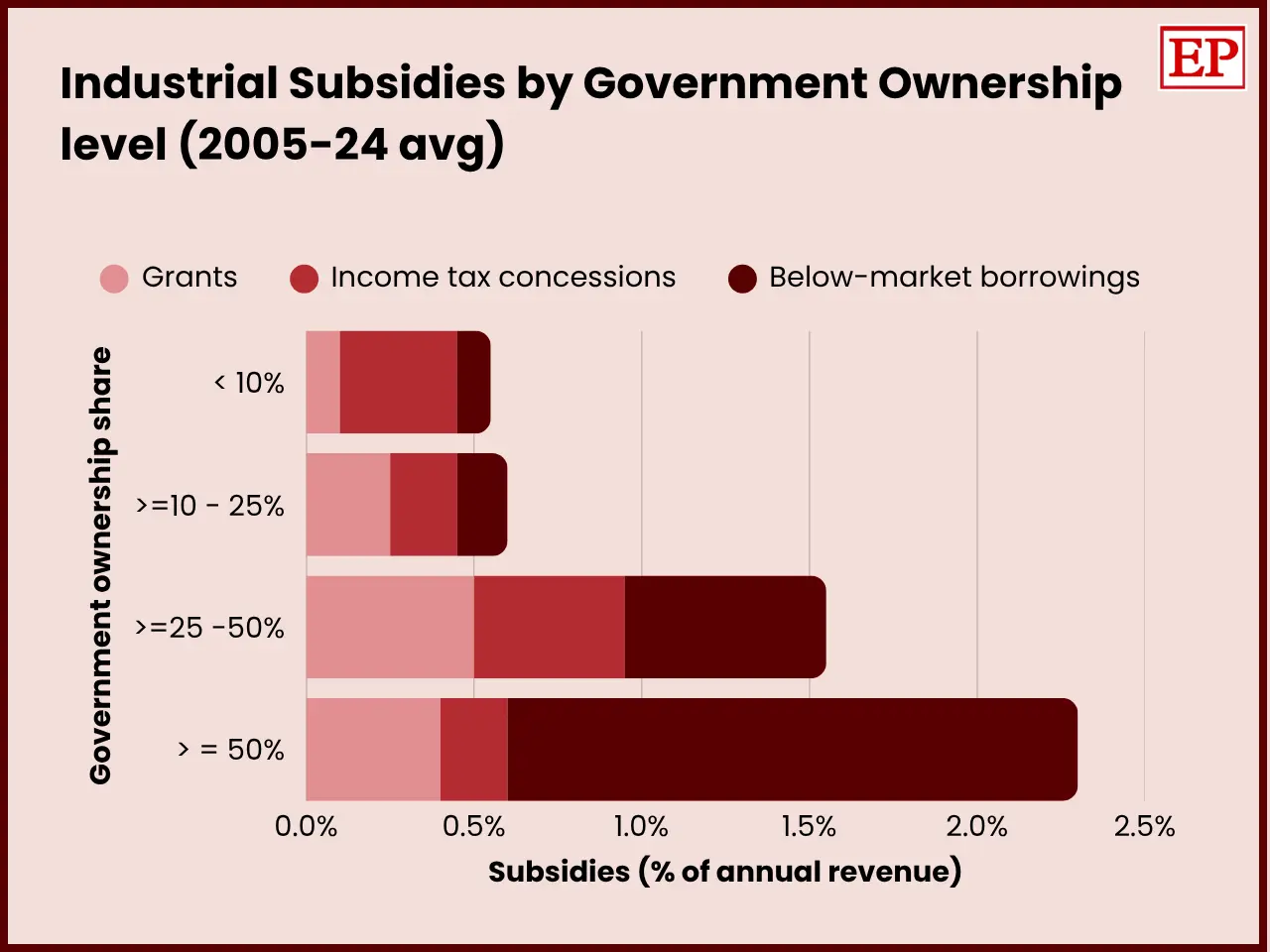
OECD's new industrial subsidy database highlights how much state-owned enterprises (SOEs) receive in subsidies. Companies partially owned by governments (making over 25% of capital) receive funding more often than companies without any state ownership, and the trend grows even stronger as the level of state ownership increases. Businesses that are majority-owned by governments (50% or more) get subsidies that make up for 2.3% of their revenue on average over the years 2005-24, four times more than non-state-owned companies whose share of state ownership is lower than 10%. This trend has proved stable over the 20 years considered, which means that there is a structural rather than phenomenological relation between state ownership and the level of subsidies received.
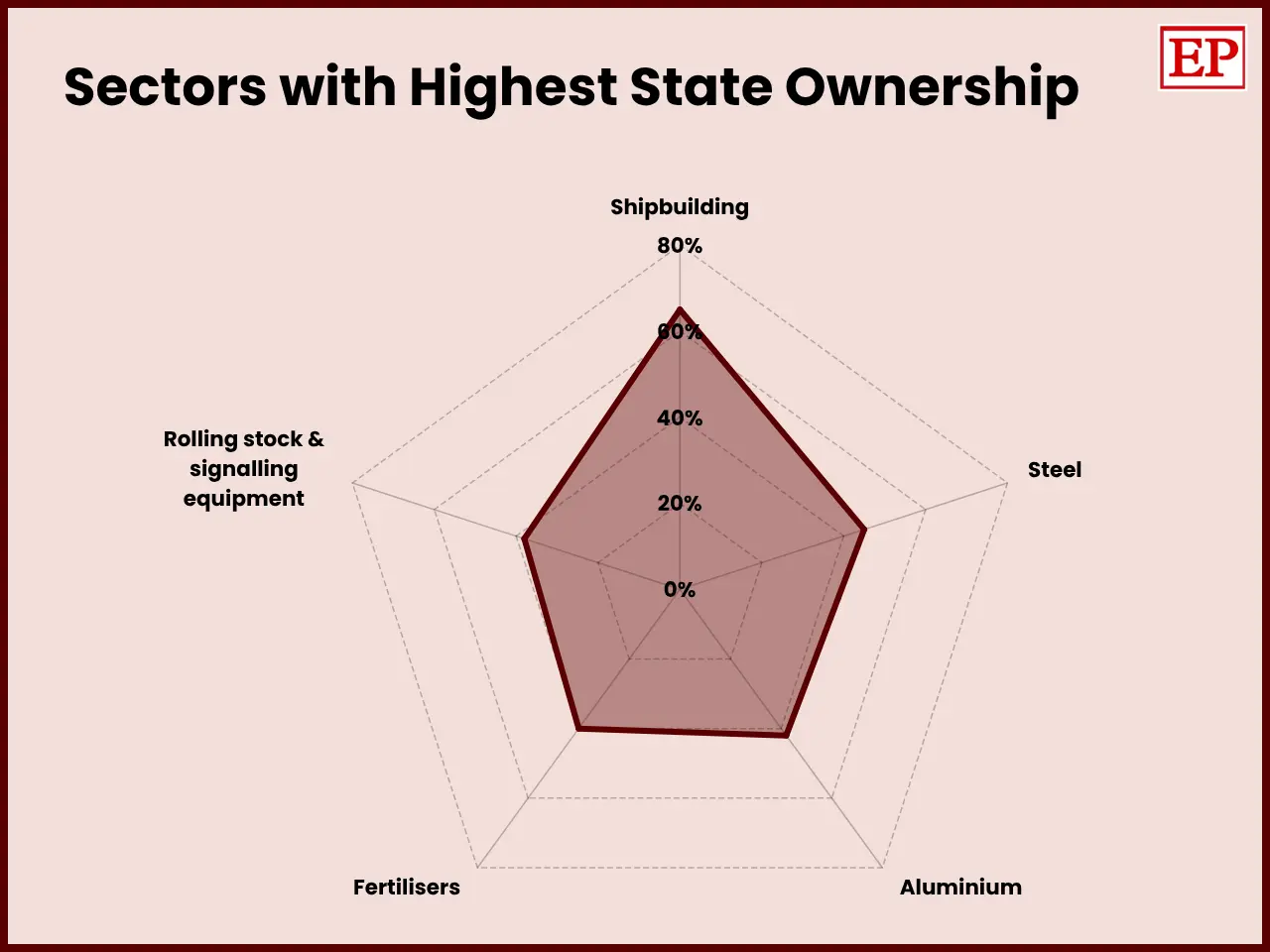
Government ownership is common in many manufacturing industries included in the database. Shipbuilding is the industry where the existence of state shares is most prevalent; in this industry, government-run companies account for 2/3 of the sector’s revenues. Other industries characterized by significant government equity include steel, aluminum, fertilizing materials, and railway equipment. However, some sectors, such as semiconductor manufacturing, are almost completely privatized.
Grants and Cheap Loans, Not Tax Breaks, Drive the Gap
State-owned companies have a clear advantage in terms of financial services. In fact, state companies’ slight advantage comes not from the fact that they receive more help in all areas but only due to two things: direct governmental handouts and loans at lower-than-market interest rates. Tax benefits here are much less important.
The reason for that discrepancy is hidden in the industries in which state-owned companies work. Since state ownership is usually concentrated in capital and credit-intensive industries with heavy use of debt financing, state-owned companies become naturally favorable candidates for preferential loan schemes. These companies have very big debts and generally weak stand-alone credit quality; however, they still can borrow money under more favorable terms due to the fact that government support is taken into consideration when assessing their credit capacity. Also, these companies tend to conduct less research and development and have fewer foreign operations than private multinational companies; therefore, their opportunities of taking advantage of R&D tax credits and cross-border tax advantages are limited.
A Dual Role: Recipients and Enablers of Subsidies
It is possible that the most relevant observation is that the state-owned businesses do not only obtain support, but they also assist in distributing such assistance. The loans below market value coming to the state-owned enterprises frequently come from state-owned banks acting on behalf of the government. In essence, state-owned banks become parties providing subsidies for their operations.
This causes what could be called a "reliance on state assistance," wherein state-owned companies are lenders and borrowers and investors and capital inflows. In conjunction with the issues with identification of what companies are actually state-owned, due to the complicated structure of ownership and obstacles related to government oversight, the situation becomes even more confused.
The consequences of this situation go beyond the financial reporting of individual enterprises. Due to the fact that state-owned enterprises are present in sectors of the economy including the steel industry, shipbuilding, and aluminum production with capital-intensive production and participate in international trading, their special access to cheap finance could cause distortion of competition and help them gain significant advantages not only in their home country but also internationally.