The city is no longer the norm, the exception. Already a majority of the world (58% or 4.7 billion people) lives in cities, and this trend will continue so that by 2050 more than 70% will live in them. But what’s not discussed as frequently is where this growth will occur. Unlike previous patterns, the coming wave of urban growth won't be centered on the giant megacities like Lagos and Mumbai. The next million and million and millions of urban dwellers will instead make their homes in thousands of smaller, relatively unheralded cities, many of them in Sub-Saharan Africa and parts of South Asia that already have the most underdeveloped urban planning departments and the tightest city budgets.
Why is this a story worth following?
Cities do change peoples’ lives for the better. The fundamental advantage is that they provide something that rural economies simply cannot offer: a deep labor market where workers can jump between different sectors, industries, and skill sets without needing to upend their lives and families. In fact, estimates of job specialization between the urban and rural areas of low- and lower-middle-income countries indicate that urban areas boast much greater specialization at low, medium, and high skill levels compared with rural areas. Pay often follows, too; hourly wages for workers tend to be higher in urban than rural areas, although these figures are in part misleading. After all, the wage premium does only appear if rising costs associated with renting and transit consume less than the gains made in wages, which means, as you can imagine, that this advantage only extends to well-prepared urban planners.
The paradox of slums
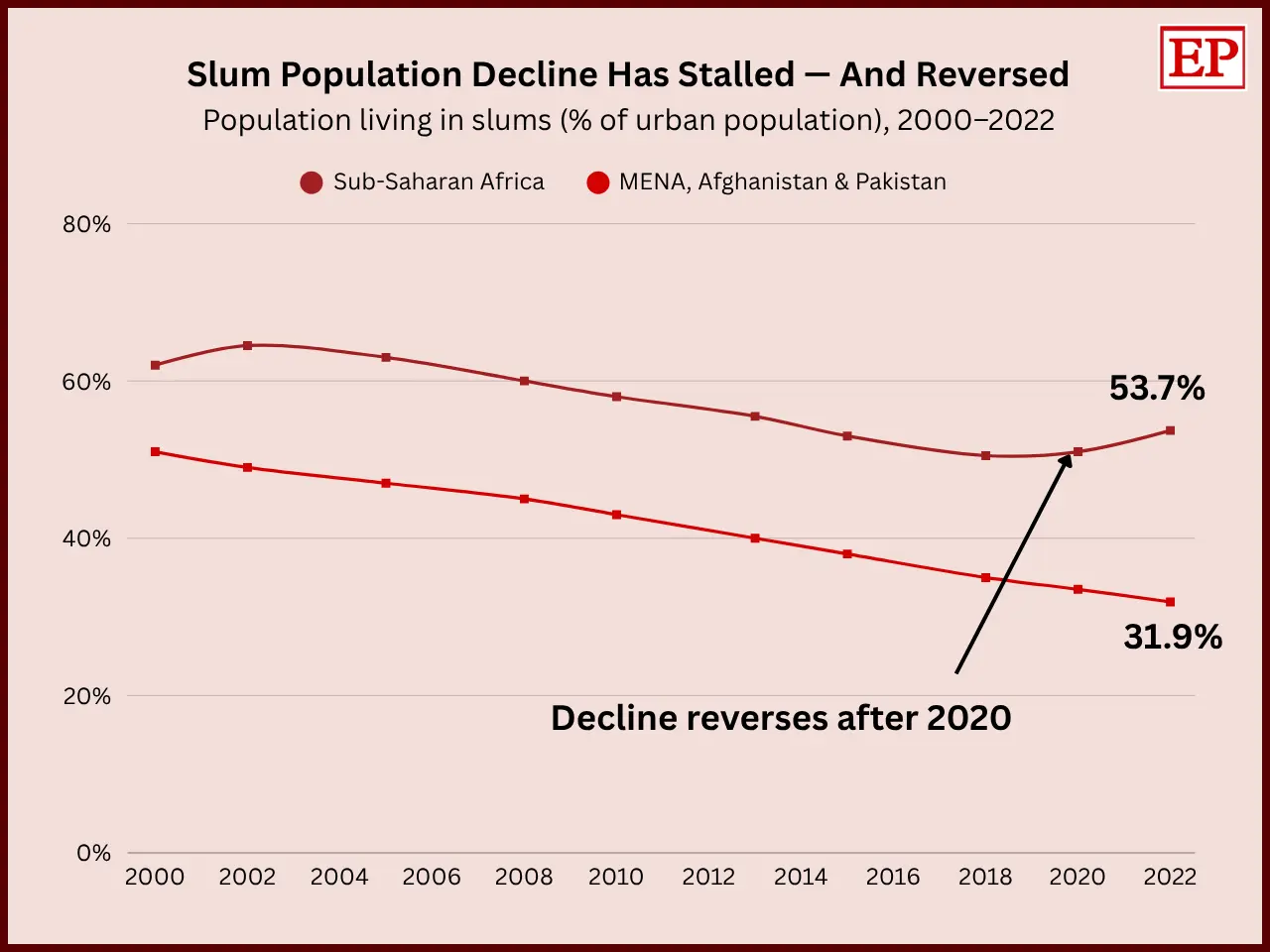
The percentage of Sub-Saharan Africa’s urban population living in slums actually declined from an estimated 62 percent in the early 2000s to just over 50 percent in 2020, an indication of actual progress. The problem is double: first, that reduction in the share has begun to increase since 2020, making almost two decades' worth of gains a wash.
A second, and more grave, falling proportion can occur simultaneously as absolute numbers rise when the cities grow at a higher rate. Globally, the number of people living in slums increased from nearly 840 million in 2018 to more than 1 billion in 2022, up 160 million over four years. The difficulty is what a statistic on aggregate urbanization trends can present simultaneously: one number for progress and another, on another layer, for crisis. Planners who would boast about reducing proportions can be blind to an increase in count happening below that percentage.
But why is this moment of urban expansion more critical than many others?
For a physical, rather than purely statistical, reason. Urbanized areas' roads, buildings, and anything man-made that constitutes a city are expanding by a minimum of 50 percent over the next 25 years, and the majority of the expansion is occurring in the lower- and upper-middle-income countries.
A lot of that infrastructure has not yet been built; therefore, the choices made now will lock our actions in for the next generation or more. Addis Ababa has proven most effective at highlighting the two diverging outcomes. By 1975, when the city population was well below one million people, by 2025 the population passed 6.7 million. Some sections of the city have been built with some semblance of actual urban planning; you can see it in road alignments and stormwater drainage plans. Some portions of the city lack actual urban planning and are easily visible too but in negative terms.
As the years build, the cost of errors becomes increasingly magnified. When, for example, the street blocks are inefficient and the land tenure system is weak, the planning errors made by a municipality today in a city like Kampala will prove costly in the decades to come as they have to retroactively build infrastructure to cope with unplanned urban slums while ensuring that the political power vested in landowners remains undisturbed. The current infrastructure being developed in our high-growth cities today is not only serving present housing needs; it is setting up the financial and political conditions under which such regions will exist in the coming half century.