The Rising Threat of Extreme Heat
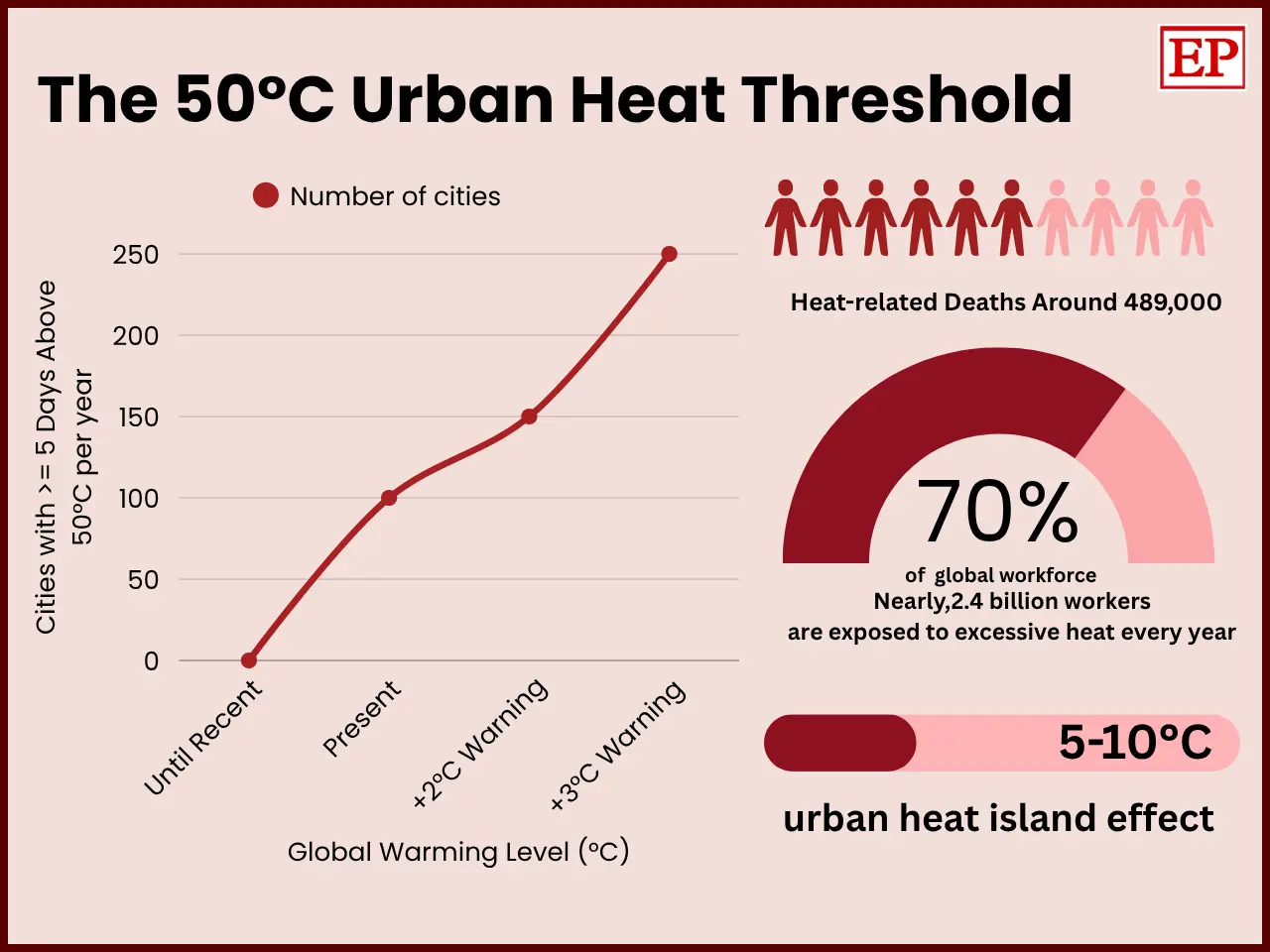
The frequency of extreme heat has increased by almost three times compared with earlier days. This growing challenge kills about 489,000 people every year, resulting in throwing people, infrastructures, and ecosystems beyond the limits of what they can deal with. People in urban areas are the worst affected by this recent phenomenon. Until recently, no city has spent five days at over 50°C in one year. At present, this is true for more than 100 cities. The number is expected to reach around 150 cities if global warming reaches 2°C and around 250 cities if the level of warming is 3°C.
What is regarded as dangerous heat is extremely subjective: 30°C can be horrible for some towns, while it is acceptable for others at a higher level of heat, climate, humidity, and amount of wind blowing area. Moreover, heat is not only a temperature; dry heat is very different from humidity.
The crisis has two main causes worth mentioning. Firstly, greenhouse gases emitted by human activity lead to the planet being heated, which, in turn, results in more frequent and stronger heatwaves. And secondly, densely populated cities lead to the urban heat island effect, which refers to the tendency of cities to become even warmer than rural areas by 5 to 10 degrees Celsius owing to the construction of tall buildings and paving of the surface. It is important to note that the issue can be considered not only the issue of climate science but also the issue of fairness because they are mostly vulnerable to extreme heat: elderly people, children, outdoor workers, and poor people. In absolute figures, it is about 2.4 billion workers, or 70% of all workers in the world, that have to deal with overwhelming heat on the job every year.
Urban Solutions Taking Shape Worldwide
Around the world, cities are taking innovative steps to adapt. In Paris, authorities conducted a “Paris at 50°C” simulation aimed at involving various stakeholders to stress-test the emergency response systems whilst considering longer-term measures such as enhanced urban forestation, shaded streets, vegetated residences, reflective buildings, and the mapping of at-risk neighborhoods.
Chennai has introduced Heat Action Plans, including early warning systems, education, cooling centers, distribution of drinking water, and helping hospitals and schools. The city has embedded heat resilience into its master plan, focusing on passive cooling in newly built structures as well as retrofitting social housing and educational institutions.
Teresina is one of the Brazilian cities working with environmentally friendly solutions: urban forests, wetlands, rivers, and green corridors as a means of cooling down neighborhoods and making them safer in terms of floods, as well as improving the quality of air. Yangzhou, the Chinese city, makes use of the principles of heat adaptation technology in its long-term urban planning strategy. It uses ecological restoration to transform old landfills into green parks and help wetlands around major rivers restore history.
Yet another case is Lagos, Nigeria, where the reforestation project has been implemented since 2008: up to now, over 6.2 million trees have been planted and 327 parks and gardens have been constructed, which has created almost 96,500 new jobs. The climate resilience strategy of the city aims at planting 50,000 trees per year and restoring 300 parks; the total financing of the project is expected to reach $9-16 billion by 2035.
Coordinated Global Action Through UNEP
The United Nations Environment Programme (UNEP) addresses the crisis of heat by advocating for sustainable cooling technologies and practices across the globe. The UNEP aims to cut down cooling-associated emissions through initiatives such as Cool Coalition and the Global Cooling Pledge and to expand access to affordable cooling technologies. Its program titled “Beat the Heat” aims at helping cities and countries assess their exposure to heat and employ nature-based cooling techniques.
Additionally, UNEP partners with the construction sector, an important source of heat exposure via the Global Alliance for Buildings and Construction, and supports the ongoing ecosystem restoration activities related to the UN Decade on Ecosystem Restoration. The main aim of UNEP is to meet the need of communities to be cool while also managing to limit the emissions at the same time.