In July each year, the World Bank’s Development Data Group updates its Country Income Classifications. The Atlas method divides nations into low, lower-middle, upper-middle, and high-income groups based on their gross national income (GNI) per capita. This approach, which will be in use for the next four years, until June 2027, identifies 218 economies. However, the classification has far-reaching implications for global economies, including which countries are eligible to receive development aid and concessional financing. It also provides an important tool for policymakers and researchers to measure the progress of countries over time.
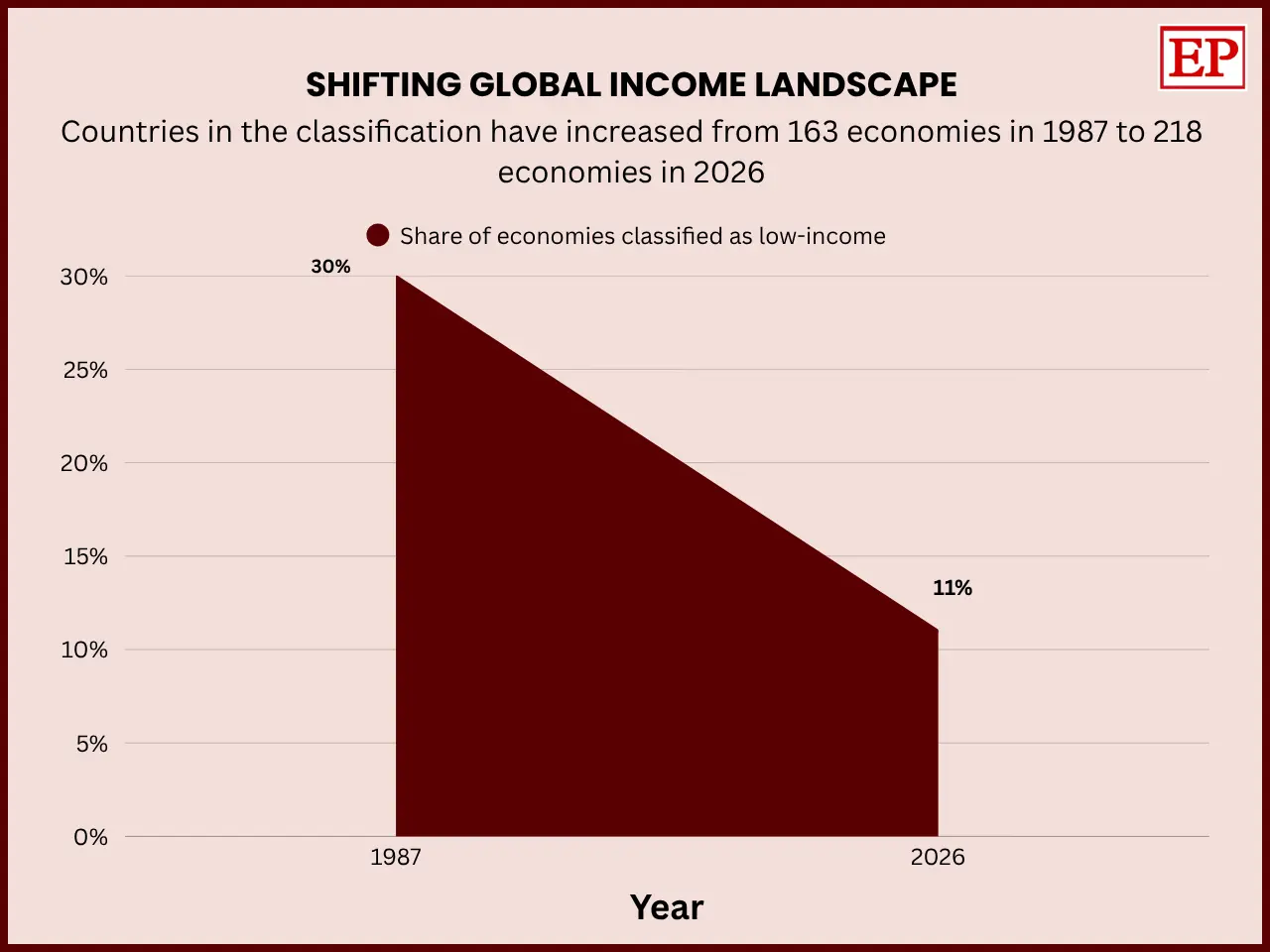
In fact, the results of the research show a significant trend over the years: The percentage of countries classified as low-income countries decreased from 30% in 1987 to 11% today. Six nations have moved up their rankings this year, and no countries went down.
Six Countries, Six Different Paths
What is striking is the entirely different process by which each country has arrived at this new level of income. Five countries experienced growth from lower- to upper-middle-income countries: Jordan, Micronesia, the Philippines, Sri Lanka, and Vietnam, while Togo ascended from the low-income to the lower-middle-income level. Vietnam’s growth can be attributed to an exports-based rise during which exports grew by over 15 percent in both 2024 and 2025 and which has seen GNI grow by around 10 percent annually since 2021. The Philippines, on the other hand, has taken a slower but more solid route, with GDP growing by around 5.8 percent for five years driven by the development of almost all industries.
Sri Lanka’s trajectory resembles a story of recovery. Having just three years passed since the economic collapse in 2022, the country has registered the annual growth of around 5 percent in 2025 thanks to tourism and financial services, going over to the next tier. Micronesia made it to the next tier in a less spectacular way, going the route of moderate construction and agricultural growth, while the decline in remittances slowed it down.
Jordan's reclassification was primarily due to better estimates instead of a sudden surge in its economy. A statistical revaluation was done, which led to a change of almost 10% to the country's economy, together with the growth rate of 2.8%, thus bringing the country to the line. Togo clearly scored the most unusual case since its economy grew by 5.9% in 2025, with the thing that affected this situation being the census of 2022 down-revising its population by almost 12%, thus increasing per capita income mechanically without any growth at the income level.
Why the Classifications Matter
These tiers of income are not merely academic classifications; they have the potential to determine eligibility for low-interest loans and grants, inform the decisions of development organizations about how to allocate funding for various initiatives, and create a shared language that can allow comparison between different countries’ economic processes. The number of countries observed has been increasing from 163 economies in 1987 to 218 economies nowadays, making the database an efficient instrument for developmental research.
Nevertheless, the World Bank claims that there is no single indicator that may show the full picture of development. Growth, changes in statistics, population, and exchange rates can make the country cross the threshold, which is perfectly illustrated by the countries in this year’s cohort: an export leader, a diversified growth economy, a country arising from the crisis, a slow and stable economy, a data adjustment, and a demographic recalculation fall into the same “changed category.”