The International Monetary Fund (IMF) provides guidance on how to mitigate the challenges posed by surging global energy and food prices as well as geopolitically imposed disruptions in supply chains. Businesses and governments are under more pressure to control the effects of rising prices due to growing energy and food costs, which also reduce consumer purchasing power and induce inflation. All of these aspects make it harder for nations to make the optimal judgments.
The IMF notes that due to nations’ differing fiscal capabilities, energy import dependence, and social policies, no single solution will apply to addressing the various challenges different nations face in responding to events when they occur; however, many nations have sufficient financial resources available to assist their citizens in mitigating the effects of price spikes, while others are burdened by excessive debt that leaves them little capability to provide assistance. Therefore, the only way for governments to provide assistance to the most targeted groups within society, without undermining long-term economic stability, is to adopt carefully designed policies that protect those groups.
Imposition on global supply and production, rising costs, and reduced levels of economic activity result from energy prices, thus causing inflationary pressures throughout the global economy. Therefore, it is recommended that countries implement the principles outlined by the IMF in addressing any impairment to the functioning of the market system, such as allowing domestic prices for energy goods to reflect the reality of the world marketplace; providing temporary assistance to low-income households through income transfers; and providing assistance to financially viable businesses through liquidity rather than subsidizing them, unless the crisis is so severe it warrants a more extensive policy response in the form of price controls. Furthermore, the IMF maintains that by continuing to restrict the price of energy through governmental issuance of subsidies and price ceilings, consumers will continue to consume large quantities of energy, even though they would rather use their resources efficiently when available (i.e., long-term need/resource shortages) and will ultimately experience significantly higher deficits and costs for governmental budgets. Additionally, since wealthy households generally consume a larger amount of energy than do lower-income households, the relative wealth of a household will lead to its receiving a greater share of any subsidy program.
Micro-industrial policies that focus on tax incentives or subsidies for a particular firm or sector are generally less clear and less effective on external balances. Such measures, when they succeed in increasing productivity, usually increase both investment and consumption, with a negative impact on the current account. If they misallocate resources and lower the overall level of efficiency, then their external accounts could improve, but at the cost of economic output. This is not the case for macro industrial policy.
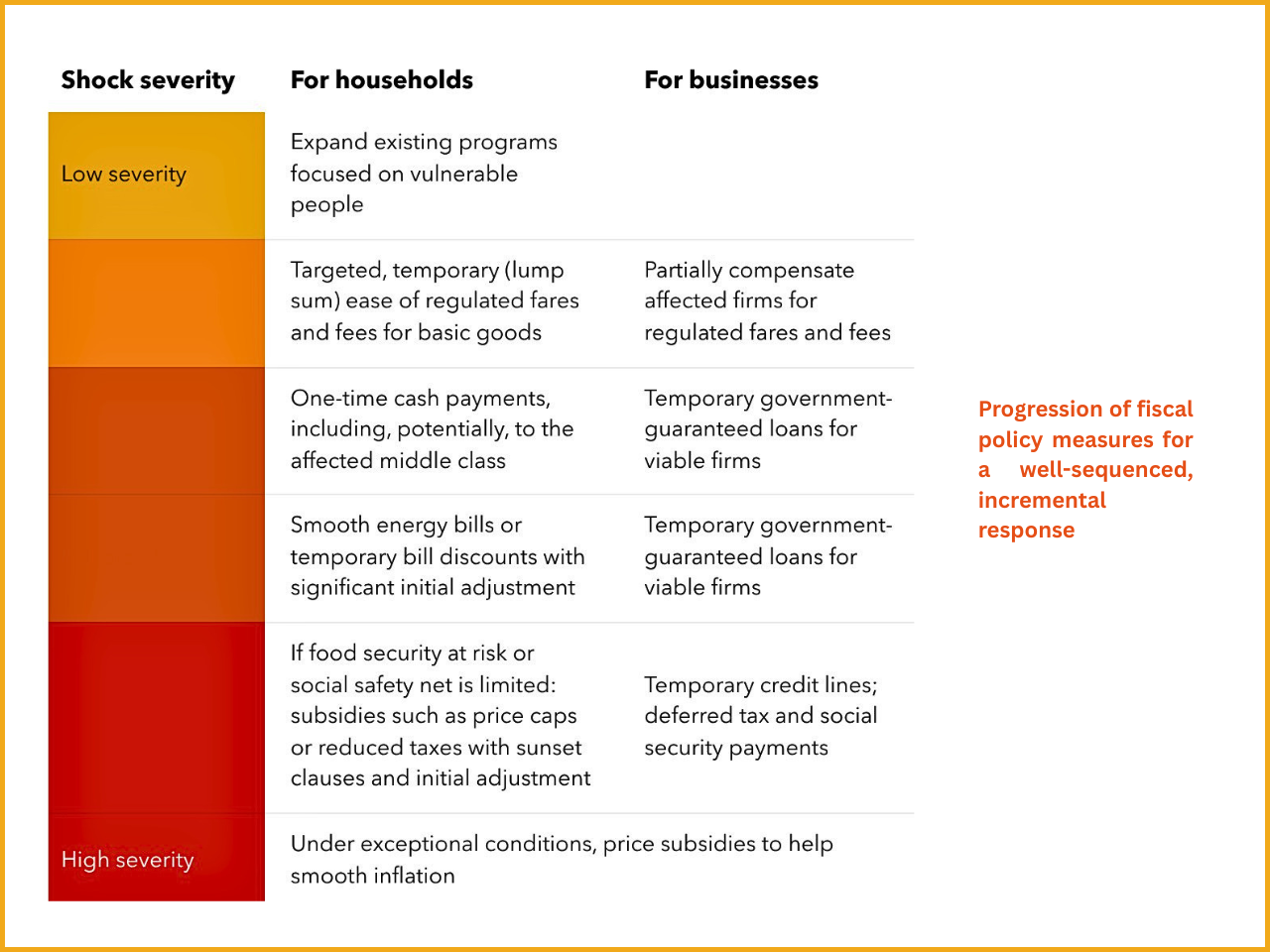
The IMF supports governments’ implementation of cash transfers through their existing welfare programs to help households that fall within the low-income classification cope with the effects of rising food and energy prices. When food and energy prices spike, low-income households typically bear a higher proportion of their total income than higher-income households; therefore, a rise in food and energy prices causes low-income families to face more financial hardship than those in other income brackets.Short-term assistance measures that governments may take to provide low-income families with relief from rising living costs while still preserving fair competition include expanding the number of families eligible for welfare programs, providing one-time tax rebates to qualified low-income families, and providing additional assistance through existing financial assistance programs. Governments can also provide reductions in tax rates or create subsidies for basic food items in emergency situations where food insecurity exists; however, the government should have an exit plan for measures once food security has been re-established.
The IMF also supports the idea of providing short-term liquidity assistance to businesses that are facing increased costs for energy (e.g., transportation-related businesses), rather than making long-term subsidies to these same businesses. A number of businesses, particularly small ones and those where transportation/fuel is a significant factor in expenses, are suffering from cash-flow constraints due to the increase in energy prices. To assist such companies, the government could also extend guaranteed loans, defer tax payments, and/or offer temporary lines of credit. However, governments should refrain from offering direct payments or long-term subsidies that are funded by taxes because these become ingrained in the future and will be politically challenging to withdraw from recipients when conditions improve. The IMF also cites risks related to broadly applicable policy solutions to this circumstance, such as price freeze measures, general subsidies, and fuel tax reductions. While these policies may temporarily keep the public from putting pressure on political leaders, they would also distort market signals, require federal governments to expend more funds than planned, and cause shortages if suppliers are not compensated to the extent of their losses from such disruptions. Rarely should these policies be put into place (e.g., when price pressures and projections become unstable or when a shock is expected to continue for a brief period of time and the absorptive capacity exists for implementation).
A second key issue from the crisis response is that developing and emerging economies are strained much more unequally than advanced economies. Developing nations generally have less developed welfare systems than developed nations, have a larger proportion of energy imported from other nations, have a much lower borrowing capacity, and have a wide variety of extremely precarious inflation-controlling systems; as a result, these economies have numerous competing goals that must be handled while resolving the growing energy prices. Large subsidy outlays have the potential to erode government resources and elevate government debt very rapidly. The IMF recommends that governments take a disciplined and well-prepared approach to policymaking. Government responses must be temporary, targeted, and transparent based on how long the crisis has existed and how severe the crisis was at that time. By targeting assistance to poor families, helping viable businesses remain in operation, and maintaining appropriate signaling from the market, countries can limit the negative effects of the crisis and prevent future inflation and budgetary problems brought on by the government’s handling of the crisis.