Unlock deep insights and expert analysis with EP Prime.
Already a member? Login here
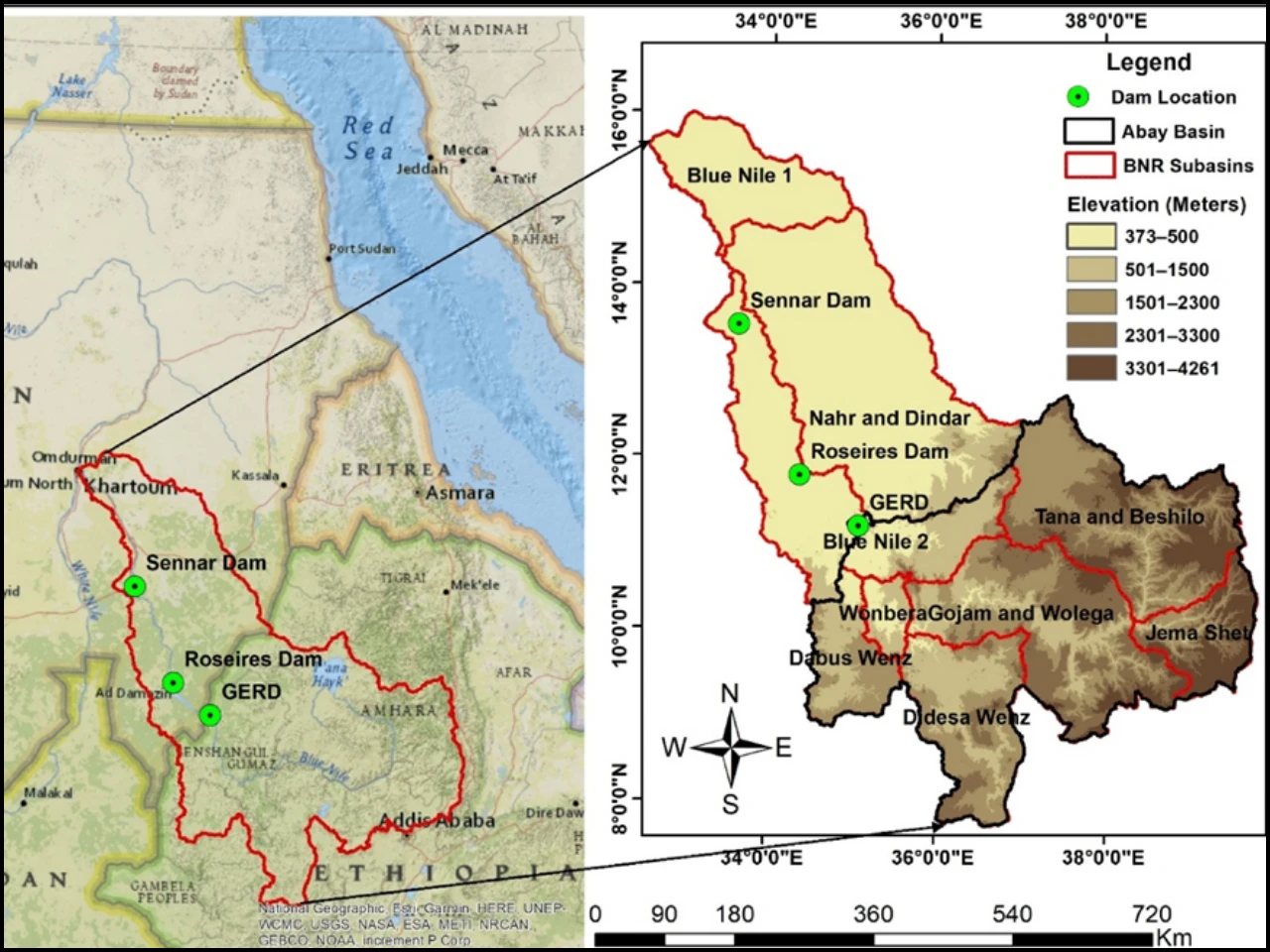
Image source: Sustainability (2022), volume 14, article 7590
President Taye Atske-Selassie participated in the celebration of the commissioning of the Grand Ethiopian Renaissance Dam (GERD) and the achievements made towards the anticipated Nile River Basin Commission (NRBC) during the 80th session of the United Nations General Assembly in New York. This truly marks a great development for Ethiopia and the entire Nile River Basin. In his speech, the president also addressed the issues of debt, sea access, regional security, and Africa's representation in global bodies, and he represented both as “epic milestones” that will change the future of the Nile Basin countries forever. He showed the great opportunities and obstacles that the area has in terms of diplomacy, oil, and water. His message focused mostly on the completion of the Nile Basin Cooperative Framework Agreement (CFA) and the subsequent establishment of the NRBC, which has its headquarters in Entebbe, Uganda. At the level of head of state, the Commission should oversee and coordinate the utilization of resources of the Nile.
Political barriers have caused progress to be slower than expected, despite the Nile Basin Initiative, a transitional arrangement, having stated that the Commission will be established by September 2025. Therefore, President Taye's guarantee that the commission is getting close to being established had both symbolic and useful significance. Declaring that the CFA represents the notion of equitable and reasonable use of the Nile, a concept that confronts long-standing imbalances in water administration, he presented this as a historic turning point.
The slow progress of establishing the NRBC can be attributed primarily to the reluctance of Egypt, Sudan, and the Democratic Republic of the Congo to ratify the CFA. Egypt has been especially hostile, claiming that a basin-wide institution would undermine its historical control over the waters of the Nile. Under colonial rule, the 1929 and 1959 treaties established this dominance, with Egypt and Sudan controlling the lion's share of the river's flow while upstream countries, particularly Ethiopia, were completely neglected. President Taye said in his speech that the time has come for all riparian governments to embrace cooperation rather than cling to antiquated structures, positioning the Commission and the CFA as remedies for this legacy.
Completed on the Blue Nile River, the levee was started in 2011 and formally inaugurated on September 9, 2025, at an approximate cost of USD 5 billion, and has an installed capacity of less than 5,000 megawatts. President Taye described the adventure as a public accomplishment but, more importantly, a development that will change the future for the broader region. He explained the significance of the Grand Ethiopian Renaissance Dam as evidence of Ethiopia's fidelity to clean energy, stating that the power generated will be enough to exhilarate nearly 60 million Ethiopians presently living without ultramodern electricity.
Debt was the most important of these. Ethiopia, like numerous African countries, is burdened with invincible situations of debt that have been aggravated by indigenous insecurity and global profitable shocks, compounded by slow growth. Following a recent International Monetary Fund (IMF) and World Bank review, Ethiopia has formally been classified as in dereliction and decreasingly unsustainable debt situations. President Taye called for "critical transnational action" through debt cancellation, debt restructuring, and debt suspense, noting that these raptorial debt traps are undermining the capability of Africa to meet its commitments for development.
The chairman also addressed matters of security, reaffirming Ethiopia's commitment to combating terrorism both domestically and in the wider cornucopia of Africa. In particular, he requested that the African Union Support and Stabilization Mission in Somalia (AUSSOM) admit elevated support from the transnational community. He noted, "This is not the time to pull back from the transnational community," and sought cooperation to combat revolutionist groups that continue to immortalize instability in the region.