2025's Hottest Sectors: AI, Renewable Energy, Cybersecurity, and More
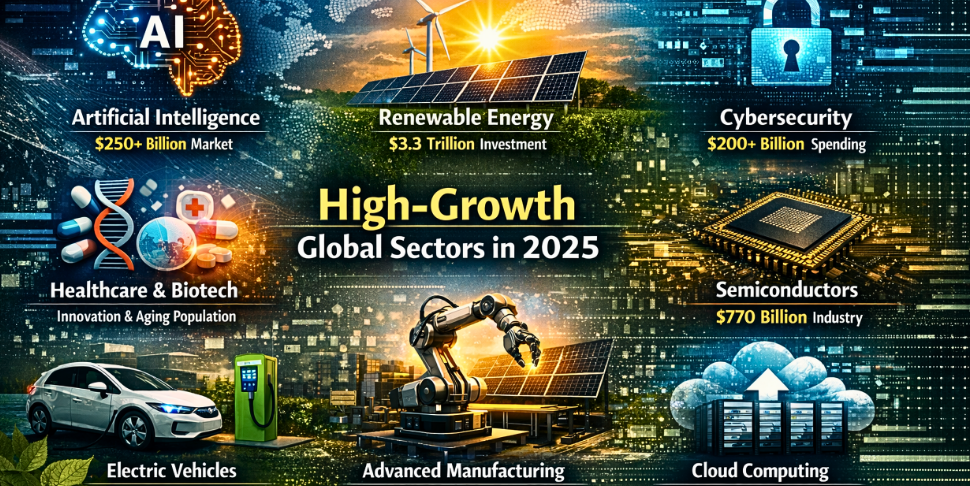
The growth in the global economy in the future is becoming more focused on sectors that are propelled by technological innovations, sustainability needs, healthcare growth, and the development of digital infrastructure in 2025. Artificial Intelligence (AI) is one of them, having become the most rapidly expanding industry globally as a general-purpose technology that transforms productivity across industries. With the broad acceptance of generative AI, machine-learning systems, and autonomous digital agents, enterprise digitization has increased faster in finance, healthcare, manufacturing, education, and governance. According to the Global Industry Projections and the Future of Jobs Report 2025 by the World Economic Forum, the demand for AI specialists, data scientists, machine-learning engineers, and AI governance professionals has been growing at a rapid rate, making AI an influential force in the economy and the main source of high-skilled jobs.
The fastest-growing sector in the real economy in 2025, according to the digital transformation, is renewable energy and clean technologies. According to the International Energy Agency (2017), the world is investing record amounts in clean energy (mostly solar photovoltaics, wind, battery storage, and modernisation of the grids). This is supported by climate commitments, energy security concerns, declining technology prices, and promising industrial policy in major economies. Not only is renewable energy a source of decarbonization, but a significant percentage of jobs are created in the fields of installation, maintenance, grid engineering, and energy-storage systems, thus it has been a strategically sustainable growth area. The increase in the digital economy has also predetermined the topicality of the needs of cybersecurity and digital risk management, which makes this sphere structurally sound and unrestricted. The occurrence of cyber threats is becoming more sophisticated and frequent with the development of cloud computing, remote work, AI systems, and digital public services. As a result, the expenditure on cybersecurity is growing significantly across the world, as well as the demand for cybersecurity analysts, experts in digital forensics, cloud-security architects, and AI-security experts. The need to regulate issues related to data protection and the protection of critical infrastructure also strengthens the growth of the industry in the long term.
In 2025, healthcare, pharmaceuticals, and biotechnology will be able to maintain stable and innovation-based growth alongside demographic ageing, increased prevalence of chronic diseases, and technological integration. The new trends in biotechnology, genomics, biologics, and AI-assisted drug discovery have changed the conventional research and development in the pharmaceutical sector. Simultaneously, telemedicine and digital health services have increased the availability of healthcare. Although the conventional healthcare workforce, including pharmacists and clinicians, is still needed, digital health, clinical research, and health-data analytics are growing at a rapid pace, as the industry is becoming more technologically oriented.
Semiconductors and advanced electronics are another growth area that is strategically important since they comprise the basis of the modern digital and industrial systems. Demands for semiconductors in 2025 have been prompted by artificial intelligence computing, data centres, electric vehicles, and manufacturing smartness. The necessity to protect geopolitical interests and the vulnerability of supply chains have made large economies irritated by investing in the production of chips within their countries to put semiconductors on the list of important industrial and national security resources. The number of jobs sought after in employment has also risen in chip designers, materials scientists, and process engineers.
The electric vehicle (EV) and battery technology industry is expected to continue growing in 2025 despite the regional differences in the adoption rates. Climate policies, emissions regulation, the reduction of battery prices, and city sustainability objectives contribute to the long-term growth. The battery production and energy-storage technologies, especially, are highly promising in terms of growth as they apply not only to transportation, but also to integrating renewable energy. Even though the sector may have short market fluctuations, its structural value to decarbonized mobility is still not eliminated. Lastly, sophisticated manufacturing, robotics, automation, and cloud-based digital infrastructure are growth areas that are intertwined to support the competitiveness of industries. The production processes and the supply-chain management have been altered with the use of Industry 4.0 technologies, such as AI-controlled quality control, robotics, additive manufacturing, and cloud computing. These technologies address the issues of labour weakness, productivity requirements, and the necessity to possess strong manufacturing systems. Due to this fact, the demand for automated engineers, robotics technicians, cloud architects, development specialists, and data infrastructure specialists increases.
All in all, the international standards and global economic indicators of 2025 are pointing to the fact that the greatest growth will be observed in those sectors that combine the use of advanced technology, sustainability, and the development of human capital. Artificial Intelligence is the most ambitious in terms of the growth rate and cross-sectoral scope. Renewable energy will dictate sustainable growth in the real economy, healthcare and cybersecurity will provide stability and social need, semiconductors will have strategic and geopolitical importance, and advanced manufacturing and digital infrastructure will guarantee long-term transformations in the industry. All these sectors would outline the structural path of the global economy in 2025 and beyond.
Suggestion For You
2025 Global FDI Trends: Divergence, Opportunities, and Risks in International Investment

The Evolution of Health Economics: Navigating Complexity and Shaping the Future of Healthcare

Credit Card Cash Loss, Unknown Facts About Credit Cards

Preferences for online shopping: What are the potential drawbacks?

Latest Podcast