Global Job Creation Slows Down: ILO Revises Expectations Amidst Declining Investment and Economic Uncertainty

This subject examines the transformation of patterns of foreign and domestic investment in relation to job creation in emerging and low-income countries. It may be able to analyze sectoral variations, the problems in attracting investment, and how the policy changes can facilitate the employment-oriented growth.
Job creation and investment are two components of economic growth, social stability, and sustainability factors of the world. With a more globalized economy, the trend of public and private investment will shape labour markets, productivity, and the speed and fairness of job creation. The world bodies like the International Labour Organization (ILO), World Bank, and World Economic Forum (WEF) have come up with detailed figures that show the potential as well as the obstacles of investing investment into good employment opportunities in the world. This article summarizes the official statistics and observations in order to show a clear picture of the effects of investment on employment in the current global environment.
The ILO reports have indicated in recent times that the job creation in the world is still going on, but at a reduced pace than earlier projected. The ILO in its World Employment and Social Outlook Update 2025 has reduced its expectations to create 53 million new jobs from the initial projection of 60 million new jobs in the world. This is a decline in the growth rate of employment by 1.7 percent in 2025 to 1.5 percent, indicative of a less favorable global economic climate in which the growth in world GDP will be 2.8 percent and not 3.2 percent. The update highlights how the more general economic factors, such as geopolitical tensions and trade shocks that weaken investment motivation and economic growth, are sensitive to job creation. Such a negative movement in employment creation happens amidst current challenges in the global labour market. ILO estimates indicate that the world economy is experiencing higher unemployment rates, estimated to be 4.9 per cent in the year 2024, however, the overall unemployment rate does not reflect the actual situation, as youth unemployment rates are higher at approximately 12.4 per cent in the case of young men, and at 12.3 per cent in the case of young women, so in this scenario young workers face challenges when entering the labour markets. In the meantime, the job gap in the world was estimated to be approximately 402 million in 2024, comprising people who wished to have employment but were not employed, as well as redundant workers.
One of the ways of dealing with these labour market pressures is through investment. But even international investment flows have been undermined over the last few years. The recent reports of the World Bank indicated that the Foreign Direct Investment (FDI) to the developing countries in the year 2023 dropped to approximately $435 billion, a record since 2005. It was a fall caused by trade and investment restrictions, geopolitical risk, and macroeconomic uncertainty, and it is a great challenge to the economic growth and employment creation in economies that rely on external capital to grow their industries and to develop their infrastructure.
FDI is particularly significant to the developing economies since, in most cases, capital, technology, and access to the market can be generated by FDI and not through domestic investments. Historically, the average amount of global FDI flows is nearly 2 trillion a year over the previous decade, and a flip of recent decreases can play a significant role in aiding the employment creation in labour-intensive industries. The impacts of capital inflow to productive sectors can have high employment impacts. A good example is the renewable energy industry. A collective review of the International Renewable Energy Agency (IRENA) and the ILO conducted jointly annually indicates that the number of jobs in the renewable energy sector rose to 16.2 million in 2023, as compared to 13.7 million in 2022. An example of how favorably placed investment in green technologies can lead to a high number of jobs in energy production, installation, and creation was the total number of jobs in solar photovoltaic (PV) at about 7.1 million, or 44 out of the global 172 million jobs in the renewable energy sector. China contributed 7.4 million jobs in this industry, which is almost half the number of jobs in the sector worldwide.
In addition to energy, the Future of Jobs Report 2025 by the World Economic Forum also predicts the overall job creation associated with structural economic changes. Although a high level of technological change, such as automation and artificial intelligence, is bound to replace some positions, the report notes that new employment opportunities will be created in other areas, such as climate change adaptation, digital technology, and sustainability. As an example, climate adaptation and mitigation efforts are estimated to add several million net new jobs by 2030, with the jobs of renewable energy experts and sustainability professionals on the list of demanded ones. The investment will not automatically generate all the job growth; the character and direction of the investment are important. The WEF points out that care service investments, personal service investments, and social service investments, as well as digital communications, are highly likely to create jobs as they are labour-intensive and can be deployed in different regions. The ILO has also reported that care infrastructures like long-term care and childcare would provide almost 300 million jobs in the world by the year 2035, with women constituting a big portion of such jobs.
It is the role of governments and multilateral institutions to facilitate investment to create job creation. Other directed government spending in infrastructure, transport, energy, water, and digital connectivity may open up the activity of the private sector and increase the market for goods and services. As an example, over 1 billion dollars of job-oriented financing has been given to Sri Lanka by the World Bank, to boost the growth of the private sector and to provide jobs in an environment where the nation is estimated to have 700000 job vacancies in the coming 10 years. There is also a need to have policies that enhance skills, assist the small and medium-sized enterprises (SMEs), and attract long-term capital. Investment in education and training means that the workers possess the capabilities that are required by the new industries, whereas financial instruments aimed at SMEs make firms expand and employ more employees. As the World Bank, through its initiative of the Private Sector Investment Lab, contends, increasing access to risk-sharing mechanisms, junior equity capital, and political risk insurance are some of the viable initiatives that can be employed to direct investment towards the creation of employment opportunities in the developing economies.
Finally, based on the input of international entities, evidence embedded in the facts is rather unspoken but becoming increasingly apparent: despite investment being the primary engine of job creation on the global level, the recent trends indicate slower employment increase, decreasing investment rates in certain areas, and structural labour market issues. To enhance the connection between investment and the creation of jobs, additional flows of capital are needed, but also a strategic location in areas with the highest employment opportunities, healthy labour policies, and skills development. Through synchronized international efforts and investment plans, it is possible that the economies will be able to utilize capital better to create employment, minimize unemployment, and facilitate inclusive development in future years.
Suggestion For You
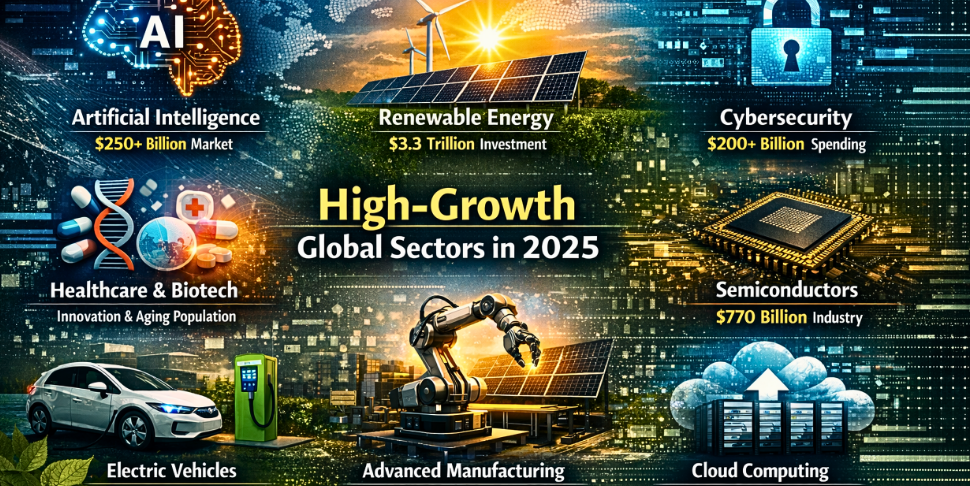
2025's Hottest Sectors: AI, Renewable Energy, Cybersecurity, and More
2025 Global FDI Trends: Divergence, Opportunities, and Risks in International Investment

The Evolution of Health Economics: Navigating Complexity and Shaping the Future of Healthcare

Credit Card Cash Loss, Unknown Facts About Credit Cards

Preferences for online shopping: What are the potential drawbacks?

Latest Podcast