Global Survey Reveals Mixed Adoption of AI in Developing Countries
Business operations around the world are being transformed through the use of Artificial Intelligence (AI) technology. The production process, decision-making, and customer engagement are all being revolutionized by AI Technology. Advanced economies are widely reported to be using AI technology; however, there is not much information available on how companies in developing countries are adopting the use of AI technology. It is essential to increase understanding about how developing countries intend to use AI, due to gains in productivity and competitiveness. A global survey was conducted by the International Finance Corporation (IFC) in June 2025 with 2,200 companies from more than 85 countries in their investment portfolio. (companies that either received direct investments from IFC or funding from venture capital and private equity firms). This survey is one of the first comprehensive analyses of the use of AI in emerging markets. The results of the survey show that there is a mixed and inconsistent picture: a number of companies that are early adopters have started testing their capabilities with AI technology, while many companies are unengaged with AI technology. To find missing data, IFC surveyed 2,200 businesses in June 2025 from more than 85 countries. The survey's results offer readers a first view of AI usage globally for developing economies with limited uptake (e.g., a few early adopters piloting), while most businesses have no actual engagement with AI systems. The intensity of AI usage across firms that implement AI varies immensely. Less than 25% of the companies polled rely only on AI for outreach and external operations, and less than 25% utilize it entirely for core functions. Conversely, approximately 25% use AI internally and externally, demonstrating a greater degree of integration and utilization of AI across multiple areas of business. Companies that embed AI into multiple activities will have a much greater chance of realizing cumulative productivity improvements and greater business value than those that use AI in isolation or for very narrow purposes alone.
A clear distinction appears to be drawn between digital versus non-digital businesses. Digital-first companies (having technology at the core of their business model) are far more likely to implement and use AI than those with traditional, analogue-based businesses. A little more than half of businesses that do not operate digitally use artificial intelligence-based technologies, compared to nearly six in ten businesses that do. The reason for this disparity is due to the capabilities of today’s AI technology (particularly conversational AI and large-language models), as they are much easier for companies to enact within an online environment and as part of their digital workflows. In contrast, embodied AI (robotics and computer vision) used in manufacturing has significantly higher barriers to integrating/distributing as compared to other forms of AI, thereby limiting the spread of such technologies among traditional businesses. The age of a business also has a major influence on AI integration. Younger businesses are much more likely to employ AI than their older counterparts. Businesses established after 2000 are more likely to use AI than those established before 2000; however, just under half of those that incorporated AI before 2000 are still using it. This indicates a shift in generational behavior, as “digital-born” and “AI-native” businesses are established to leverage AI as part of their total operational strategy at inception, versus trying to integrate AI into established practices/systems later on.
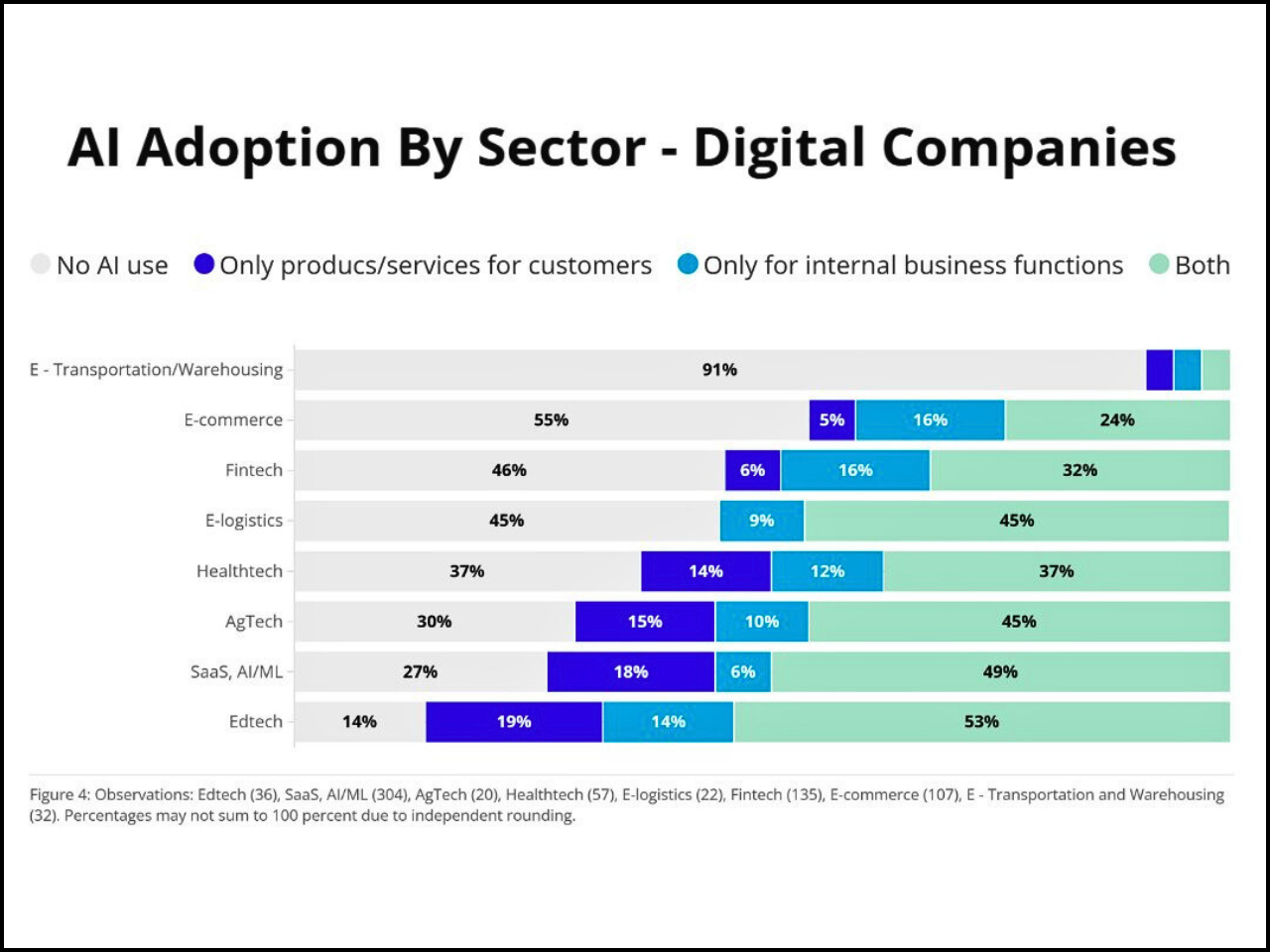
Different industries have different rates of AI use. Within the digital economy, businesses related to software or that have many data transactions (such as financial services, education, agriculture, and health care) have the highest adoption of AI. In comparison to other sectors, EdTech is the most active user of AI, especially when referring to customer-facing functions. This would indicate that companies in EdTech are already leveraging AI to deliver more personalized and adaptive learning through their products; in turn, they are drastically changing the way that educational services are provided in developing nations. Companies in these industries have access to a lot of data, are complicated at the operational level, and have strong motivations to automate processes and improve the accuracy of forecasting. On the other hand, when we look at traditional (non-digital) industries, professional services exhibit the greatest level of AI usage compared to other traditional industries. More than one-third of all companies in this industry currently utilize AI; this is significantly higher than the rates seen in the remaining traditional industries. This finding supports prior research that professional services are characterized by tasks like document review, forecasting, and consulting, all of which lend themselves well to automation and augmentation through AI tools.
The geographical distribution of artificial intelligence (AI) use is significantly different between regions of the world. Businesses in Sub-Saharan Africa and the Middle East, for instance, reported relatively low levels of AI adoption when compared to South and East Asia. Similarly, businesses in Europe, Central Asia, Latin America, and the Caribbean adopt AI at a rate that is close to 50% of all businesses worldwide. A deviation is East Asia, which did not have as many digital centers in the IFC’s study when compared to other published research, and therefore might appear to have a low level of AI use because of this exclusion. These trends show that businesses play a crucial role when it comes to taking new technology and using it to create economic value. As firms produce most of the world’s products and services, the adoption of new technologies like AI will impact productivity levels, international trade competitiveness, and growth over the long term. While the survey was conducted to evaluate current levels of AI, it highlights the barriers to and opportunities for the adoption of AI technologies by firms in emerging economies. Although AI adoption has been at an early stage in developing economies (through the few firms that have experienced productivity benefits and/or innovation benefits), the extent to which it will be adopted across industries will depend on the extent to which the structural, technological, and skill-related limitations or barriers can be overcome.

Monthly Edition